Categories
Hobbies Stories

The Broken Tree


A tribute to a tree

It was the final year of school, and like any other school-going child, I was expected to bury my head in my books.

To facilitate this task, I had been given a little space, all to myself. One small corner, cut off from the whole house. There was room only for a small table, and chair. If I pushed my chair a little away from the table, I would hit the back wall. To my left, was the bedroom, which could be completely hidden from view, by a curtain.

All I had to do, was draw the curtain, and I would have nothing to disturb me from studying – except of course, the view from the windows. The front and the side walls had huge windows, providing a clear and beautiful view of Silk Cotton and Neem Trees, interspersed with Bougainvillea. A street lamp was the lone indicator, that I was in the middle of an urban city.

The birds on the trees would cheer me up when I was studying management functions, and the trees would silently watch over my shoulder, as I concentrated on accounts.

Amidst all the greenery, in the distance, one tree stood out like a sore thumb. It was barren, and its top-most branch was broken. It had always been like that, and showed no signs of changing any time soon. Occasionally, a large bird – possibly a kite – sat on its branches.

Every time I looked out of the side window, my gaze fell straight on that tree. Even though it was leafless, it looked strong, and I took a liking to it.

I tried, on several occasions, to try to locate the tree on the ground. But it was visible only through the window.

In spring, the Silk Cotton and Bougainvillea painted a colourful painting. When the storm came, leaves and branches of the Neem Tree shook violently. The rains made all the trees grow taller, and greener. But the broken tree stood as still as stone.

I had finished my school, and was well into my graduation. My ‘study table’ was now the ironing table. Days turned into months, and months into years. I kept returning to the window to look at that tree. It was there, standing resolutely, even as the wind brought drastic changes in its surroundings.

The broken tree did not change at all. The trees in its vicinity kept growing, slowly, and steadily. Until one day, the tree was completely out of view.

Once the tree was out of view, I stopped looking out those windows.

Recently, a shopping complex was built nearby. The distant trees are all gone, and only the Neem and Silk Cotton Trees are left. I haven’t seen the broken tree since. And it is unlikely that I ever will.

The Broken Tree
The Broken Tree

Although it was meant to be a photo challenge, this week’s theme inspired me to write, and draw…
Weekly Photo Challenge : Silhouette

Categories
Hobbies Stories

A Colourful Challenge


It took me several mini sessions throughout the week, and one extended session today, to complete this challenge… a long overdue homework!

When I was in school, a teacher introduced us to Madhubani, as well as Warli styles of painting. She showed us samples of both styles, and asked us to create something in one of these styles.

I loved the Warli style of drawings – mainly because they were very simple to make. The simplicity of the drawings however, did not take away the charm of the designs. I had made several bookmarks – all of which, I gifted away.

I found the Madhubani style of painting rather complicated – it was full of intricacies, and one that would require a lot of patience, as well as colour sense – neither of which I possessed at that time.

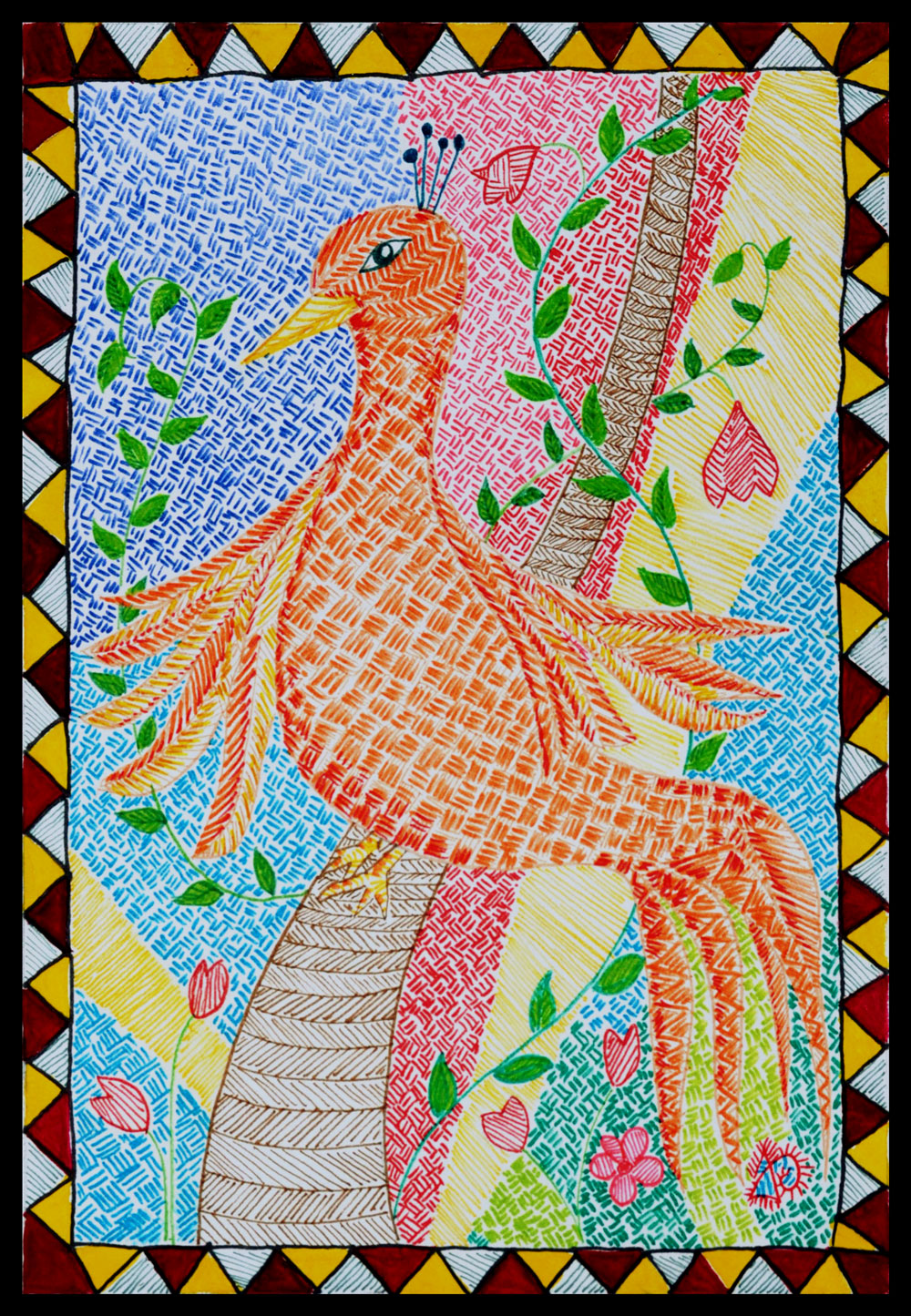
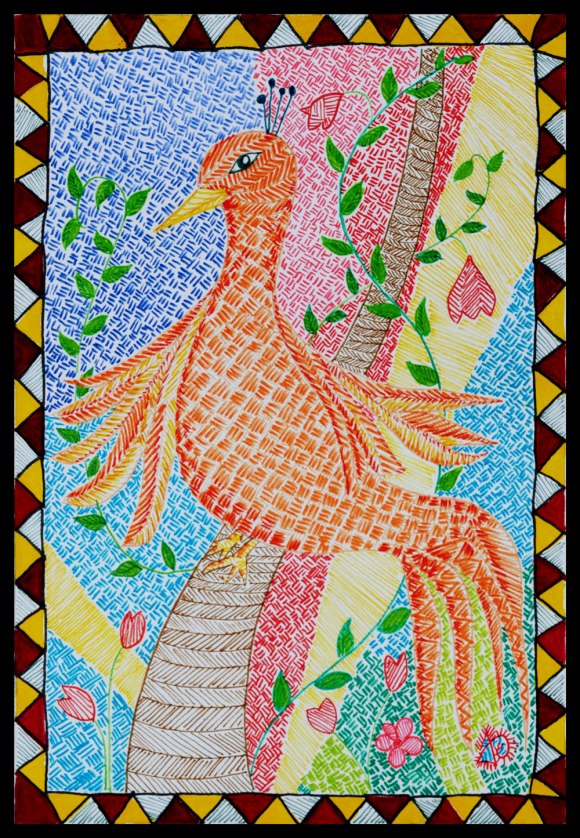
This week, I decided to try my hand at this very old homework of mine. I tried to draw a bird, and filled it in with lines, in Madhubani style of painting. I hope the next attempt would be better…

Bird
Bird – Attempted Madhubani Style

Wikipedia knoweth all:
Warli Painting
Madhubani Art

Weekly Writing Challenge : A Splash Of Colour

Categories
Stories

Guest Post : Jal Satyagrah


As the world reflects on the ‘Occupy Wall Street’ protests, residents of a small village in India protest against the government for their basic human rights…

The government of Madhya Pradesh decided to raise the water level of the Omkareshwar dam, without providing rehabilitation for the residents of the villages, which would be submerged. Residents of the submerged villages protested – by standing their ground.

From the perspective of a volunteer who saw the struggle first-hand, penned by my good friend, Sneha Chandna:

Kanshi Lal Bhai* sat in water for 17 days along with 50 other people in Ghoghalgaon, to protest against the illegal raising of the water level in Omkareshwar dam. Ghoghalgaon is one of the 30 villages that will submerge, when the Omkareshwar dam reservoir is filled up to its full capacity.

That Kanshi Lal Bhai is beyond 55 years of age, and is completely blind, complicates the situation a bit, but doesn’t stop him from supporting other protesters.

The Government made an official announcement to raise the water level in Omkareshwar dam (from 189 to 193 metres), in the month of May, and started raising the water level in August, 2012. This was an open and blatant violation of the Supreme Court and High Court order, that says that the government can submerge a region only after 6 months of the Resettlement and Rehabilitation of its people.

It seems the distance between a blind, displaced, illiterate, yet determined Kanshi Lal ji, and the machinery for the Delivery of Justice, (which includes the National Hydroelectric Development Corporation, Madhya Pradesh Government, High Court of MP and the Supreme Court), is more than the distance between the Earth and the Sun. It is this distance that makes the victory of the protesters at Omkareshwar Dam, all the more special.

Being a participant in the whole process, one is deeply humbled. In fact, as the protest progressed before my eyes, with each passing day I found it difficult to believe that a small set of people with their truly limited resources could manage to keep the state machinery on its toes and the print and electronic media on their side. As I expressed my disbelief to a senior NBA activist Sh. Ramesh Billorey, he said that in spite of the differences between the resources and power, it’s the truth that helps one sail through, “Satya Hamesha Jhoot par Bhaari Padta hai”.

During the time of the protest, Print and Electronic media played a very crucial role in highlighting the issue all over the country and put pressure on all decision-making institutions to agree to people’s demands. Media persons had, in fact, become a part of the support system for the movement. Also, as the protest ended, realization dawned that the movement had made history, by awakening the conscience of a nation, that is otherwise too busy to notice anything that the tribal or rural folks have to say. Also, it led to similar protests in other parts of the country, where development-led displacement has happened, or is about to happen, such as the issue of Koodankulam nuclear plant.

The victory of those displaced by the Omkareshwar dam, was followed by strong police action in the Harda District of Indira Sagar Dam, where the MP government refused to agree to people’s demands, and removed them forcefully from the Satyagraha site. A lot of media persons asked NBA activists why would the government agree to demands in the case of one dam, and not agree to similar demands by those affected by another dam?

Had the government agreed to the demands of those affected by the Indira Sagar dam, they would have had to allot more than double the amount of land they will now allot to those displaced by Omkareshwar dam.

As a lay person, often times I’ve been forced to wonder, what if someday some of my own rights are violated. It will take so much of time, money and effort to figure out a way to access the legal machinery, that it might as well become the single-most important pursuit of my life.

If it could be this way for an educated young person of the country, imagine what the situation would be for the tribal communities of a village, which has not known any vocation other than farming, which grows most of what it consumes, or which has little money, if at all. All the arguments of the government seem skewed in the scheme of things.

Some 30 villages will submerge because of the Omkareshwar dam, and 268 villages will submerge due to the Indira Sagar Dam. These dams will produce electricity.

Interestingly a short stay in one of the villages that will submerge, will make one notice that electricity in these very villages is available only for 8-10 hours. Yes, it’s true that Foreign Direct Investment might attract investors, but let’s first try to impress them with roads and electricity in every village of the country.

* * *

* Name changed

About the writer: Sneha has just returned from Khandwa, Madhya Pradesh, where she was actively involved with the Jal Satyagrah. She is currently working with ‘Koshish’.

Narmada Bachao Andolan was established in 1989 by Ms Medha Patkar, protesting against construction of dams across the River Narmada. While Ms Patkar works more at the national level now, the Jal Satyagrah was coordinated in Khandwa, by Alok and Silvy. Silvy sat in the water for 17 days, and that is how people sat along with her, and Alok coordinated fully with the media.

For more information on the Narmade Bachao Andolan, and the Jal Satyagrah, please visit their blog, right here on wordpress : Tales Of Narmada

Categories
Stories

The Old, Beneath The New


A gallery tour of Ugrasen ki Baoli – not really on a tourist’s itinerary. But then, not even locals are aware of its presence!

Ugrasen ki Baoli

Delhi has been loved, and loathed, by people for centuries. She has been built, razed to the ground, and rebuilt, by the same people who destroyed her.

The city has always been the favourite city of successive rulers. The proof of their love, lies in the monuments they constructed, that are spread across the city. Most of the newer buildings were constructed at the site of older structures. So the Fort of Rai Pithora, was razed to the ground, only for the Qutub Minar to be built.

Purana Qila (Old Fort) was built by Humayun, only to be destroyed by Sher Shah Suri. Sher Shah built his own capital at that site, only for Humayun to return! But even before the battles between these kings, an ancient civilization existed there – excavations of objects and pottery dating back to 1000 BC proving the antiquity of the Fort.

Besides the most obvious monuments, there are several smaller ones – those that are not on a tourist’s itinerary. They are hidden from public view. Even locals, never fully explore the city. To peel away the different layers of the city, requires more than just a few days. To understand what makes immigrants fall in love with the city, requires more than a lifetime.

In our quest to explore the ‘other’ side of Delhi, a few of us visited a baoli.

A baoli is a step-well, unique to the desert regions of western India. Ugrasen ki Baoli, is just off the main road near Connaught Place (Rajiv Chowk), at the heart of Delhi.

A short walk from the Barakhamba Metro station led us to the walls of the baoli. It looked like any other stone wall we’d seen, until we stepped inside. We collectively gasped at the sight in front of us – a long flight of steps leading to the bottom of the well.

There were scores of pigeons happily going about their daily lives, unaware of their historical home; a few groups of people, wanting to ‘hang out’ together; and one youth, working on his laptop, seeking refuge from the harsh heat!

We descended the stairs, to be welcomed by a very strong odour and screeching sounds. We looked up from the bottom of the well, to the ceiling of the tower – bats. We climbed up the stairs faster than we had descended!

The old, the new, and the pigeons – The three elements that define Delhi – A gallery tour

Related Links:
My friend who introduced the baoli to me, posted a few photographs on one of his posts too. Do check them out here.

Categories
Stories

The Guide


It was a hazy February morning. And we found ourselves free for the day. One of us had a car, and the rest of us made ourselves comfortable in it. We decided to visit the zoo. When we reached, our eyes fell on a huge stone wall. We forgot about the zoo, and decided to explore this imposing structure.

We didn’t know exactly where we were, but the main entrance was nowhere in sight. We located an opening in the fence, running along the perimeter of the complex. A narrow dusty path lay between the thick stone walls, and the fence along the main road. There was perhaps room only for two or three people to walk. We followed the path.

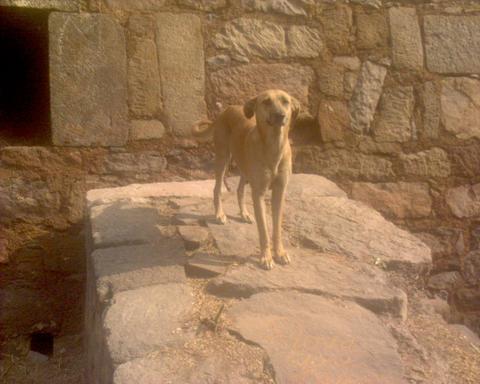
A group of college students were walking ahead of us. And it was only after a while, that we realised that a stray dog had been following us since the time we had entered. We paused, and the dog passed us by.

The path split into two, one of which, descended towards a lake. We resumed our walk along the narrow path next to the stone walls. The path was on higher ground, and we could see the lake beyond the trees.

We climbed down to catch a glimpse of birds on the lake. When we returned to the path, we found the dog waiting for us. It wanted to catch our attention. And it succeeded.

Our focus shifted from the monument, to the dog. We paused, and the dog paused as well.

It walked up a stone step, and looked into one of the openings in the wall. It knew we were watching its movements. So this time, we were waiting for it. It stood still, while one of us took a photograph. Once the photo-session was over, it walked ahead.

Meanwhile, the group of students walking ahead of us had turned back. We realised why, when we hit a dead end. There was a stone wall ahead of us, the lake was gone, and there was a thick cluster of trees in its place. Our friend, the dog, casually walked into this ‘forest’. On an impulse, we decided to follow it.

We climbed down the cliff, and reached the bottom. It was marshy, but our friend guided us along a thin strip of solid ground. At the end of the ascent, we found ourselves at the magnificent, towering entrance of the Old Fort!

After our initial amazement, we turned around.

Our guide was long gone…

The Guide
The Guide

Photo By Anand – used without permission (but I’m sure he wouldn’t mind :))

Categories
Hobbies Stories

Letter To Unniyarcha


I suppose,
Somewhere in Heaven,

18 September 2012

Dear Unniyarcha,

I hope you don’t mind the informal salutation. Even though we have never met, somehow, I feel that you would not mind being addressed in this manner. I have heard about you, though I must admit, my knowledge is rather limited.

Last week, I began taking part in the weekly writing challenge. For this week, I decided to write a letter to you. Let me introduce myself. I live in the 21st century. My home is several miles away from where you lived, but both our homes are part of the same country. We no longer have kings and queens, but we still have wars. The conflicts in our society are very similar to the conflicts during your lifetime.

You are a source of great inspiration to me, and over the past several months, I have been busy trying to create something – based on you. I am writing to you, because I wish to share my vision with you.

In your time, there were sculptors and painters who created such wonderful works of art, puppeteers who breathed life into inanimate objects, magicians who created wonderful illusions, actors, dancers and musicians who recreated dramas on stage. In our time, we still have these art forms, but some people have invented new media, and many of these wonderful arts can be performed within something called a ‘computer’.

I am still a student, and trying to learn new things. In my school, I tried to implement what I learnt, to create a character. If you were to be reborn, in our times, this is what I believe you might be. A seemingly ordinary girl – but one who has an extensive knowledge of Kalaripayattu. Simple, confident, friendly, strong and respected.

I had a rather tough time, and at times I felt rather unpleasant, wondering if I could really conquer the challenge I had set for myself. I took up sole responsibility, and in hindsight, I think it was not a very wise thing to do. Nevertheless, I accomplished a part of what I set out to do. The character has her flaws, and will probably always remain a work-in-progress – aren’t all humans! But I am satisfied with what I managed.

I hope someday she gets to meet you, and gets an opportunity to learn something from you. I thank you for patiently reading this letter. I hope it wasn’t much of an inconvenience. I am enclosing some photographs of the girl. I hope you like them.

yours truly,

Kasturika

* * *

Unniyarcha is a popular legendary warrior, believed to have lived in the 16th century. She was an expert at wielding the Urumi.

Urumi is a long sword made of flexible steel, sharp enough to cut into flesh, but flexible enough to be rolled into a tight coil. It is dangerous to the opponents and wielders alike, and requires great agility and skill to master.

Kalaripayattu is one of the oldest fighting systems in existence. It is believed that the Buddhist monk Bodhidharma travelled from the southern part of India and taught martial arts to the monks at Shaolin Temple. The origin of Shaolin Kung Fu is attributed to the ancient Indian martial art systems.

Source : Wikipedia

Categories
Hobbies Stories

Teacher’s Day Out


Today is Teachers’ Day in India – in honour of Dr S Radhakrishnan. In the small primary school that my mother volunteers, the children come from poor* families, and are often ill behaved. While most of the other teachers resort to beating the children into being quiet, she doesn’t believe in beating the kids. As a result, managing them, is a nightmare for my mother. Along with the politics of the management and back-biting from other teachers, the kids were at least partially responsible for my mother falling sick this past week.

After a prolonged absence from work, when she went back to school, the children greeted her with flowers and cards. One little present stood out. The most mischievous child had made a box out of paper. Coloured with crayons, decorated with ‘chamki‘ **, complete with a ‘ribbon’ – it was simple and charming.

When I was in school, one of my teacher’s  said,  “Every person I meet, is a teacher to me…”
Here’s wishing all my teachers, a happy Teachers’ Day!

*poor – the term poor here refers not merely to the financial status of the students.  Most of the families earn a decent income. They live in bad localities, and their behaviour is often unruly.

** chamki – sequins

Categories
Stories

Electrifying Encounter


The thrill of watching an international match at the court – perhaps a once-in-a-lifetime memory to treasure.

We were one of the first few to enter the court complex. We chose our seats right at the centre – where we felt we had the best view of all the courts. Soon, all the seats were taken. The event – Badminton quarter-finals at the Commonwealth Games.

With five action – packed matches being held simultaneously, it was difficult to keep pace with all the matches. We kept track of the progress of the national players, by paying attention to the crowd’s cheers. The ‘aaah’s and the ‘oooh’s indicated that the mixed doubles pair were struggling. The cheers and chants increased, as Chetan Anand and P Kashyap successfully wrapped up their matches.

And then, the entrance of Saina Nehwal, marked by a huge applause. The huge home support defeated her opponent even before the match began. She struggled to return the serves, and looked rather miserable. The crowd, anticipating a good contest, felt short-changed, as Saina won, in a mere 10 minutes!

The women’s doubles game was the last match of the session. And the full capacity crowd turned its attention towards the duel. The disappointment of the lop-sided match played earlier on the court was forgotten, as Jwala Gutta and Ashwini Ponnappa took on the formidable Malaysians. The rallies were long, and each stroke was returned with interest. When we thought the smash was good, the opposition put it back in play. The entire crowd shouted ‘huh!’, in unison, providing extra effort for the home girls, as they smashed the shuttle mercilessly, only to find it being smashed in return.

The entire crowd was up on its feet, the energy of over four thousand spectators, creating a heady, adrenaline packed atmosphere. Ultimately, the game was won by the hosts, to the immense joy of the fans, who gave a standing ovation for the victorious underdogs.

Borrowing from a famous advertisement:

Transportation : Rs 50
Lunch : Rs 150
Cost of ticket : Rs 200
The thrill of watching Indians excel in a proper International sport : Priceless!


Saina Nehwal returned home with a bronze medal in the on-going Olympics, &
P Kashyap reached the quarter-finals – the furthest by an Indian in the men’s event.

Categories
Hobbies Stories

From Grandfather, With Love


My grandfather was the eldest in his family. We were his youngest grandchildren. The age difference between us is almost nine decades!

My grandfather’s life was very eventful. It could be said, that he lead a full life. He was a professor in the Burmese University, joined the Army during the world war, served in the foreign service thereafter. Then he helped establish one of the leading heart institutes of the country, where he worked till his last breath.

He had several hobbies. He occasionally undertook carpentry, and even tried his hand at bee-keeping. But the one hobby that lasted the longest, was photography.

None of his photographs prior to the second world war survived – the family had to leave Burma (modern Myanmar), and several possessions were lost.

All his photographs from 1945 onwards, however, were carefully pasted in a book – thick black pages bound together, with beautiful photographs chronicling the life of his children, and even some important people of the times . He developed most of his photographs himself. And he took great pains arranging them in the album, and putting captions for them. He had the foresight to know that other people will one day look at the album with no clue as to who’s in the pictures! The album is showing signs of ageing, and rarely comes out of the cupboard. But when it does, it takes us back in time, to another world.

My grandfather’s love for photography was inherited by my father, who bought a range-finder – spending almost a month’s salary on it. Point-and-shoot or compact cameras never entered our house. From our father, that passion passed onto us. Like our father and grandfather, my brother’s love for photography is serious.

Digital photography had begun entering the market by the time I was old enough to be trusted with the film camera. And my father’s old range-finder was the only one I ever used before my brother’s DSLR entered our lives.

“Extend your palm,” said my aunt to my brother during one of our visits. “I’ve been wanting to give this to you for a long time. It might be useful to you. It belonged to your grandfather,” she said.

She placed a cylindrical leather pouch in his outstretched palm. Like a child unwrapping his gift, my brother’s face lit up with excitement, when he realised, what it was, that he had inherited.

It was my grandfather’s tripod.

“It looks absolutely new!”

No one knows how old the tripod is, but it is, at the very least, seventy years old! And we know that only because the tripod features in one of the pictures my grandfather took of his youngest son – our father.

I have no living memory of my grandfather, and I often wish I had been born earlier – or he had lived longer – so that I may have been able to converse with him. But every time I take a picture, or look at that tripod, I can’t help but think he’s around us – always encouraging us to continue documenting life.

Related links:
Free Bird – A story I wrote in memory of my grandmother (featured in the SHEROES #SheWrites Anthology on Juggernaut)
R. Karthik’s Flickr Photostream

Categories
Hobbies Stories

And There Was A Painting


Fish out of water
Fish out of water

We travelled for three days on the crowded train – there were more than two hundred of us, and only a hundred confirmed tickets. A bus journey from Dimapur brought us to the campus of Nagaland University, located atop the hills, in Kohima. Exhausted after the journey, we didn’t bother about blankets, as we fell into deep slumber in the dormitory.

During our stay, we discovered the ‘passion fruit’. We devoured them like wild beasts. We had never heard of them, and we knew that we may never taste them ever again. By the time we left, the locals had made a handsome profit!

The nearby hangar served as the venue for talks and concerts. The music and dance performances mesmerised the large audience, and the atmosphere quite literally came alive when clouds filled the ‘auditorium’!

We had the privilege of attending workshops conducted by national artists. And the highlight of the entire trip was the ‘classical overnight’. Beginning after dinner, continuing till dawn, the all-night programme held us in a state of trance. We didn’t sleep during the concert, and yet, ‘woke up’ feeling refreshed, without a hint of exhaustion.

We spent the last day in the main town, visiting the War cemetery, and the Museum.

Due to the insurgent outfits operating throughout the North-Eastern Region, we were forbidden to travel at night. That meant that we had to reach Dimapur before sunset. The last night of our stay was spent on the railway platform at Dimapur Railway station.

We had to board the early morning train, which would stop only for fifteen minutes. We collected all the luggage in one place, and hauled every bit of luggage inside the train as fast as we could, irrespective of whose bag it was. After a chaotic hour or so, we found out that along with our baggage, two large boxes of RDX had found their way into the train. The train we boarded for our return journey was even more crowded than the one in which we went. The mood in the train was dull.

That didn’t last long, however, when we tasted the freshly cut pineapples that were being served by vendors in the train. Juicy and soft, they simply melted in the mouth, and there was not a hint of fibre – you could be forgiven for thinking that they were mangoes. The exotic produce of the north-east, it seemed didn’t end with the passion fruit!

Eventually, we bade farewell to all the people with whom we had shared our entire experience. People who were strangers only a few days back, and people whom we would probably never meet again.

It is unlikely we would ever be a part of such a trip, ever again.

We didn’t carry a camera to capture the great, and the not-so-great moments (and there were plenty of both!) Our stock of passion fruits lasted no more than a few days, and the trip became a distant memory, within just a few months. Looking back, it all seems like a dream. The details of the trip are blurry, and there is little record of us ever having been there. I never wrote anything about it, to remind me of the time.

However, we do have some proof of it being real – a pair of brooches that we bought as souvenirs.

And a painting.

This painting was made in Kohima. I had attended the workshop being conducted by Padma Shree Anjolie Ela Menon. Perhaps there was something in the air that made me draw this – I had never before drawn something abstract, and even after the trip, I have not dared to venture into that territory.

Upon returning, I discovered, to my horror, that the acrylic paint had actually not dried up, and the foam plate I had placed over the canvas to ‘protect’ it, got stuck, and ruined the painting.

Several months passed, and I never fixed it. After over four years, I finally painted over the bad patches. While the scars are still visible, the picture is more presentable.