We left Chennai on Christmas eve. After a short visit to Chidambaram and overnight at Vaitheeshwaran Koil, on Christmas morning we set off towards our destination — a small village named Komal.
I remember my grandmother mentioning Komal several times, but beyond the name, I knew nothing. To me, Komal sounded out of place. It was too north-Indian a name, to be a village in Tamil Nadu. In fact, for a long time, I thought it was in Myanmar!
We knew no-one in the village. The house was sold several years ago, and my father hadn’t been anywhere near Komal for forty years.
We had no address. Back then, my father told us, people never had addresses. Everyone knew everyone else in the village. Each house was identified by its occupants. How, then, were we to find that house? “I’ll know it when I see it. I’m told it hasn’t changed one bit,” said my father.
One of my father’s cousins gave us the name of a person who could help us locate the house, just in case.
“It is near a temple.”
We followed the highway leading towards Kumbakonam and asked for directions from locals. Our landmark was a temple. We found one. And another. And another. But my father could not recognise anything. “There should be a bridge, followed by a row of shops. I don’t understand. ”
My father asked a few local people about the person my uncle had mentioned. “No brahmins live on this street,” said one man with a glare. He pointed towards another street, and told us to ask there.
On the other street, we were told that only Iyengars lived there, no Iyers. They pointed towards the end of the street and told us that some of the residents had been living there for years. Perhaps they could help.
At the end of the street, we stopped outside an old looking house, that my father thought looked familiar. Unsure, he knocked on the door, and asked the residents if he could take a look. A few minutes later, he came out and told us that it was not the one.
We had been going around in circles for over an hour. The sun was beating down on us.
Dejected, and frustrated, we were planning to return to Chennai, when we saw an elderly gentleman. As a last-ditch effort, we asked him about our mysterious contact person. To our delight, he knew the person. “Oh! Yes, I know him! But he doesn’t live here. He lives in Komal. This is Therazendur.’*
Once we realised we were in the wrong village, it took us barely 10 minutes to reach the narrow entry to Komal.
“The bridge!” my father exclaimed. “I know this! We are here! Those are the shops. Take this turn. Right here. Wait! Stop!” No sooner had the car stopped, that my father sprang out of the car. He looked around the small roads, and then began walking at a fast pace.
There was an old man, walking alongside a cycle, on the side of the road. My father asked him about a house that had once belonged to an uncle of his. “Oh that person passed away many years ago,” replied the old man.
“Yes,” my father replied in an excited tone, glad that someone finally knew about the house. “That was my uncle. My father had bought it from him.”
The old man’s eyes widened. He took my grandfather’s name.**
“Yes! I am his youngest son! Can you take me to that house?”
My father’s steps quickened. His excitement was evident. The minute he laid his eyes on the house, my father pointed towards it and exclaimed, “It is just as we had left it!”
The old man introduced us to the occupants of the house. He must have become accustomed to members of my father’s family coming to see the old house, and graciously allowed us inside.
“This house was the only house in the entire village to have electricity, in those days!” My father was visibly proud. “There used to be a swing. A large swing. Is it still there?”
The owner smiled and said it was there. Everything was just the way it had been. The swing, the large stone grinder, even the light switches and fans!
“This house was purchased in 1940 when the war broke out, and my mother had to move with three of her children along with our grandparents and stay in a largish house. It was bought for Rs. 4000. It was in this house that I was born,” my aunt later told me.
Watching my father almost run around the house, I can only imagine how many memories must have come back to him. Every wall, every pillar, must have meant the world to him — a world very different, and in another time, from that of ours right now.
The owner told us that my uncle once casually asked if it were up for sale.
“So was it?”
“No! It’s been a very lucky house for me,” replied our smiling host.
The house
Kolam outside the Komal house
The porch
The courtyard
The corridor
A stone grinder can be seen on the right
* My grandfather was born in Therazendur. We had practically gone around the whole village a couple of times, and it is likely that we passed by one of the houses that may have once belonged to his family. But we will never know.
** That old man, we later found out, was a distant relative of my grandmother!
About the photographs: These photographs are of someone’s house. They graciously allowed us to enter their private space and I request these photographs not to be used elsewhere.
While I was in Chennai last year, I received a message from a friend of mine:
‘So are you coming tomorrow?’
‘I’m in Chennai right now’, I replied.
‘Ooh Margazhi. Have fun!’
I didn’t understand what she meant by that. I had visited Chennai during the winter months a few times in the past, but apart from the pleasant weather, I couldn’t think of any other reason to enjoy. I soon found out.
The Tamil month of Margazhi* is considered highly auspicious. For those who are religiously inclined, Margazhi is a month of lots of pujas — temples open much earlier and devotees visit in large numbers for the special pujas. But that was not what my friend, an ardent follower of performing arts, meant.
Margazhi is a cultural extravaganza, a haven for fans of the classical arts, with hundreds of Kutcheries — music and dance concerts — organised throughout the month. Margazhi is, in fact, now synonymous with the music festival.
Chennai takes its music seriously, and audiences don’t clap unless the performance is very good. I found that out on our last day in Chennai, when we spent close to six hours in one auditorium, listening to back-to-back musical performances (for free)!
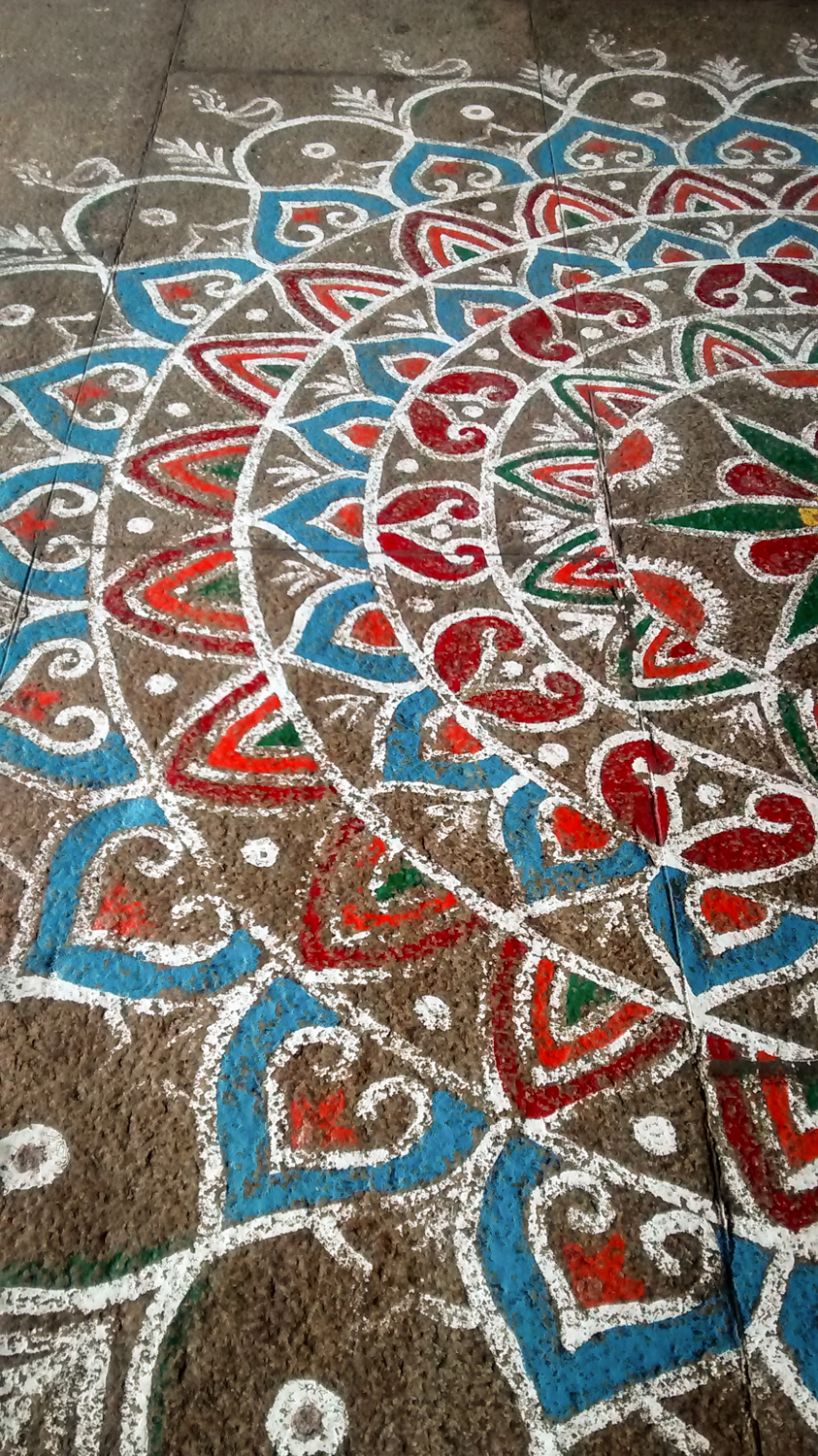
Even those not interested in the arts — and there are probably few of those in Chennai — cannot escape the Margazhi season, for the art overflows on the streets. Take a walk in the interior parts of residential areas. The Kolams that are drawn at door-steps of every house are much bigger and colourful. The kolams at the temples, though, were my favourite. These are from the Chidambaram temple:
Kolam at Chidambaram Temple
One of the twin kolams along the side of the entrance of Chidambaram Temple
And if you are not interested in art, well then there’s always the sea. The cool sea breeze, on the cool sand is the perfect place to relax.
Yes, Margazhi is the time to visit Tamil Nadu.
*Margazhi begins in mid-December and ends in mid-January. The Corresponding Sanskrit name is Mārgaṣīrṣa. After the end of this month, the harvest festival of Pongal (which falls on Makar Sankranti) is celebrated. The festival marks beginning of Uttarayan – the beginning of the sun’s ascent, signifying the beginning of the end of winter.
The images in this post are my entries for this week’s Photo Challenge. To see more symmetrical images, check out the Daily Post’s Weekly Photo Challenge.
A part of the large kolam t the entrance of Chidambaram Temple
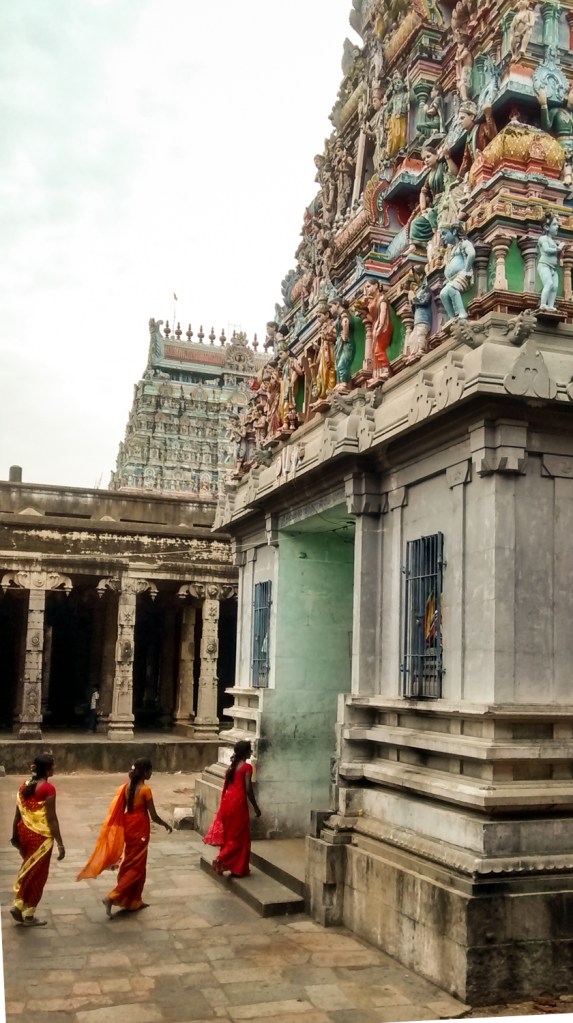
We were on our way to the Vaitheeswaran Temple, when we decided to take a short detour. The magnificent gopuram* of the ancient temple was visible from afar, and it was on an impulse, that we decided to visit the Chidambaram temple.
A part of the large kolam at the entrance of Chidambaram Temple
Opposite the entrance stood an intricately carved wooden structure, being prepared, perhaps, for the grand pooja which was to take place only two days after our visit. A long row of shops – selling flowers, pooja items, idols of Gods, colourful kolam powders and filter coffee – lined either side of the path leading up the entrance. We deposited our slippers with one of the shoe-caretakers (for lack of a better word), and stepped inside.
Beautiful kolams greeted us, followed by the grand gopuram which we had seen from afar. There were more gopurams inside the premises. Hundreds of devotees had come, mostly in crowded buses, from different parts of the country. We followed the crowd.
After a long walk from the entrance, we entered the main shrine. Devotees who were closer to the sanctum sanctorum, bent over the railings; those who were behind, stood on their toes; children sat on shoulders of their fathers, all of them waiting to get a glimpse of Nataraja, the lord of dance. As the curtain was pulled apart, temple bells and folded palms filled the shrine.
This ancient temple, spread over 40 acres, is one of the largest temples in the world (fourth largest, to be precise)**. Intricate sculptures of deities atop the gopurams, stone panels depicting dance postures, halls with high ceilings, all supported by massive pillars embellished with floral detailing. With several shrines and tanks, the temple priest told us, it would take one full day to properly visit the temple complex. An hour, was hardly going to be sufficient to soak in the magnificence and grandeur of the temple.
Every year Bharatanatyam dancers converge in this temple during the annual festival to worship, their offerings in the form of dance. I can only wonder what that atmosphere would be like. Hopefully I will visit the temple once again. And on that day, I will spend more than just an hour.
Devotees heading towards a shrine, Chidambaram Temple
* Gopuram is a monumental tower, usually ornate, at the entrance of any temple, especially in Southern India. This forms a prominent feature of Koils, Hindu temples of the Dravidian style. They are topped by the kalasam, a bulbous stone finial. (Source: Wikipedia)
** The three largest temples are, in order, Angkor Wat, Cambodia; The Srirangam Temple, Trichy, Tamil Nadu: Akshardham, Delhi, India (Source)
Being late December, it was no surprise to see Christmas Trees decorating the airports of Delhi and Chennai. But I should have known the large candy sticks at the exit of Chennai Airport were more than just festive decorations – they were a sign of things to come!
We ate out almost everyday. And for every meal there was dessert! Adirsam, Mysore pak, Jangiri, Badusha, Kesari and many types of Payasams accompanied the traditional meals. We tried out the local soan papdi sold by a street vendor in Mylapore. And ice cream at the beach was a must.
One particular day, we had a double doze of chocolate. One of the desserts was a sizzling brownie, topped with vanilla ice cream and chocolate sauce, at Haven Sampoorna. The other was ‘Death by chocolate’ at Tangerine.
It was hard to resist the temptation to dig into these beauties. And after eating, I couldn’t help but wish for more! There never really can be enough of chocolate, can there? 😉
This dessert is to die for 😉
Chocolate Brownie Sizzler with Vanilla Ice Cream and Chocolate Sauce
Now you see it
Now you don’t! There’s still some chocolate sauce though. No, we didn’t finish it!
It was in the first week of March, late in the afternoon. Winter was receding and the weather was just perfect for going monument hunting.
Before leaving, we ran a quick search on the internet. A map in hand, we got off at the Qutab Minar Metro station and walked along the road. After about fifteen minutes, we entered a small opening.
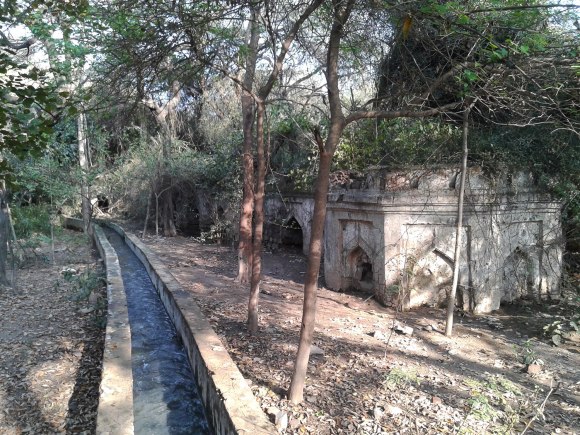
It’s called a park. But we soon realised we were in a jungle.
The water ‘stream’ which served as our landmark
We tried to figure out where we were on the map. We turned the map around, trying to align it with the shadows, to get a sense of which direction to head towards. As it turned out, we were poor map readers. We took different paths, each one giving us different leads, and none of them making any presence on the map.
Along each dust road, we saw broken and crumbling remains of the past, surrounded by the filth of ‘modern’ day. The old ruins told us we were somewhere – but not exactly where. After taking three different roads, and ending up at the same water stream, I folded the map and put it inside my pocket.
We asked some locals for directions. Some of them gave us a vague direction in which to go. One lady pointed out that we had entered the wrong gate, and that the proper entrance was ahead along the main road. There was, however, a way through the village. We had come too far inside. If we were to turn back, it would only be to return another day.
A middle-aged gentleman gave us two sets of directions; the one he recommended, was longer and clean, through the main road; the other was shorter and filthy, through the village. We gambled on the shorter one. We had already walked a lot, and since we were wearing shoes, we didn’t think filth would be much of a problem. If only we knew better.
Was this a garbage dumping ground 4 centuries ago?
We walked along the narrow, steep village roads and crossed a stretch of rotting garbage. But it was a foul-smelling stretch of pigs, which made us run as fast as we could. We continued on the path, wondering what else was in store. As per the directions, we had to take another turn. There were trees all around and we still couldn’t figure out where we were. We decided between ourselves, that if we did not find anything in the next 5 minutes, we’d look for the way out.
And then, just after turning, we saw a stone signboard.
The wall, well hidden; the security guard stands out like a sore thumb
Almost an hour after entering the jungle, we stood facing a stone wall. We walked around and climbed up the stairs.
Rajon ki baoli, read the stone sign. The mason’s stepwell. We had reached what we had come looking for. Tired wanderers, the thirst of our eyes was finally quenched with the sight of the well.
Upon entering Rajon ki Baoli
The corridors along the side of the well
View from the top
The well
Stairs leading up to the roof
For those of you who have a little better sense of direction, hopefully this map will help. Clearly, we didn’t do our homework properly. To view the interactive map on Google Maps, click here. For better photographs, ask Wiki
How to reach Rajon ki baoliHow to get a good workout
The city of Delhi is often referred to, as a burial ground – of emperors and nobles, princes and princesses, saints and warriors. After visiting a few tombs, one gets the feeling that all the tombs are alike. That might be true for most, but there are exceptions.
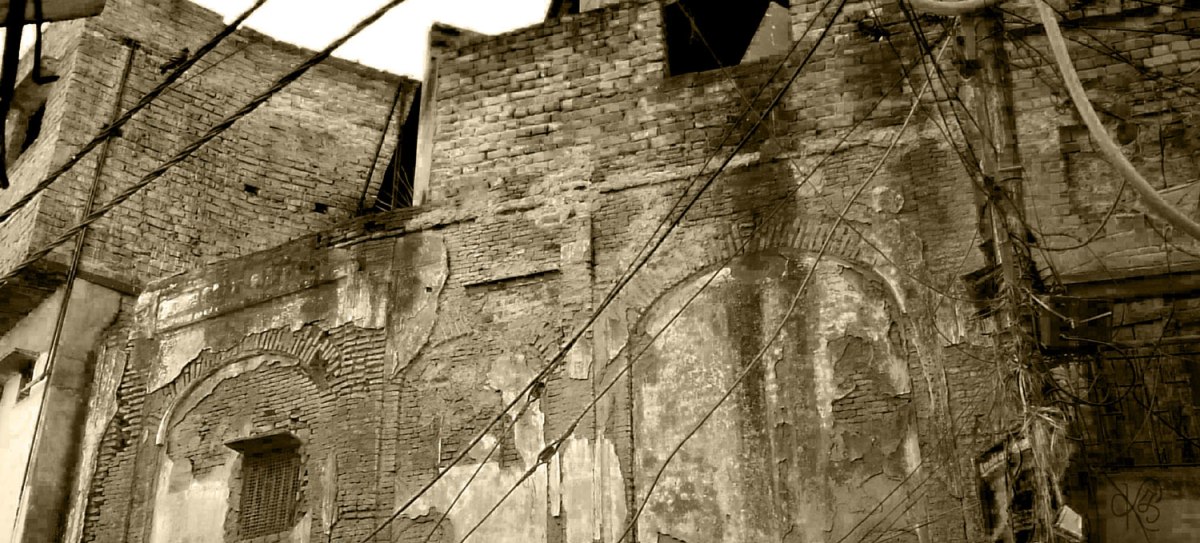
This past week, I tagged along with a group of heritage-hunters, and headed towards Chandini Chowk. A friendly local offered to guide us through the uneven paths, deep within the bazaar. We went down narrow and dark lanes, past crumbling havelis and butcher shops, and even hopped over a sleeping goat! We approached a sharp turn in the path, which revealed perhaps the smallest, and the saddest tomb in Delhi.
Information
Entrance
The only three women who were ever elected to the throne in the Mohammedan East, reigned in the thirteenth century.
– Lane-Poole
Raziya Sultan was the daughter of Iltutmish*, and the only woman to have ruled over Delhi. Her father had chosen Raziya as his successor to the throne. This was obviously not welcomed by her brother, as well as the majority of noblemen.
Iltutmish claimed that his daughter was better than many sons. And it did not take long for the citizens of the kingdom, to realise this. Raziya was appointed ruler by the common people.
Sultan Raziya was a great monarch. She was wise, just, and generous, a benefactor to her kingdom, a dispenser of justice, the protector of her subjects, and the leader of her armies. She was endowed with all the qualities befitting a king, but she was not born a man, and for that reason, in the estimation of men, all these virtues were worthless.
– Minhajas-Siraj
Raziya Sultan’s tenure as a ruler was a short one. A female monarch, appointed by common people did not go down well with the establishment. The fact that she showed her face in public, and was tolerant towards the Hindus, made her case weaker. She was assassinated after three years at the throne.
Houses Adjoining The Graves
Close Up
There is a conflict, regarding the actual site where she was buried. Claims include Chandini Chowk in Old Delhi, Siwan in Haryana, and Tonk in Rajasthan. The site at Chandini Chowk, was a jungle during the reign of Raziya Sultan, and there is no engraving to identify the souls resting there. A part of the mausoleum has been converted to a mosque.
Raziya was a person born well ahead of her time. Unfortunately, her story is overshadowed by others who came after her. A hero for all ages, may her soul rest in peace.
* * *
* Iltutmish (alternate spelling Altamish) Full name : Shams-ud-din Iltutmish
The third ruler in the Slave Dynasty. The first was Qutb-ud-din Aibak, and the second, Aram Shah. The Slave (Mamluk) Dynasty was the first of five unrelated dynasties to rule over Delhi, in what is referred to, as Delhi Sultanate.
The Daily Post asks readers to write about their heros. I have paid a tribute to Unniyarcha before. Raziya Sultan is my answer to The Daily Post’s prompt.
A gallery tour of Ugrasen ki Baoli – not really on a tourist’s itinerary. But then, not even locals are aware of its presence!
Ugrasen ki Baoli
Delhi has been loved, and loathed, by people for centuries. She has been built, razed to the ground, and rebuilt, by the same people who destroyed her.
The city has always been the favourite city of successive rulers. The proof of their love, lies in the monuments they constructed, that are spread across the city. Most of the newer buildings were constructed at the site of older structures. So the Fort of Rai Pithora, was razed to the ground, only for the Qutub Minar to be built.
Purana Qila (Old Fort) was built by Humayun, only to be destroyed by Sher Shah Suri. Sher Shah built his own capital at that site, only for Humayun to return! But even before the battles between these kings, an ancient civilization existed there – excavations of objects and pottery dating back to 1000 BC proving the antiquity of the Fort.
Besides the most obvious monuments, there are several smaller ones – those that are not on a tourist’s itinerary. They are hidden from public view. Even locals, never fully explore the city. To peel away the different layers of the city, requires more than just a few days. To understand what makes immigrants fall in love with the city, requires more than a lifetime.
In our quest to explore the ‘other’ side of Delhi, a few of us visited a baoli.
A baoli is a step-well, unique to the desert regions of western India. Ugrasen ki Baoli, is just off the main road near Connaught Place (Rajiv Chowk), at the heart of Delhi.
A short walk from the Barakhamba Metro station led us to the walls of the baoli. It looked like any other stone wall we’d seen, until we stepped inside. We collectively gasped at the sight in front of us – a long flight of steps leading to the bottom of the well.
There were scores of pigeons happily going about their daily lives, unaware of their historical home; a few groups of people, wanting to ‘hang out’ together; and one youth, working on his laptop, seeking refuge from the harsh heat!
We descended the stairs, to be welcomed by a very strong odour and screeching sounds. We looked up from the bottom of the well, to the ceiling of the tower – bats. We climbed up the stairs faster than we had descended!
The old, the new, and the pigeons – The three elements that define Delhi – A gallery tour
Mosque on Western end
Just Before Closing Time
Identification
Information
Outer Walls
Banyan Tree Roots
Banyan Tree within the complex
Tree just outside
Providing shade
Upon Entering – First View
Pigeons in flight
Bat cave!
Arched Corridors on the sides
Mid-way – Going Up
Mid-way – Looking Down
Related Links:
My friend who introduced the baoli to me, posted a few photographs on one of his posts too. Do check them out here.
It was a hazy February morning. And we found ourselves free for the day. One of us had a car, and the rest of us made ourselves comfortable in it. We decided to visit the zoo. When we reached, our eyes fell on a huge stone wall. We forgot about the zoo, and decided to explore this imposing structure.
We didn’t know exactly where we were, but the main entrance was nowhere in sight. We located an opening in the fence, running along the perimeter of the complex. A narrow dusty path lay between the thick stone walls, and the fence along the main road. There was perhaps room only for two or three people to walk. We followed the path.
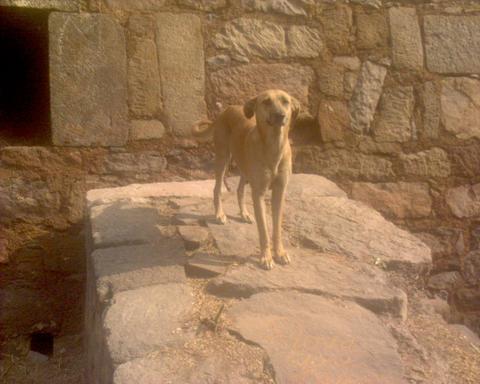
A group of college students were walking ahead of us. And it was only after a while, that we realised that a stray dog had been following us since the time we had entered. We paused, and the dog passed us by.
The path split into two, one of which, descended towards a lake. We resumed our walk along the narrow path next to the stone walls. The path was on higher ground, and we could see the lake beyond the trees.
We climbed down to catch a glimpse of birds on the lake. When we returned to the path, we found the dog waiting for us. It wanted to catch our attention. And it succeeded.
Our focus shifted from the monument, to the dog. We paused, and the dog paused as well.
It walked up a stone step, and looked into one of the openings in the wall. It knew we were watching its movements. So this time, we were waiting for it. It stood still, while one of us took a photograph. Once the photo-session was over, it walked ahead.
Meanwhile, the group of students walking ahead of us had turned back. We realised why, when we hit a dead end. There was a stone wall ahead of us, the lake was gone, and there was a thick cluster of trees in its place. Our friend, the dog, casually walked into this ‘forest’. On an impulse, we decided to follow it.
We climbed down the cliff, and reached the bottom. It was marshy, but our friend guided us along a thin strip of solid ground. At the end of the ascent, we found ourselves at the magnificent, towering entrance of the Old Fort!
After our initial amazement, we turned around.
Our guide was long gone…
The Guide
Photo By Anand – used without permission (but I’m sure he wouldn’t mind :))
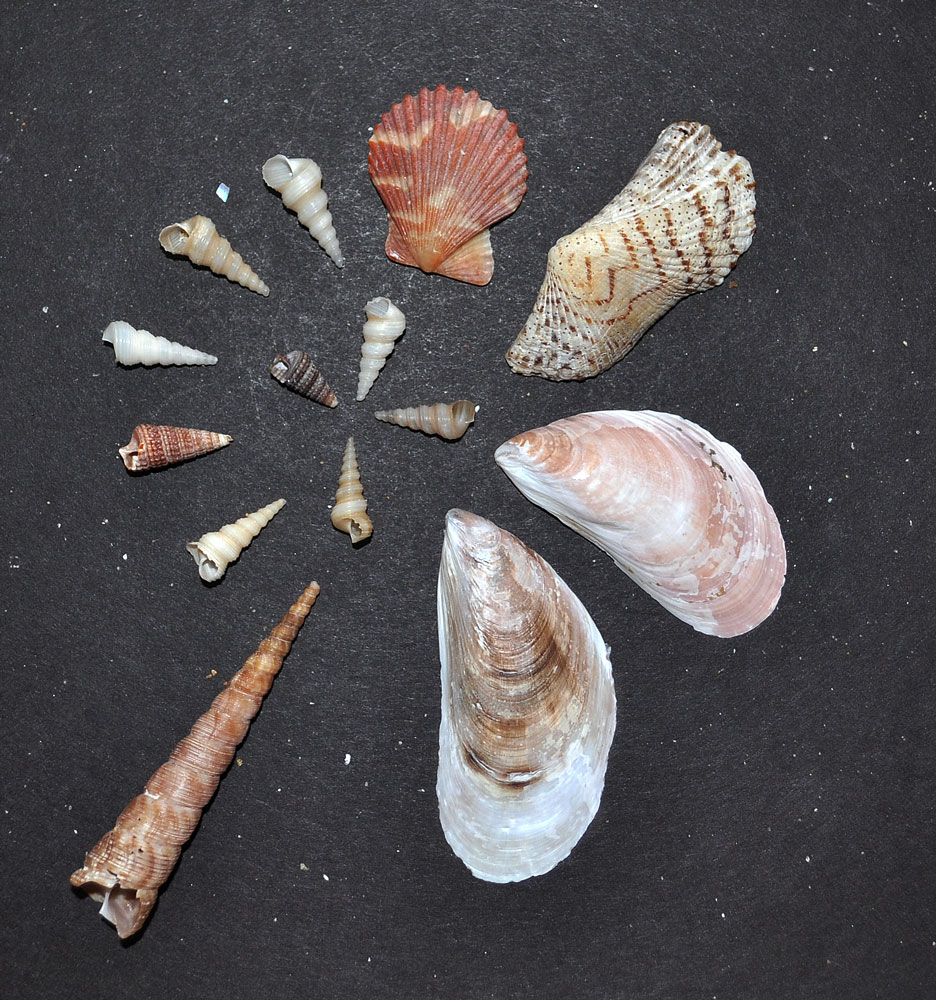
A trip to Chennai is incomplete without a visit to the beach – and collecting sea shells! Here’s the latest addition to the ever growing collection – most are broken, but we still brought them home 🙂
















 Musings of an eccentric mind