The theme for this week’s ‘Weekly Photo Challenge‘ is happy. The gallery below includes photographs of the bag I bought at a handicrafts bazaar, and an assortment of pencils and brushes – some unused, and some very old!
Unfortunately, the photographs didn’t quite turn out to be the way I wanted them. Here are some images I managed to salvage. Hope you enjoy!
A gallery tour of Ugrasen ki Baoli – not really on a tourist’s itinerary. But then, not even locals are aware of its presence!
Ugrasen ki Baoli
Delhi has been loved, and loathed, by people for centuries. She has been built, razed to the ground, and rebuilt, by the same people who destroyed her.
The city has always been the favourite city of successive rulers. The proof of their love, lies in the monuments they constructed, that are spread across the city. Most of the newer buildings were constructed at the site of older structures. So the Fort of Rai Pithora, was razed to the ground, only for the Qutub Minar to be built.
Purana Qila (Old Fort) was built by Humayun, only to be destroyed by Sher Shah Suri. Sher Shah built his own capital at that site, only for Humayun to return! But even before the battles between these kings, an ancient civilization existed there – excavations of objects and pottery dating back to 1000 BC proving the antiquity of the Fort.
Besides the most obvious monuments, there are several smaller ones – those that are not on a tourist’s itinerary. They are hidden from public view. Even locals, never fully explore the city. To peel away the different layers of the city, requires more than just a few days. To understand what makes immigrants fall in love with the city, requires more than a lifetime.
In our quest to explore the ‘other’ side of Delhi, a few of us visited a baoli.
A baoli is a step-well, unique to the desert regions of western India. Ugrasen ki Baoli, is just off the main road near Connaught Place (Rajiv Chowk), at the heart of Delhi.
A short walk from the Barakhamba Metro station led us to the walls of the baoli. It looked like any other stone wall we’d seen, until we stepped inside. We collectively gasped at the sight in front of us – a long flight of steps leading to the bottom of the well.
There were scores of pigeons happily going about their daily lives, unaware of their historical home; a few groups of people, wanting to ‘hang out’ together; and one youth, working on his laptop, seeking refuge from the harsh heat!
We descended the stairs, to be welcomed by a very strong odour and screeching sounds. We looked up from the bottom of the well, to the ceiling of the tower – bats. We climbed up the stairs faster than we had descended!
The old, the new, and the pigeons – The three elements that define Delhi – A gallery tour
Mosque on Western end
Just Before Closing Time
Identification
Information
Outer Walls
Banyan Tree Roots
Banyan Tree within the complex
Tree just outside
Providing shade
Upon Entering – First View
Pigeons in flight
Bat cave!
Arched Corridors on the sides
Mid-way – Going Up
Mid-way – Looking Down
Related Links:
My friend who introduced the baoli to me, posted a few photographs on one of his posts too. Do check them out here.
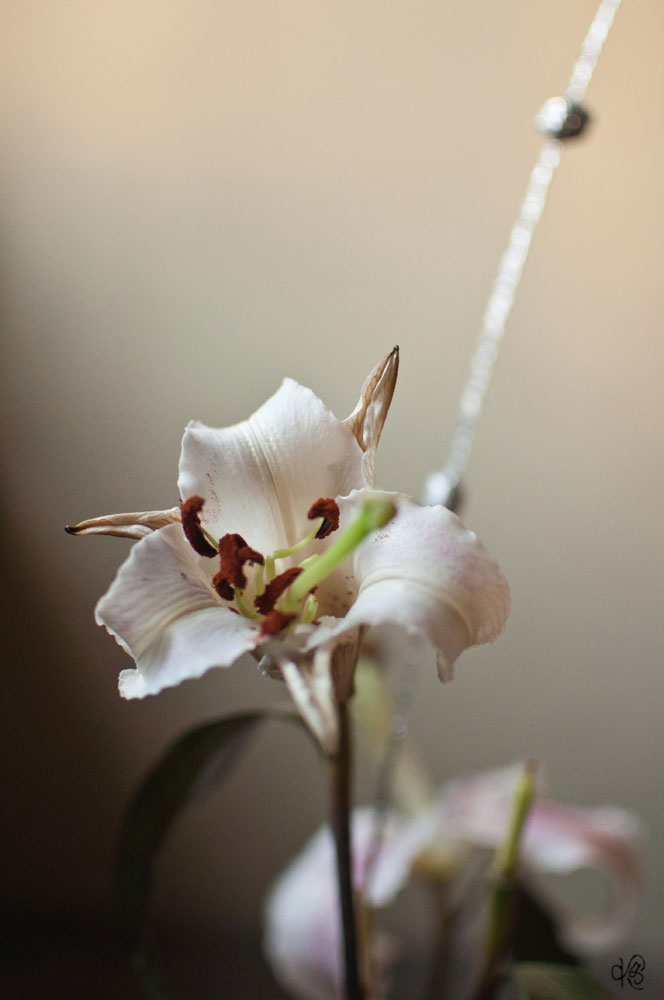
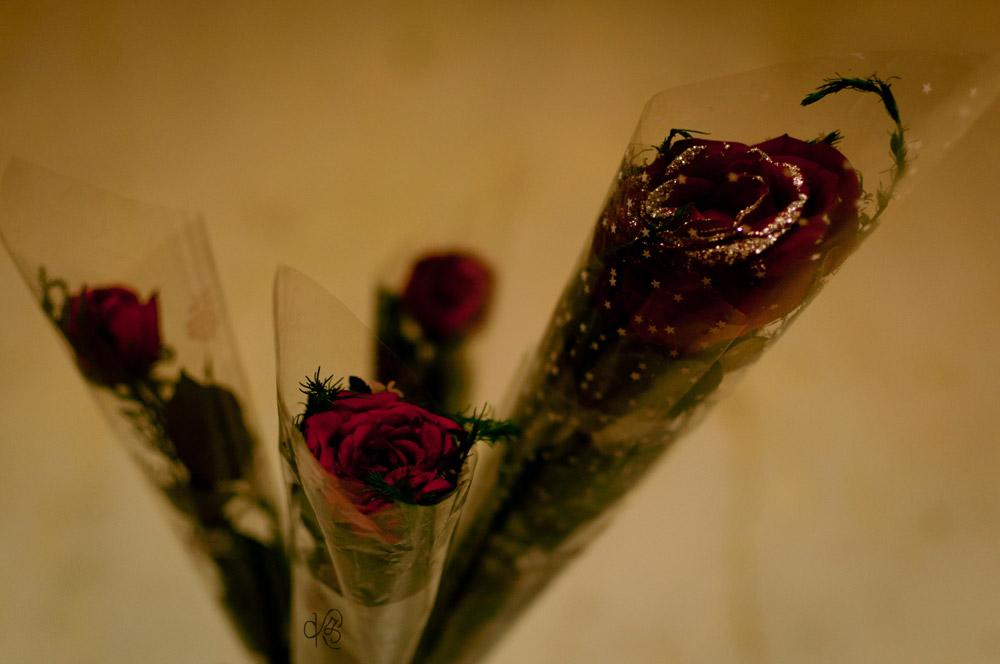
She had been uprooted from her home, decorated to highlight her appealing petals, and given away to indifferent people. In her new ‘home’, she sat quietly in a corner, waiting to be noticed.
Her new family did not appreciate her. They had seen many more like her, and like all the others, she would be abandoned. The garbage collector would pick her up, and she would spend the rest of her short life along with plastics and other alien creatures.
She looked absolutely beautiful. And at the same time, she looked sad. We noticed her head looking towards the ground. She was tired, and disappointed. We decided to adopt her.
We peeled away the pins and wires that surrounded her, and even as I offered her water, some of her delicate petals gave way.
Free from the shackles, and getting a little care, she felt lighter. Was there a hint of a smile? She still missed her home. Nothing could replace that, but now, she hoped she could spend the rest of her days in peace.
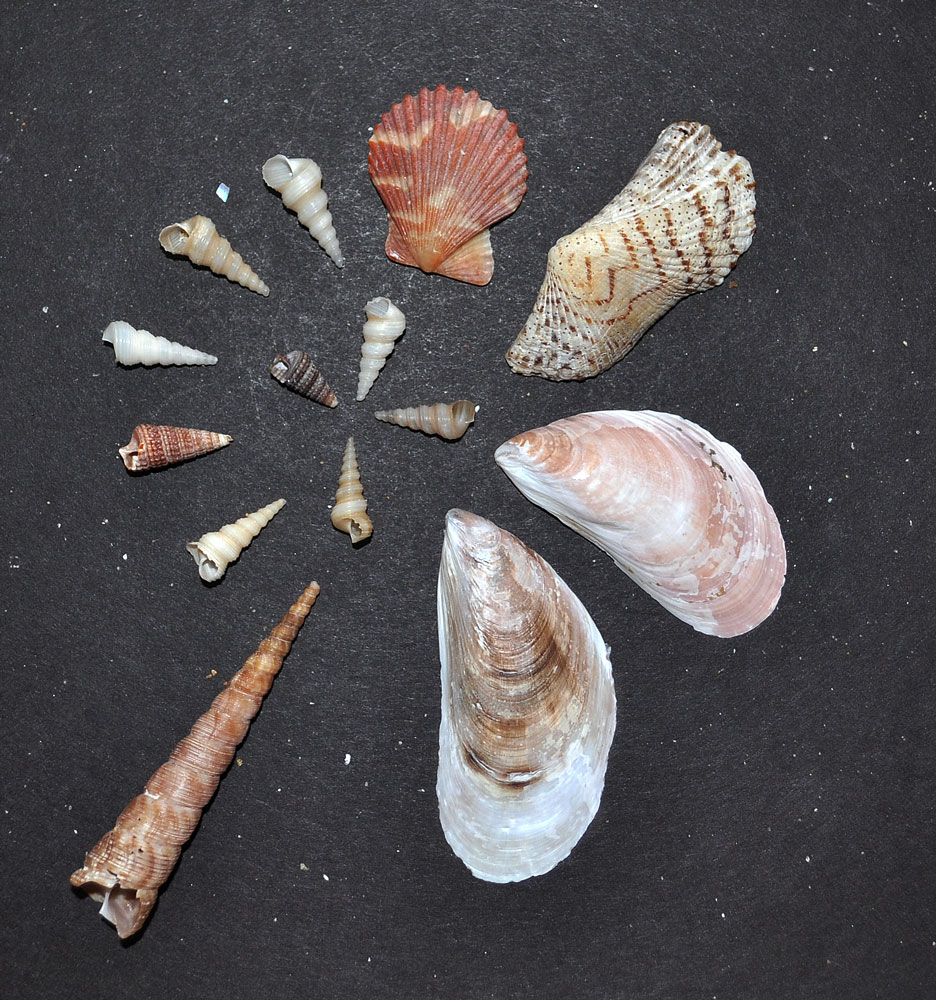
I’ve mentioned a few times, my love for ‘junk’. Here’s something that we hang around with everyday 🙂 The shells here, have been collected, and passed down, over three generations! Hope you enjoy 🙂
Everyone loves mangoes – have it fresh, in pickles, chutneys, salads, shakes, juices, puddings… Even designers love them. The mango motif lends itself to endless adaptations, and can be embellished on almost everything. But the leaves of this tree often do not get the same sort of limelight.
Mango leaves are considered sacred, and are hung at the doorstep of houses on auspicious occasions. Some of the reasons, that I have heard, are warding off negative energy, keeping insects away, and for prosperity.
This past week, India celebrated Ganesh Chaturthi. Our humble mango leaves made their appearance for the pooja. Here’s my attempt to photograph them. It was my first attempt at shooting in the full manual mode, and what better subject to start with 🙂
Today is Teachers’ Day in India – in honour of Dr S Radhakrishnan. In the small primary school that my mother volunteers, the children come from poor* families, and are often ill behaved. While most of the other teachers resort to beating the children into being quiet, she doesn’t believe in beating the kids. As a result, managing them, is a nightmare for my mother. Along with the politics of the management and back-biting from other teachers, the kids were at least partially responsible for my mother falling sick this past week.
After a prolonged absence from work, when she went back to school, the children greeted her with flowers and cards. One little present stood out. The most mischievous child had made a box out of paper. Coloured with crayons, decorated with ‘chamki‘ **, complete with a ‘ribbon’ – it was simple and charming.
When I was in school, one of my teacher’s said, “Every person I meet, is a teacher to me…”
Here’s wishing all my teachers, a happy Teachers’ Day!
Happy Teacher’s Day, Ma’am
Roses are red… The vase is blue
Flowers
Open Box
Paper Box
*poor – the term poor here refers not merely to the financial status of the students. Most of the families earn a decent income. They live in bad localities, and their behaviour is often unruly.
A trip to Chennai is incomplete without a visit to the beach – and collecting sea shells! Here’s the latest addition to the ever growing collection – most are broken, but we still brought them home 🙂
My grandfather was the eldest in his family. We were his youngest grandchildren. The age difference between us is almost nine decades!
My grandfather’s life was very eventful. It could be said, that he lead a full life. He was a professor in the Burmese University, joined the Army during the world war, served in the foreign service thereafter. Then he helped establish one of the leading heart institutes of the country, where he worked till his last breath.
He had several hobbies. He occasionally undertook carpentry, and even tried his hand at bee-keeping. But the one hobby that lasted the longest, was photography.
None of his photographs prior to the second world war survived – the family had to leave Burma (modern Myanmar), and several possessions were lost.
All his photographs from 1945 onwards, however, were carefully pasted in a book – thick black pages bound together, with beautiful photographs chronicling the life of his children, and even some important people of the times . He developed most of his photographs himself. And he took great pains arranging them in the album, and putting captions for them. He had the foresight to know that other people will one day look at the album with no clue as to who’s in the pictures! The album is showing signs of ageing, and rarely comes out of the cupboard. But when it does, it takes us back in time, to another world.
My grandfather’s love for photography was inherited by my father, who bought a range-finder – spending almost a month’s salary on it. Point-and-shoot or compact cameras never entered our house. From our father, that passion passed onto us. Like our father and grandfather, my brother’s love for photography is serious.
Digital photography had begun entering the market by the time I was old enough to be trusted with the film camera. And my father’s old range-finder was the only one I ever used before my brother’s DSLR entered our lives.
“Extend your palm,” said my aunt to my brother during one of our visits. “I’ve been wanting to give this to you for a long time. It might be useful to you. It belonged to your grandfather,” she said.
She placed a cylindrical leather pouch in his outstretched palm. Like a child unwrapping his gift, my brother’s face lit up with excitement, when he realised, what it was, that he had inherited.
It was my grandfather’s tripod.
“It looks absolutely new!”
No one knows how old the tripod is, but it is, at the very least, seventy years old! And we know that only because the tripod features in one of the pictures my grandfather took of his youngest son – our father.
I have no living memory of my grandfather, and I often wish I had been born earlier – or he had lived longer – so that I may have been able to converse with him. But every time I take a picture, or look at that tripod, I can’t help but think he’s around us – always encouraging us to continue documenting life.
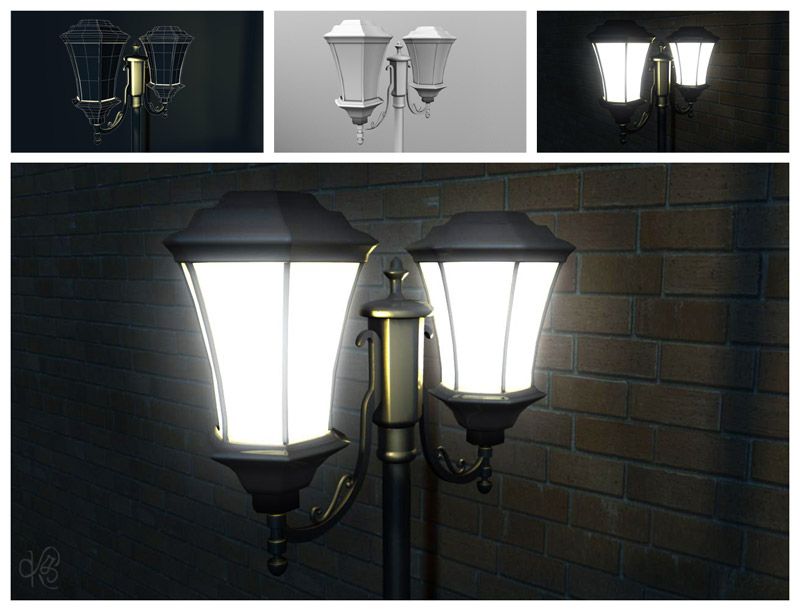
I recently submitted my assignments for internal assessment (3D modelling, texturing and lighting). Here are the renders – the wire-frame, ambient occlusion, beauty pass, and composite. They have all been made using real images as references. The chocolate box took the most effort, and is, by far, the most original of the lot. Hope you enjoy!
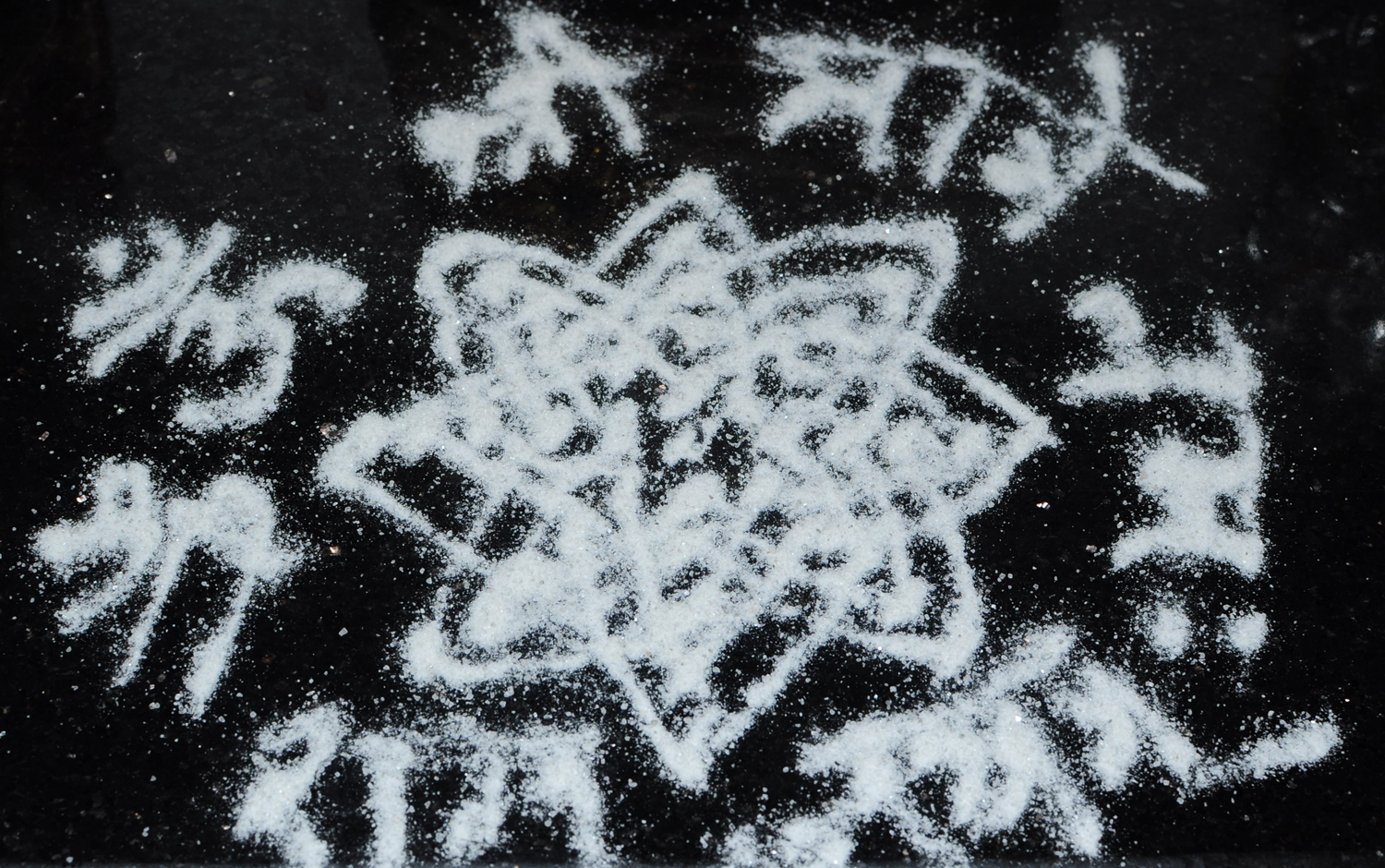
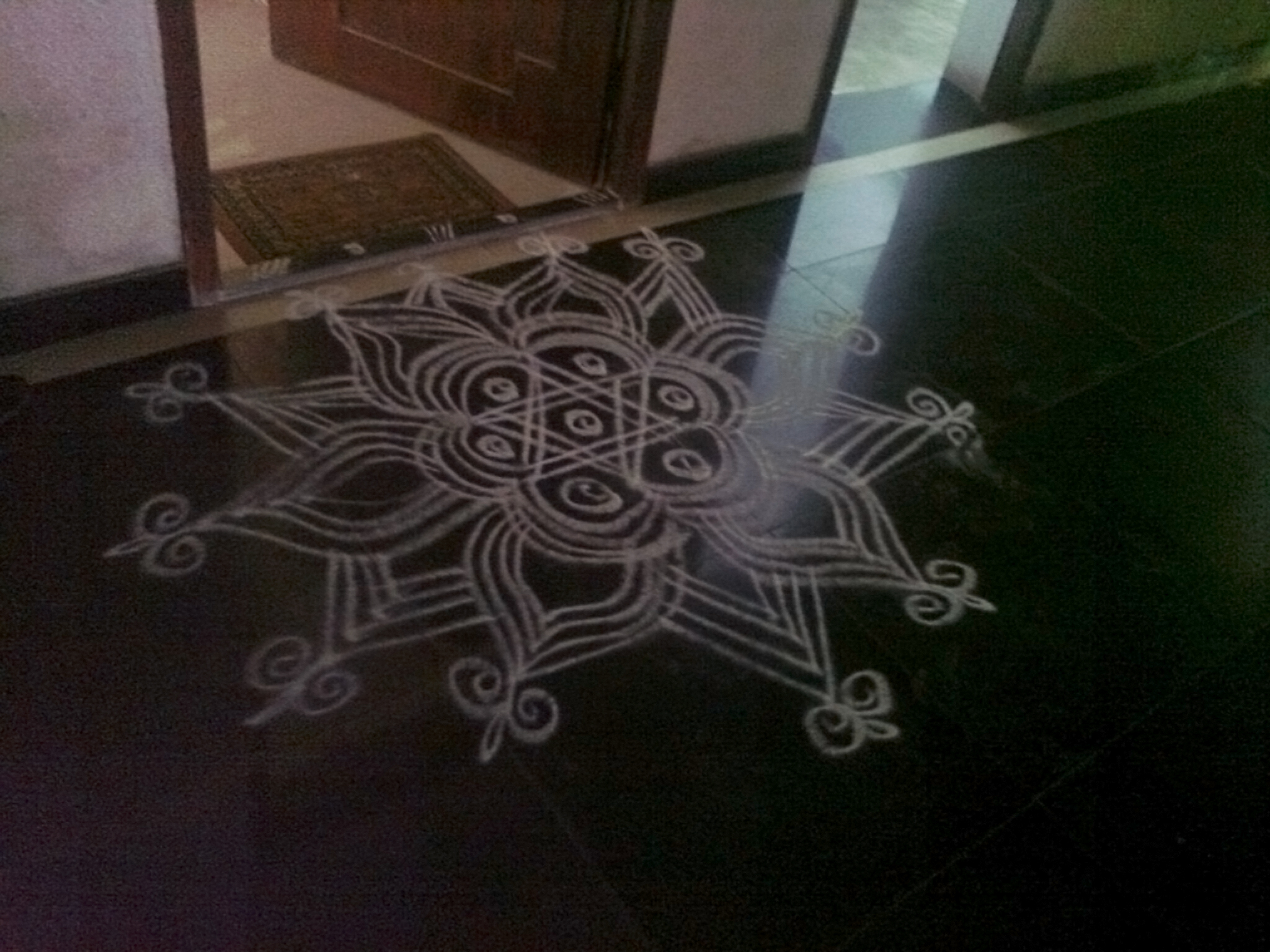
As the sun prepares to visit this part of the world, a few of its rays have jumped ahead, trying to take a peak at our front entrance. While most of the city is either asleep, or busy getting ready to take on the day’s work, my mother opens the door and thoroughly cleans the floor with water. She then opens a small box and picks up a pinch of the white powder that it contains.
The Hrydayakamalam
She rolls the powder between her thumb and index finger and makes a series of dots. They are perfectly arranged in a symmetrical pattern – drawn with pin-point accuracy. She picks up more powder and with a steady hand, draws several even lines – some connecting the dots, others, encircling them.
Ever since I can remember, my mother has performed this fascinating ritual, every single day, without fail.
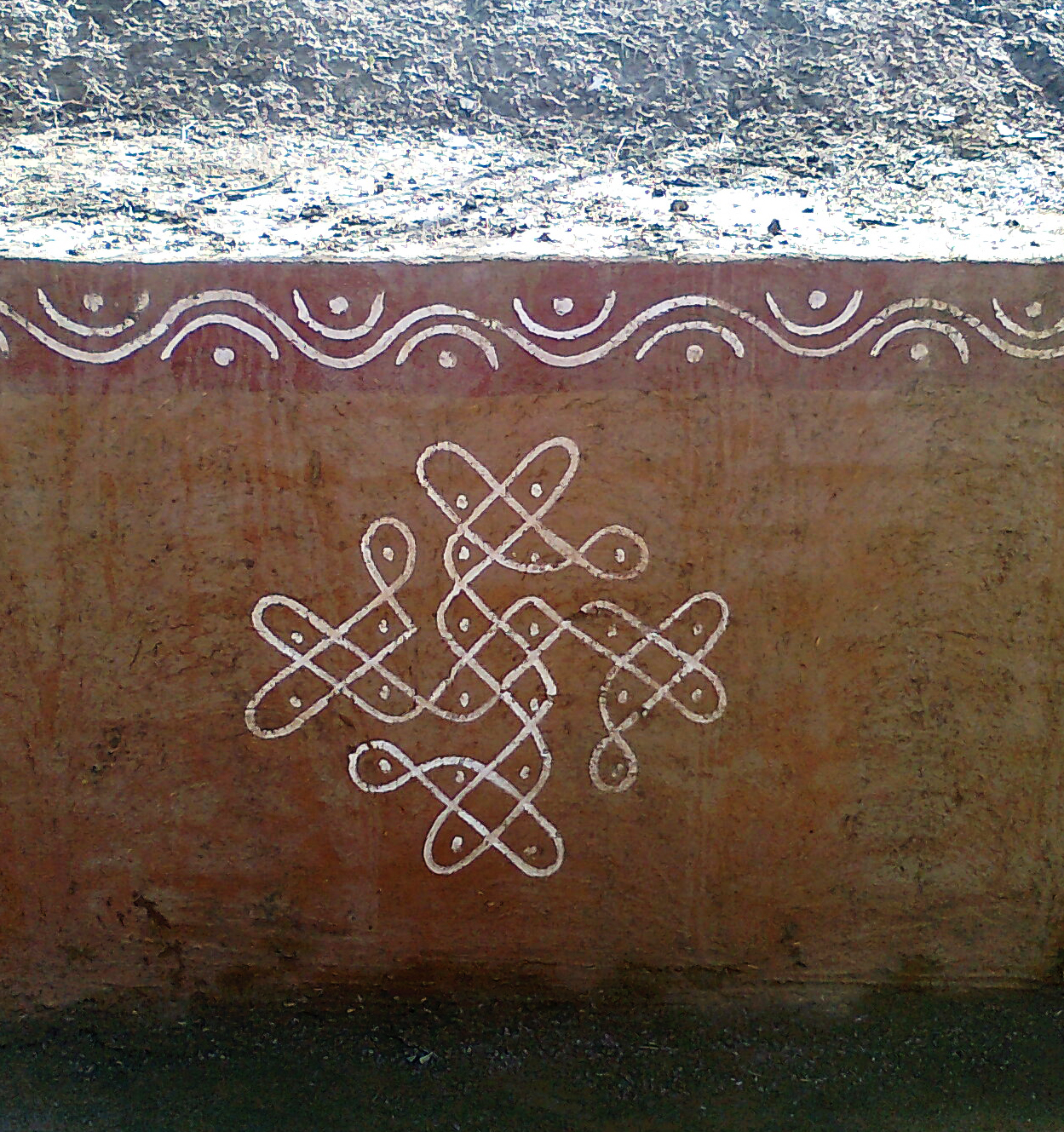
Traditional dots at the Surajkund crafts fair
Earlier, the only source of obtaining the kolam podi*, was relatives who visited us. Our trips to Chennai would be incomplete without buying the white stone powder, which she used for making the designs. Now the powder is available more readily. Kolams are not common in Delhi. Here, elaborate ‘rangolis‘** are made with colourful powders and flowers, that too only on Diwali, or special occasions. Some other migrants like us make the kolams with a more long lasting wet ‘paint’ made using rice flour. Others use ready-made stickers.
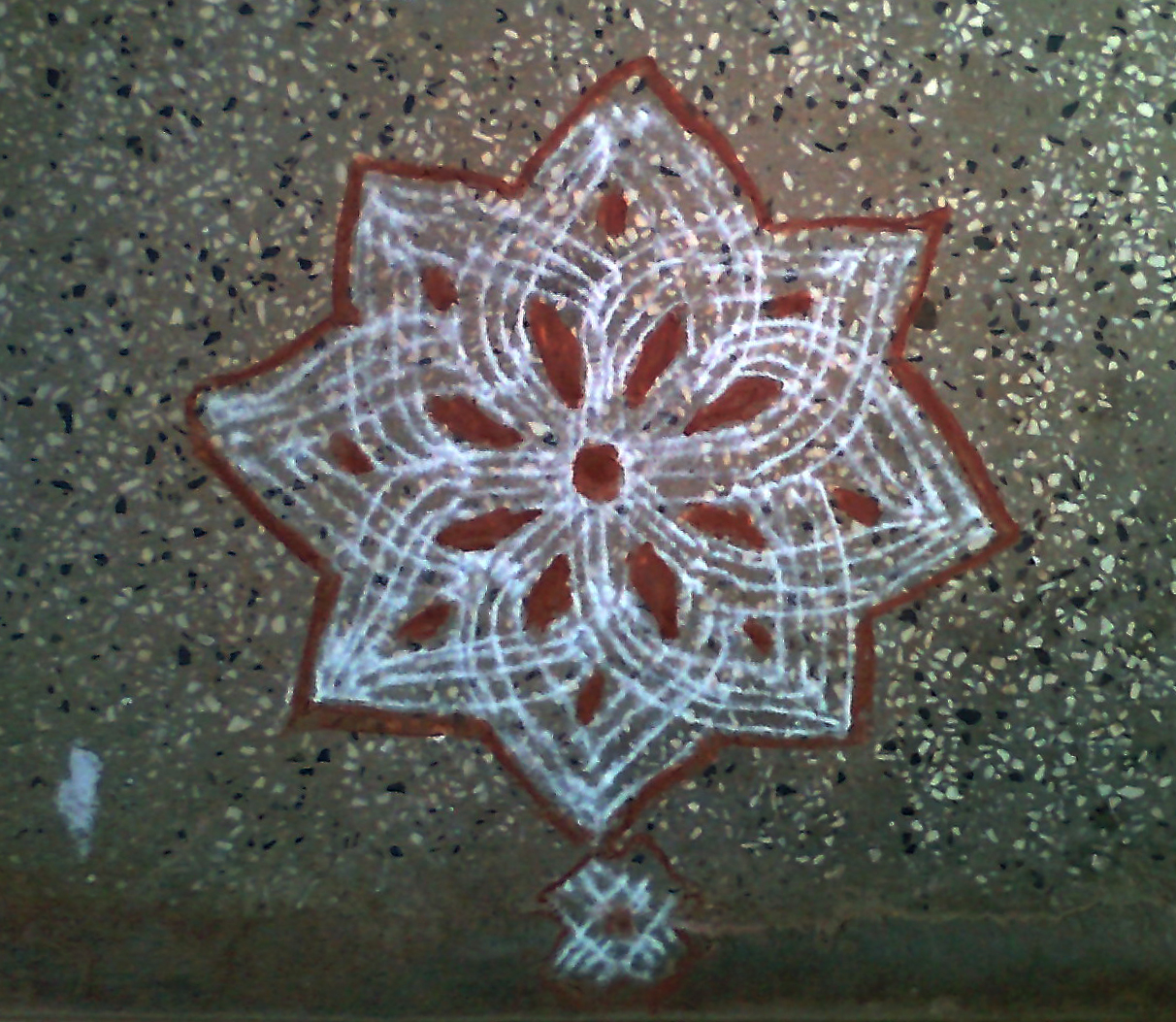
Traditional Kolam made with lines and filled with red stone colour
Visitors often ignore the kolam at the entrance and sometimes step over them. Some mischief makers deliberately destroy them. And on several occasions, the sweeper sweeps them away. It infuriates my mother… “Kolams are swept away only when the family is in mourning… Wiping it away is a sin”, she would shout. But nothing has ever deterred my mother from starting afresh the next morning.
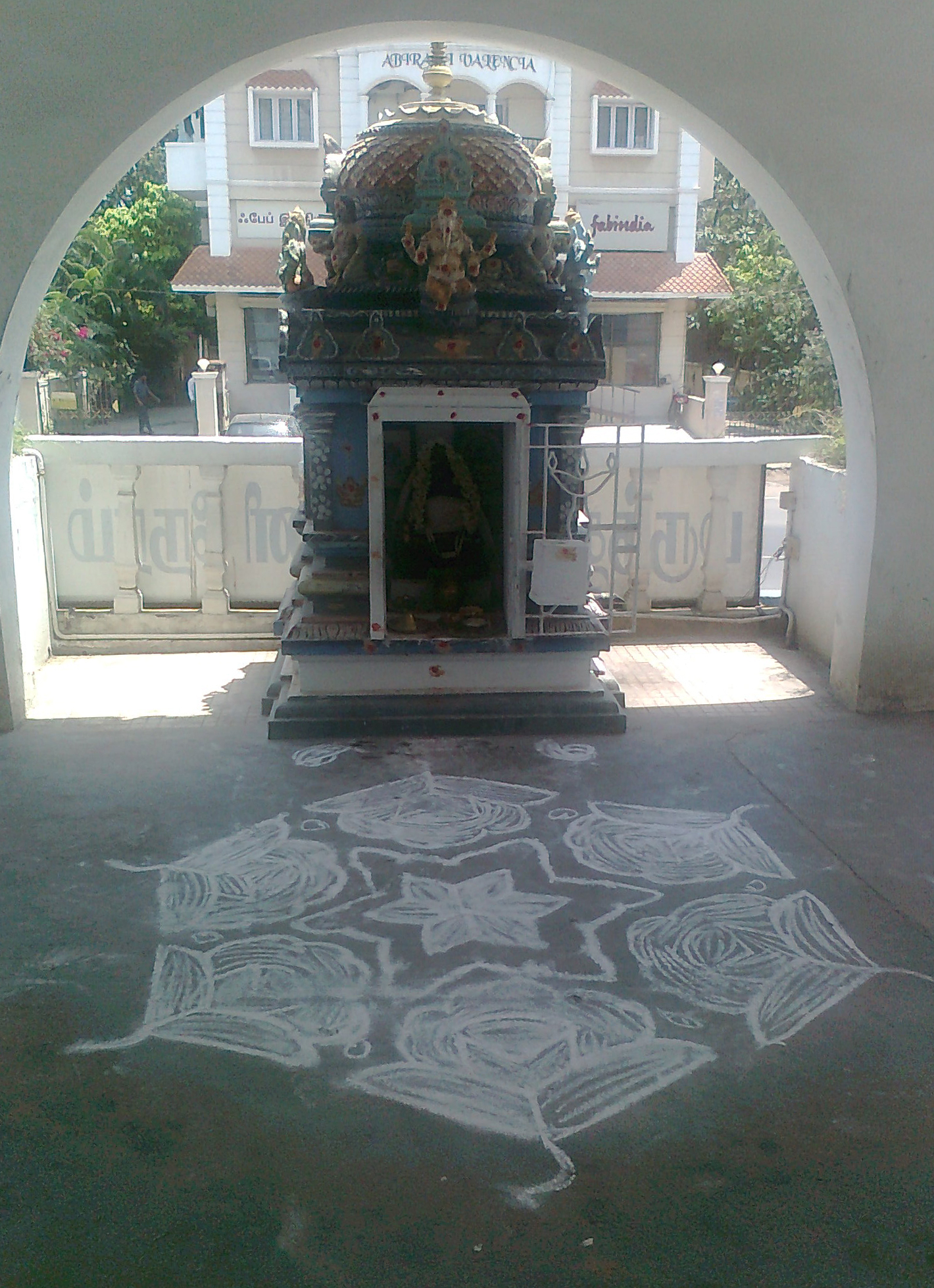
In Chennai, though, kolams are found everywhere – at the entrance of every house, temples, and even public buildings. Friday belongs to Devi, and so, the kolams are extra special on these days. On festive occasions, the red stone comes out of the shelf. The stone is dipped in a little water and the kolam is painted with a deep red colour.
Kolam in a hospital (Chennai)
Celebrations like marriages present a much larger canvas for the ladies. Rice flour kolams are prepared the night before the auspicious event, and, covering large areas, they are grander than what one can imagine. That they will be hidden beneath the holy flame, does not matter to the artists.
As the years have rolled by, my mother’s kolams have evolved. They are no longer limited to the strict geometrical patterns. Nor are the materials restricted to the traditional ones. The kolams are now more abstract, and created spontaneously. On special occasions, she adds more colour – something that she has adopted from the North Indian rangolis. There are times when she is unable to make it early in the morning, but even today, she does not allow anyone to step out of the house before the kolam is drawn. And we don’t mind – the entire process takes just a few minutes – the years of practice have made it second nature to her.
The neighbour’s kolam (Chennai)
It is this art form, and my mother’s interpretations and designs, that inspired me to create something of my own. Based on the traditional paisley motif – the ‘aam‘, or the ‘mangai‘***, it is a tribute to the millions of women who practice traditional art forms as part of their daily lives. It is a tribute to the art form that encourages everybody to become an artist.
But above all, it is a tribute to my mother – who expresses her creativity and skill through patterns on the floor every single day, only to sweep it away the next morning.
This slideshow requires JavaScript.
* * *
* Podi – powder
** Rangoli – Hindi term designs made on the floor.
*** aam – Hindi for mango
mangai – Tamil for unripe mango















 Musings of an eccentric mind