Categories
Stories

The Old, Beneath The New


A gallery tour of Ugrasen ki Baoli – not really on a tourist’s itinerary. But then, not even locals are aware of its presence!

Ugrasen ki Baoli

Delhi has been loved, and loathed, by people for centuries. She has been built, razed to the ground, and rebuilt, by the same people who destroyed her.

The city has always been the favourite city of successive rulers. The proof of their love, lies in the monuments they constructed, that are spread across the city. Most of the newer buildings were constructed at the site of older structures. So the Fort of Rai Pithora, was razed to the ground, only for the Qutub Minar to be built.

Purana Qila (Old Fort) was built by Humayun, only to be destroyed by Sher Shah Suri. Sher Shah built his own capital at that site, only for Humayun to return! But even before the battles between these kings, an ancient civilization existed there – excavations of objects and pottery dating back to 1000 BC proving the antiquity of the Fort.

Besides the most obvious monuments, there are several smaller ones – those that are not on a tourist’s itinerary. They are hidden from public view. Even locals, never fully explore the city. To peel away the different layers of the city, requires more than just a few days. To understand what makes immigrants fall in love with the city, requires more than a lifetime.

In our quest to explore the ‘other’ side of Delhi, a few of us visited a baoli.

A baoli is a step-well, unique to the desert regions of western India. Ugrasen ki Baoli, is just off the main road near Connaught Place (Rajiv Chowk), at the heart of Delhi.

A short walk from the Barakhamba Metro station led us to the walls of the baoli. It looked like any other stone wall we’d seen, until we stepped inside. We collectively gasped at the sight in front of us – a long flight of steps leading to the bottom of the well.

There were scores of pigeons happily going about their daily lives, unaware of their historical home; a few groups of people, wanting to ‘hang out’ together; and one youth, working on his laptop, seeking refuge from the harsh heat!

We descended the stairs, to be welcomed by a very strong odour and screeching sounds. We looked up from the bottom of the well, to the ceiling of the tower – bats. We climbed up the stairs faster than we had descended!

The old, the new, and the pigeons – The three elements that define Delhi – A gallery tour

Related Links:
My friend who introduced the baoli to me, posted a few photographs on one of his posts too. Do check them out here.
Categories
Stories

The Guide


It was a hazy February morning. And we found ourselves free for the day. One of us had a car, and the rest of us made ourselves comfortable in it. We decided to visit the zoo. When we reached, our eyes fell on a huge stone wall. We forgot about the zoo, and decided to explore this imposing structure.

We didn’t know exactly where we were, but the main entrance was nowhere in sight. We located an opening in the fence, running along the perimeter of the complex. A narrow dusty path lay between the thick stone walls, and the fence along the main road. There was perhaps room only for two or three people to walk. We followed the path.

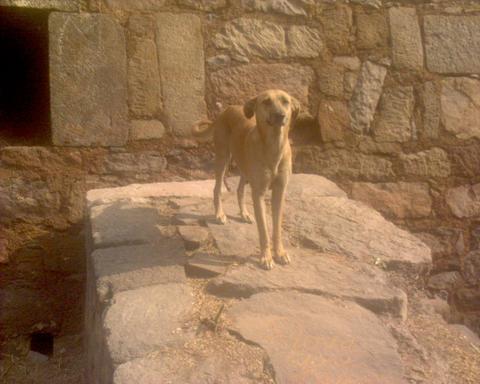
A group of college students were walking ahead of us. And it was only after a while, that we realised that a stray dog had been following us since the time we had entered. We paused, and the dog passed us by.

The path split into two, one of which, descended towards a lake. We resumed our walk along the narrow path next to the stone walls. The path was on higher ground, and we could see the lake beyond the trees.

We climbed down to catch a glimpse of birds on the lake. When we returned to the path, we found the dog waiting for us. It wanted to catch our attention. And it succeeded.

Our focus shifted from the monument, to the dog. We paused, and the dog paused as well.

It walked up a stone step, and looked into one of the openings in the wall. It knew we were watching its movements. So this time, we were waiting for it. It stood still, while one of us took a photograph. Once the photo-session was over, it walked ahead.

Meanwhile, the group of students walking ahead of us had turned back. We realised why, when we hit a dead end. There was a stone wall ahead of us, the lake was gone, and there was a thick cluster of trees in its place. Our friend, the dog, casually walked into this ‘forest’. On an impulse, we decided to follow it.

We climbed down the cliff, and reached the bottom. It was marshy, but our friend guided us along a thin strip of solid ground. At the end of the ascent, we found ourselves at the magnificent, towering entrance of the Old Fort!

After our initial amazement, we turned around.

Our guide was long gone…

The Guide
The Guide

Photo By Anand – used without permission (but I’m sure he wouldn’t mind :))

Categories
Hobbies

Mango Leaves


Everyone loves mangoes – have it fresh, in pickles, chutneys, salads, shakes, juices, puddings… Even designers love them. The mango motif lends itself to endless adaptations, and can be embellished on almost everything. But the leaves of this tree often do not get the same sort of limelight.

Mango leaves are considered sacred, and are hung at the doorstep of houses on auspicious occasions. Some of the reasons, that I have heard, are warding off negative energy, keeping insects away, and for prosperity.

This past week, India celebrated Ganesh Chaturthi. Our humble mango leaves made their appearance for the pooja. Here’s my attempt to photograph them. It was my first attempt at shooting in the full manual mode, and what better subject to start with 🙂

Categories
Hobbies Stories

Letter To Unniyarcha


I suppose,
Somewhere in Heaven,

18 September 2012

Dear Unniyarcha,

I hope you don’t mind the informal salutation. Even though we have never met, somehow, I feel that you would not mind being addressed in this manner. I have heard about you, though I must admit, my knowledge is rather limited.

Last week, I began taking part in the weekly writing challenge. For this week, I decided to write a letter to you. Let me introduce myself. I live in the 21st century. My home is several miles away from where you lived, but both our homes are part of the same country. We no longer have kings and queens, but we still have wars. The conflicts in our society are very similar to the conflicts during your lifetime.

You are a source of great inspiration to me, and over the past several months, I have been busy trying to create something – based on you. I am writing to you, because I wish to share my vision with you.

In your time, there were sculptors and painters who created such wonderful works of art, puppeteers who breathed life into inanimate objects, magicians who created wonderful illusions, actors, dancers and musicians who recreated dramas on stage. In our time, we still have these art forms, but some people have invented new media, and many of these wonderful arts can be performed within something called a ‘computer’.

I am still a student, and trying to learn new things. In my school, I tried to implement what I learnt, to create a character. If you were to be reborn, in our times, this is what I believe you might be. A seemingly ordinary girl – but one who has an extensive knowledge of Kalaripayattu. Simple, confident, friendly, strong and respected.

I had a rather tough time, and at times I felt rather unpleasant, wondering if I could really conquer the challenge I had set for myself. I took up sole responsibility, and in hindsight, I think it was not a very wise thing to do. Nevertheless, I accomplished a part of what I set out to do. The character has her flaws, and will probably always remain a work-in-progress – aren’t all humans! But I am satisfied with what I managed.

I hope someday she gets to meet you, and gets an opportunity to learn something from you. I thank you for patiently reading this letter. I hope it wasn’t much of an inconvenience. I am enclosing some photographs of the girl. I hope you like them.

yours truly,

Kasturika

* * *

Unniyarcha is a popular legendary warrior, believed to have lived in the 16th century. She was an expert at wielding the Urumi.

Urumi is a long sword made of flexible steel, sharp enough to cut into flesh, but flexible enough to be rolled into a tight coil. It is dangerous to the opponents and wielders alike, and requires great agility and skill to master.

Kalaripayattu is one of the oldest fighting systems in existence. It is believed that the Buddhist monk Bodhidharma travelled from the southern part of India and taught martial arts to the monks at Shaolin Temple. The origin of Shaolin Kung Fu is attributed to the ancient Indian martial art systems.

Source : Wikipedia

Categories
Hobbies Stories

Teacher’s Day Out


Today is Teachers’ Day in India – in honour of Dr S Radhakrishnan. In the small primary school that my mother volunteers, the children come from poor* families, and are often ill behaved. While most of the other teachers resort to beating the children into being quiet, she doesn’t believe in beating the kids. As a result, managing them, is a nightmare for my mother. Along with the politics of the management and back-biting from other teachers, the kids were at least partially responsible for my mother falling sick this past week.

After a prolonged absence from work, when she went back to school, the children greeted her with flowers and cards. One little present stood out. The most mischievous child had made a box out of paper. Coloured with crayons, decorated with ‘chamki‘ **, complete with a ‘ribbon’ – it was simple and charming.

When I was in school, one of my teacher’s  said,  “Every person I meet, is a teacher to me…”
Here’s wishing all my teachers, a happy Teachers’ Day!

*poor – the term poor here refers not merely to the financial status of the students.  Most of the families earn a decent income. They live in bad localities, and their behaviour is often unruly.

** chamki – sequins

Categories
Stories

Electrifying Encounter


The thrill of watching an international match at the court – perhaps a once-in-a-lifetime memory to treasure.

We were one of the first few to enter the court complex. We chose our seats right at the centre – where we felt we had the best view of all the courts. Soon, all the seats were taken. The event – Badminton quarter-finals at the Commonwealth Games.

With five action – packed matches being held simultaneously, it was difficult to keep pace with all the matches. We kept track of the progress of the national players, by paying attention to the crowd’s cheers. The ‘aaah’s and the ‘oooh’s indicated that the mixed doubles pair were struggling. The cheers and chants increased, as Chetan Anand and P Kashyap successfully wrapped up their matches.

And then, the entrance of Saina Nehwal, marked by a huge applause. The huge home support defeated her opponent even before the match began. She struggled to return the serves, and looked rather miserable. The crowd, anticipating a good contest, felt short-changed, as Saina won, in a mere 10 minutes!

The women’s doubles game was the last match of the session. And the full capacity crowd turned its attention towards the duel. The disappointment of the lop-sided match played earlier on the court was forgotten, as Jwala Gutta and Ashwini Ponnappa took on the formidable Malaysians. The rallies were long, and each stroke was returned with interest. When we thought the smash was good, the opposition put it back in play. The entire crowd shouted ‘huh!’, in unison, providing extra effort for the home girls, as they smashed the shuttle mercilessly, only to find it being smashed in return.

The entire crowd was up on its feet, the energy of over four thousand spectators, creating a heady, adrenaline packed atmosphere. Ultimately, the game was won by the hosts, to the immense joy of the fans, who gave a standing ovation for the victorious underdogs.

Borrowing from a famous advertisement:

Transportation : Rs 50
Lunch : Rs 150
Cost of ticket : Rs 200
The thrill of watching Indians excel in a proper International sport : Priceless!


Saina Nehwal returned home with a bronze medal in the on-going Olympics, &
P Kashyap reached the quarter-finals – the furthest by an Indian in the men’s event.

Categories
Stories

Patterns On The Floor


As the sun prepares to visit this part of the world, a few of its rays have jumped ahead, trying to take a peak at our front entrance. While most of the city is either asleep, or busy getting ready to take on the day’s work, my mother opens the door and thoroughly cleans the floor with water. She then opens a small box and picks up a pinch of the white powder that it contains.

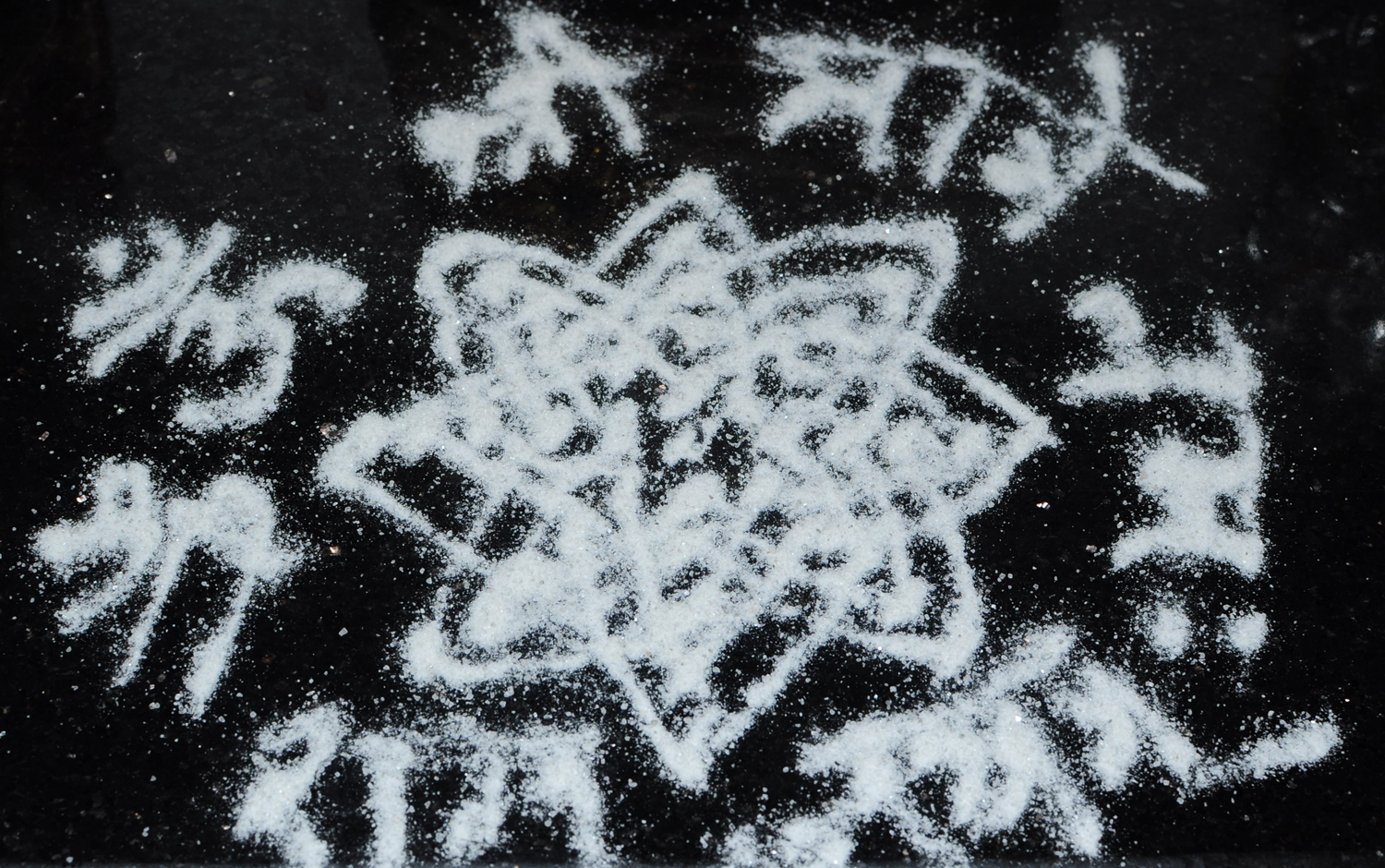
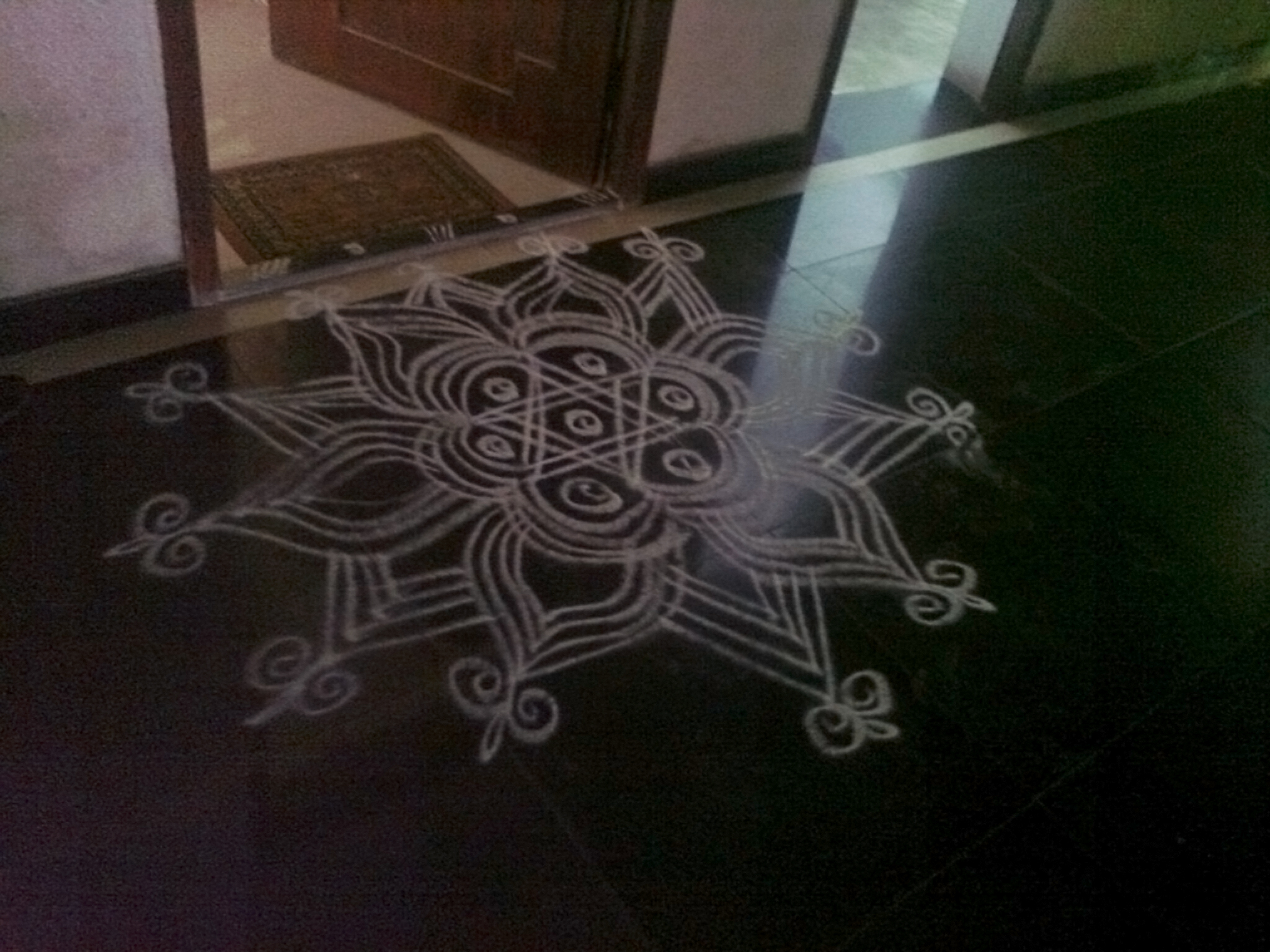
The Hrydayakamalam
The Hrydayakamalam

She rolls the powder between her thumb and index finger and makes a series of dots. They are perfectly arranged in a symmetrical pattern – drawn with pin-point accuracy. She picks up more powder and with a steady hand, draws several even lines – some connecting the dots, others, encircling them.

Ever since I can remember, my mother has performed this fascinating ritual, every single day, without fail.

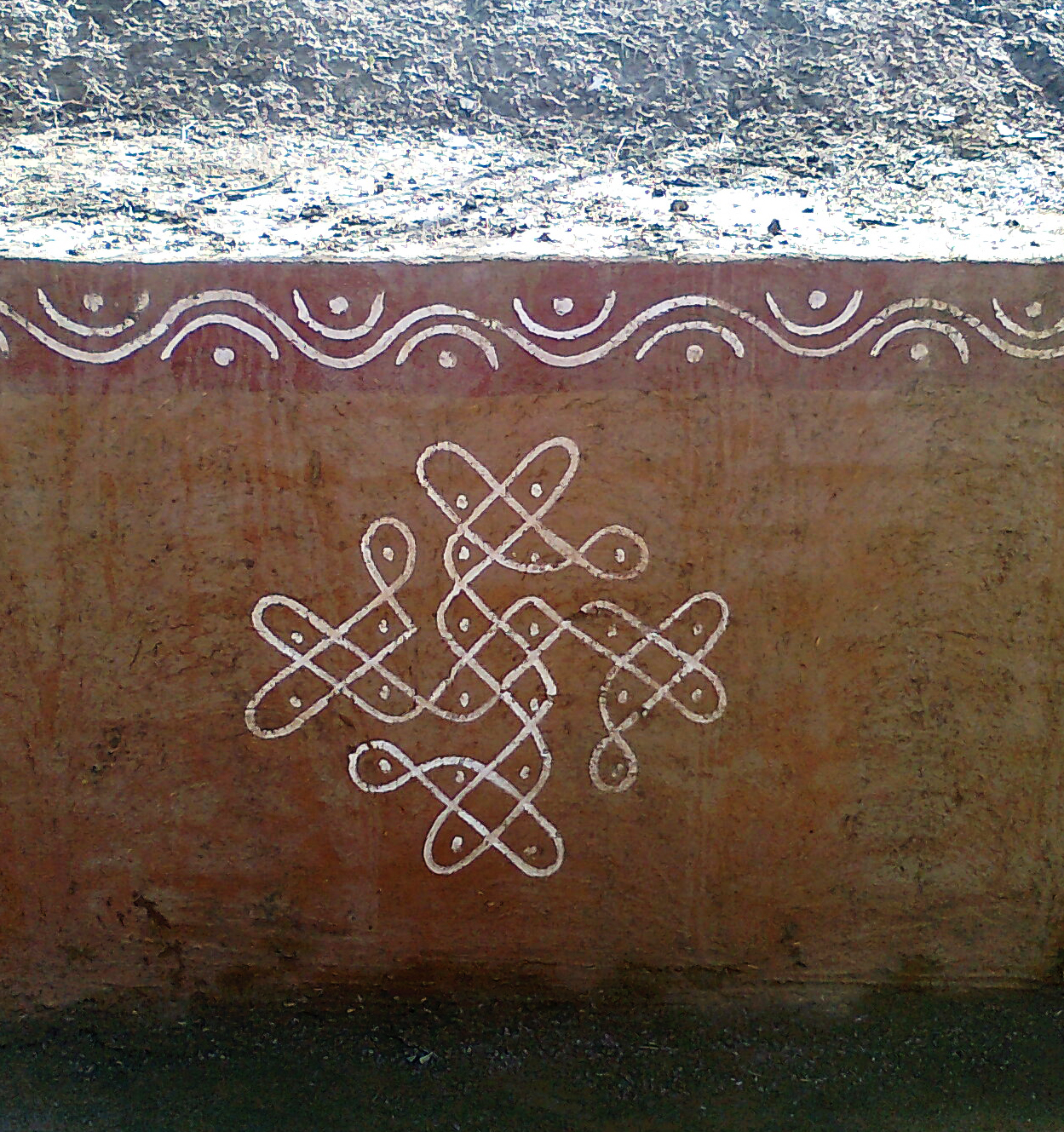
Traditional dots at the Surajkund crafts fair

Earlier, the only source of obtaining the kolam podi*, was relatives who visited us. Our trips to Chennai would be incomplete without buying the white stone powder, which she used for making the designs. Now the powder is available more readily. Kolams are not common in Delhi. Here, elaborate ‘rangolis‘** are made with colourful powders and flowers, that too only on Diwali, or special occasions. Some other migrants like us make the kolams with a more long lasting wet ‘paint’ made using rice flour. Others use ready-made stickers.

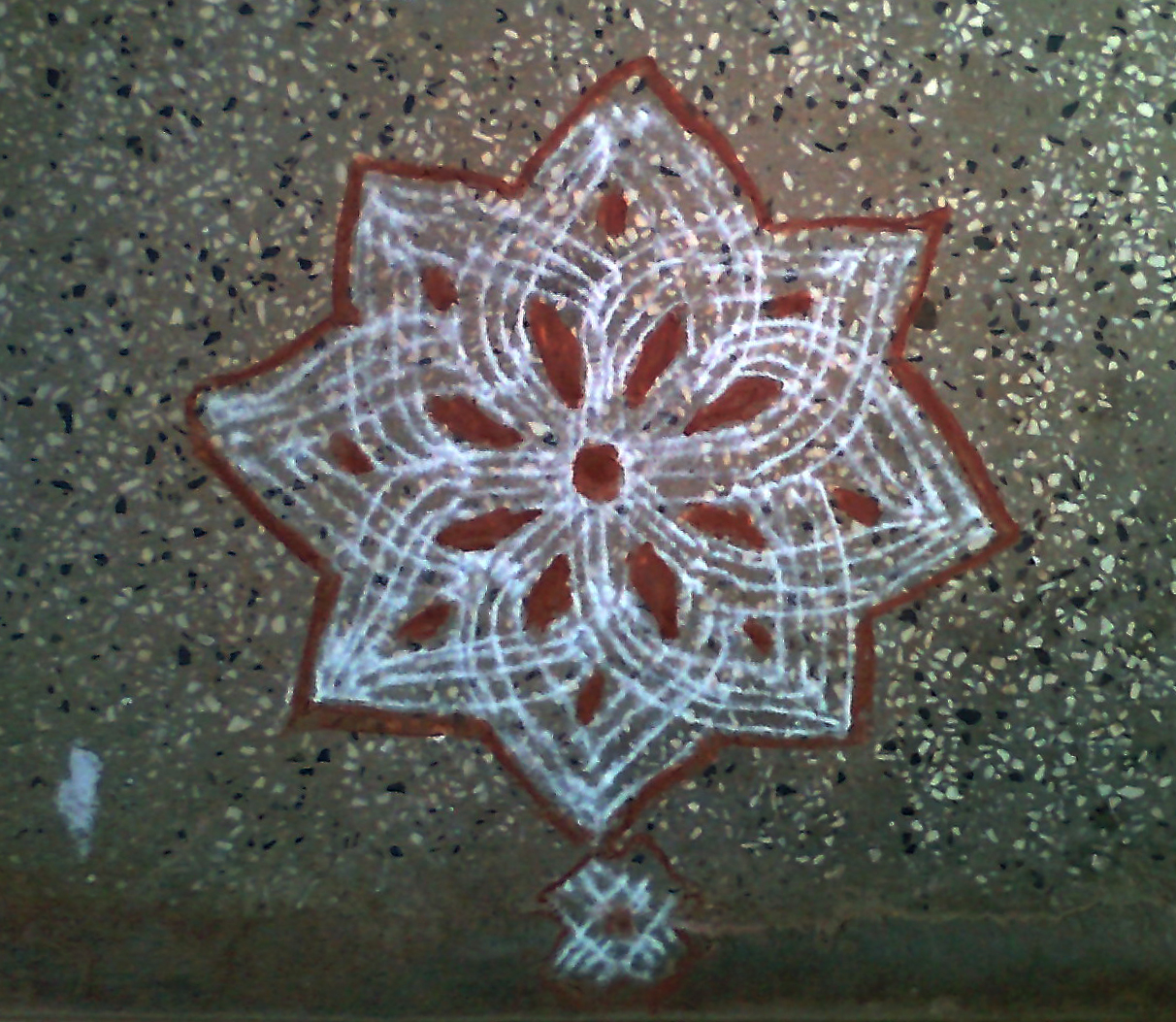
Traditional Kolam made with lines and filled with red stone color
Traditional Kolam made with lines and filled with red stone colour

Visitors often ignore the kolam at the entrance and sometimes step over them. Some mischief makers deliberately destroy them. And on several occasions, the sweeper sweeps them away. It infuriates my mother… “Kolams are swept away only when the family is in mourning… Wiping it away is a sin”, she would shout. But nothing has ever deterred my mother from starting afresh the next morning.

In Chennai, though, kolams are found everywhere – at the entrance of every house, temples, and even public buildings. Friday belongs to Devi, and so, the kolams are extra special on these days. On festive occasions, the red stone comes out of the shelf. The stone is dipped in a little water and the kolam is painted with a deep red colour.

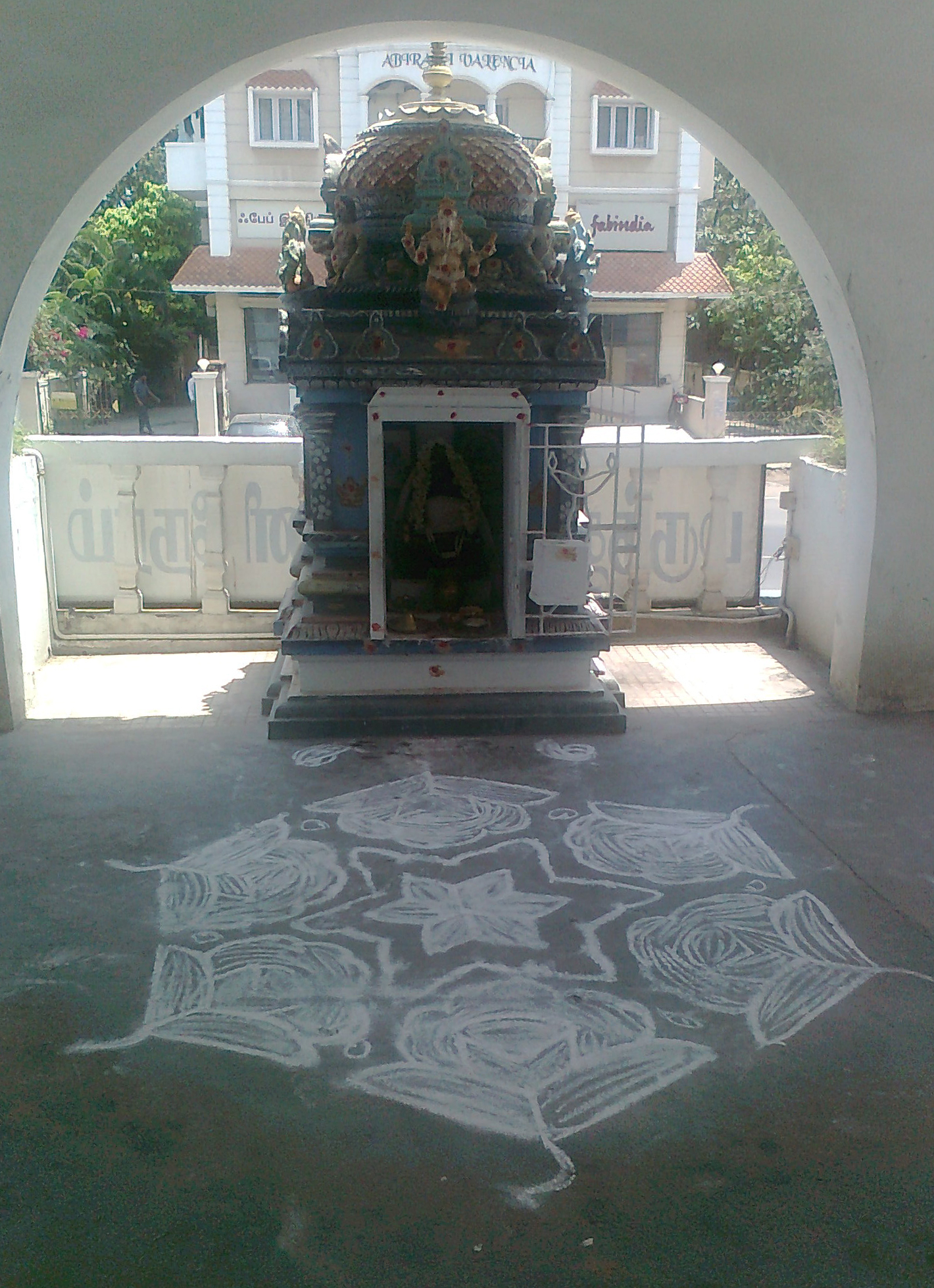
A small temple in a hospital (Chennai)
Kolam in a hospital (Chennai)

Celebrations like marriages present a much larger canvas for the ladies. Rice flour kolams are prepared the night before the auspicious event, and, covering large areas, they are grander than what one can imagine. That they will be hidden beneath the holy flame, does not matter to the artists.

As the years have rolled by, my mother’s kolams have evolved. They are no longer limited to the strict geometrical patterns. Nor are the materials restricted to the traditional ones. The kolams are now more abstract, and created spontaneously. On special occasions, she adds more colour – something that she has adopted from the North Indian rangolis. There are times when she is unable to make it early in the morning, but even today, she does not allow anyone to step out of the house before the kolam is drawn. And we don’t mind – the entire process takes just a few minutes – the years of practice have made it second nature to her.

The neighbour's kolam (Chennai)
The neighbour’s kolam (Chennai)

It is this art form, and my mother’s interpretations and designs, that inspired me to create something of my own. Based on the traditional paisley motif – the  ‘aam‘, or the ‘mangai‘***, it is a tribute to the millions of women who practice traditional art forms as part of their daily lives. It is a tribute to the art form that encourages everybody to become an artist.

But above all, it is a tribute to my mother – who expresses her creativity and skill through patterns on the floor every single day, only to sweep it away the next morning.

This slideshow requires JavaScript.

* * *

* Podi – powder
** Rangoli – Hindi term designs made on the floor.
*** aam – Hindi for mango
mangai – Tamil for unripe mango

Categories
Stories

The Journey


Last weekend, I had been invited to attend a cultural programme. It was the Annual Day Celebrations of a social organisation, which provided foster care for street children.

The course of the programme seemed to follow the pattern of the lives of the children taking part in it.

The show began with a group of children singing the anthem of the organisation, an old Hindi classic film song – ‘Aa chal ke tujhe…‘* They seemed nervous as they missed a few beats and struggled with the correct notes. As another group sang, their voices revealed their state of mind – hesitant and unsure.

Young children then came out in their colourful attire, and enlightened the audience about real life examples of women’s entrepreneurship, and staged a play about rural life.

As the evening grew, the atmosphere became more lively. The children in the audience cheered loudly during the award ceremony, as their caretakers, and some older children, were being felicitated.

The convocation ceremony showed how contrasting our lives were. For us, attending school was as integral a part of our lives, as eating and sleeping. But for the children of the home, simply clearing the examinations was a huge milestone. They weren’t as lucky as we were – abandoned by their own parents, left to fend for themselves at a tender age, victims of various types of abuse.

As the older children began their dance performances, their eyes glowing with pride, their movements synchronised, and expressions filled with confidence, it was clear, that they had put their past behind them and were now ready to embrace their new lives.

The event was nothing short of being grand – and I’m glad I was there to witness it.

* * *

*Aa chal ke tujhe, mai leke chalun, ik aise gagan ke tale, jahaan gum bhi na ho, aansu bhi na ho, bas pyaar hi pyaar pale…

Come, I’ll take you to a place so beautiful, where there is no sorrow, no tears, only love…

Categories
Stories

The Taste Of Life


The summer has already set in and the heat is becoming unbearable. If its this hot in April, I fear to even think about May and June.

The past couple of days, have been a little different though.

Today, the wind is blowing hard. The sky is overcast, but there are some rays of light, which have managed to sneak past the clouds to get a glimpse of the world.

In the balcony, the plants are having a ball. For the past few weeks, they’ve gone crazy. Everyday they’ve been dressing up in their best outfits. The Nandiyavattai*, the common purple Flowers*, Hibiscuses, Loudspeaker* Lilies, and even Jasmine flowers, have come out in large numbers after a long, long time.

Today, also happens to be the Tamil New Year. Although there isn’t much we do to celebrate the new year, our mother draws a special kolam** at the entrance of the house, and prepares a special dish.

This dish has all flavours – sweet, salty, sour, bitter, spice, and pungent. The dish represents life, and its ingredients, its different flavours. In life, some moments are sweet, others, bitter. We experience a wide variety of emotions. On the first day of the year, this dish is prepared to remind us, that the future will be filled with varying emotions. We must, not only prepare ourselves to face life, but also learn to enjoy its different flavours.

Puthandu vazthukal (happy new year), and a happy Baisakhi to all.

* * *

Nandiyavattai – The Tamil name of a plant, whose name I did not know – till now. Called ‘Moonbeam’ or ‘Wax Flower’ in English, ‘Chandni’ in Hindi and ‘Tabernaemontana coronaria’ in Science.

The Common purple Flowers – Another plant whose name I found out today. Called ‘Madagascar Periwinkle’ in English,  ‘Sadabahar’ in Hindi and ‘Cantharanthus roseus’ in Science.

Loudspeaker Lilies – They look like a pair of loudspeakers, hence we call them that. The internet world does not seem to recognise that name. So its just plain old lilies.

**Kolam – Patterns drawn with stone powder at the entrance of the house.

Categories
Stories

For the love of the game


April 4, 2012 (sometime at night)

The flu season is here. The newspaper is full of reports about this bug called IPL* that seems to have infected thousands, if not millions of people. A few years ago, I too, had been a victim of this bug. It had crippled me during evenings. I couldn’t move out of the couch and would get into a fit every now and then, which would set my pulse racing.

I am happy to report, that I have since, become immune. Although the front page, back page, and practically every page in between, was covered with ‘news’ about the opening ceremony, I found it easy to ignore them.

In the middle of all these reports, one article, stood out like a sore thumb. It was about an archer who had won several titles for the country in the recent past**. She revealed that during her stay at the academy, she was paid a ‘stipend’ of Rupees 500. Her family is living in poverty. To make ends meet, she sold a silver bow for a song. The saving grace for this lady was that it caught the attention of someone who reported it.

Cricket is a popular sport in the country. Why? I don’t know. Those who make it big even for a short while can live a luxurious life. And so every kid wants to become a cricketer. And every business house wants to sponsor them.

* * *

There is a sports complex nearby. On week days, children attend football coaching sessions there. At the end of the session, they run away from the ground like prisoners escaping from jail. Some of the older kids lean on trees at the edge of the park wearing large headphones, sipping sports drinks. Sometimes, I wonder if they really play because they want to, or because it looks cool.

As the week draws to an end, I am reminded about what’s in store for the next two days.

On week ends, the park has a different story to tell. It becomes a training ground for professional rugby players of the local club. They come early in the morning and spend several hours running and playing.

A certain energy engulfs the ground when they run and pass the ball. The energy is contagious. People, out on their morning walks, seem to walk faster, and the joggers put in extra miles.

The players train for national events, most of them, hoping to make it to the national team. The sport probably does not give them a handsome pay cheque. And it doesn’t get any dedicated columns in newspapers and magazines. But the players still play – because they love the game.

* * *

*IPL – Indian premier league – a deadly mixture of money, politics, business, glamour and cricket.

**Poverty forces former archer to sell bow