Categories
Hobbies

Reflection


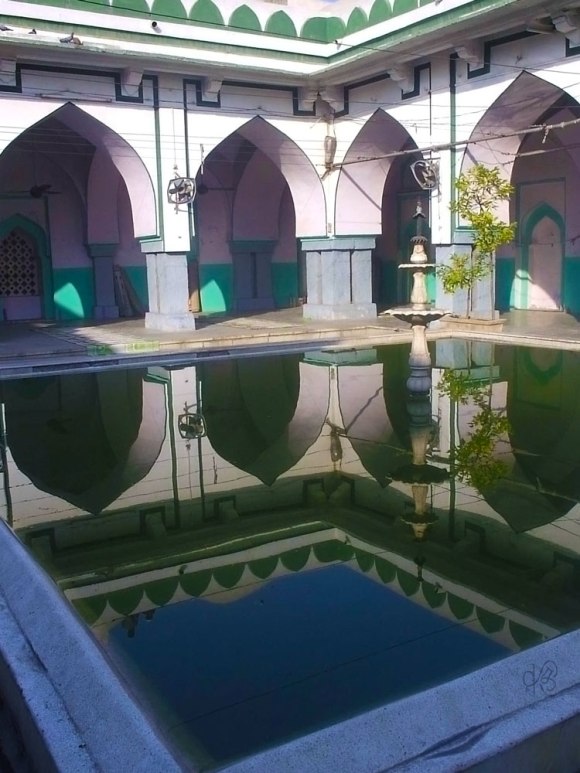
Kalan Masjid
Kalan Masjid, Chandni Chowk

The Kalan Masjid lies close to Raziya Sultan’s Tomb. A rather quiet place, somewhere inside a very crowded Bazaar. Built in 1387 by Feroz Shah Tughlaq, it is one of the oldest Mosques in Delhi.

* * *

This post is part of, what appears to be, a series of short, sometimes confusing, posts.

Writing Challenge : Just Do It
Photo Challenge : Reflections
The Unsung Hero

Categories
Stories

The Unsung Hero


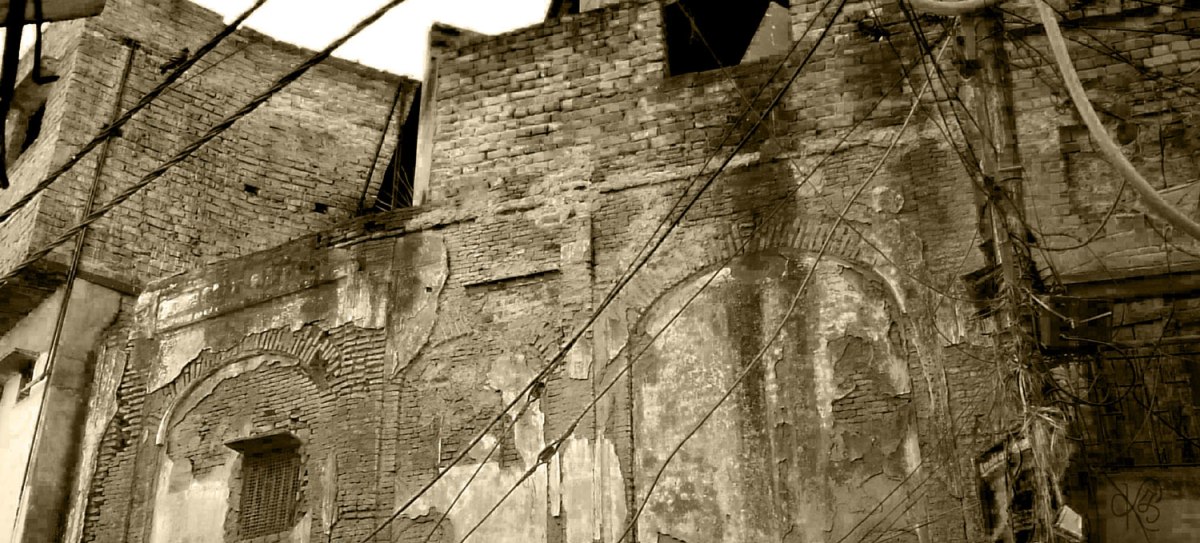
Crumbling Haveli
Crumbling Haveli

The city of Delhi is often referred to, as a burial ground – of emperors and nobles, princes and princesses, saints and warriors. After visiting a few tombs, one gets the feeling that all the tombs are alike. That might be true for most, but there are exceptions.

This past week, I tagged along with a group of heritage-hunters, and headed towards Chandini Chowk. A friendly local offered to guide us through the uneven paths, deep within the bazaar. We went down narrow and dark lanes, past crumbling havelis and butcher shops, and even hopped over a sleeping goat! We approached a sharp turn in the path, which revealed perhaps the smallest, and the saddest tomb in Delhi.

The only three women who were ever elected to the throne in the Mohammedan East, reigned in the thirteenth century.
– Lane-Poole

Raziya Sultan was the daughter of Iltutmish*, and the only woman to have ruled over Delhi. Her father had chosen Raziya as his successor to the throne. This was obviously not welcomed by her brother, as well as the majority of noblemen.

Iltutmish claimed that his daughter was better than many sons. And it did not take long for the citizens of the kingdom, to realise this. Raziya was appointed ruler by the common people.

Sultan Raziya was a great monarch. She was wise, just, and generous, a benefactor to her kingdom, a dispenser of justice, the protector of her subjects, and the leader of her armies. She was endowed with all the qualities befitting a king, but she was not born a man, and for that reason, in the estimation of men, all these virtues were worthless.
– Minhajas-Siraj

Raziya Sultan’s tenure as a ruler was a short one. A female monarch, appointed by common people did not go down well with the establishment. The fact that she showed her face in public, and was tolerant towards the Hindus, made her case weaker. She was assassinated after three years at the throne.

There is a conflict, regarding the actual site where she was buried. Claims include Chandini Chowk in Old Delhi, Siwan in Haryana, and Tonk in Rajasthan. The site at Chandini Chowk, was a jungle during the reign of Raziya Sultan, and there is no engraving to identify the souls resting there. A part of the mausoleum has been converted to a mosque.

Raziya was a person born well ahead of her time. Unfortunately, her story is overshadowed by others who came after her. A hero for all ages, may her soul rest in peace.

*  *  *

* Iltutmish (alternate spelling Altamish) Full name : Shams-ud-din Iltutmish

The third ruler in the Slave Dynasty. The first was Qutb-ud-din Aibak, and the second, Aram Shah. The Slave (Mamluk) Dynasty was the first of five unrelated dynasties to rule over Delhi, in what is referred to, as Delhi Sultanate.

Sources and suggested reading:

Razia Sultan Was Far Better Than Her Brothers – Sunday Guardian
Chapter 5 – Raziya, The Mohammedan Empress of India, History of India – Volume 5 – The Mohammedan Period as Described by its Own Historians – Edited by A. V. Williams Jackson (Selected from the works of late Sir Henry Miers Elliot)

The Daily Post asks readers to write about their heros. I have paid a tribute to Unniyarcha before. Raziya Sultan is my answer to The Daily Post’s prompt.

Categories
Stories

Conversations Over Cream Coffee


It was a chilly Sunday. And the best way to spend it was sitting in the winter sun.

We decided to visit the Indian Coffee House at Connaught Place*. We climbed up to the second floor of Mohan Singh Place. There were only a few people on the terrace. Empty tables were spread randomly, while plastic chairs were piled up, one on top of another, along the entrance. We grabbed our chairs, pulled up one of the plastic tables, and sat down to bask in the sun.

Apart from the outfits of the waiters, there really isn’t anything that looks fancy at the Indian Coffee House. Even the food isn’t really great. But the coffee is good, and its cheap! The main reason why I keep going there, however, is that it is absolutely laid-back. There is no such thing as spending too much time here. When most cafés will eventually ask you to leave, no one here will even hint at that. You are more likely to see people stepping in, than stepping out – even if you spend hours. Like my friend said, ‘It’s like being at home!’

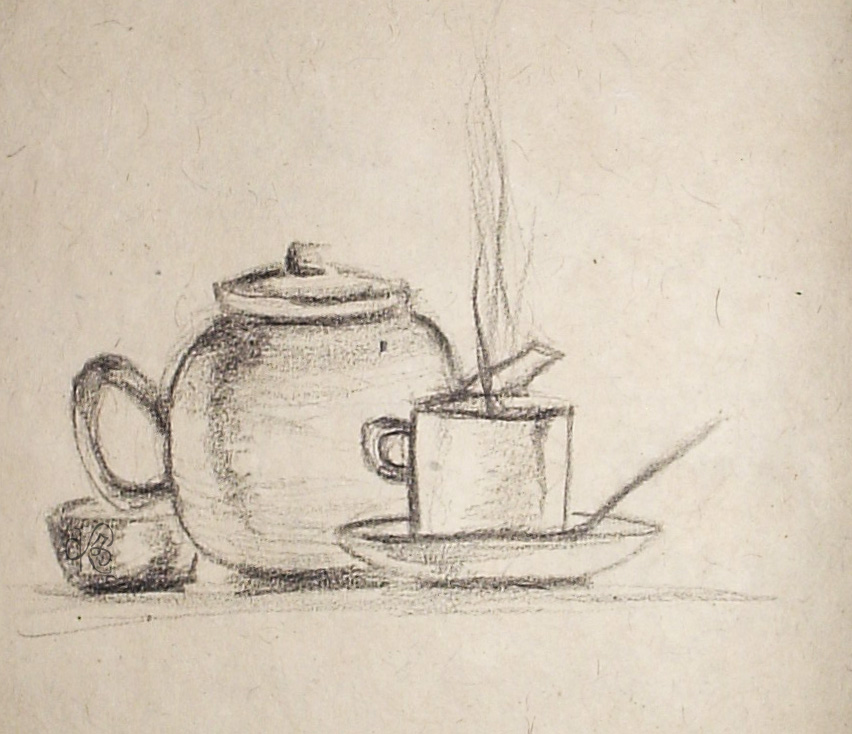
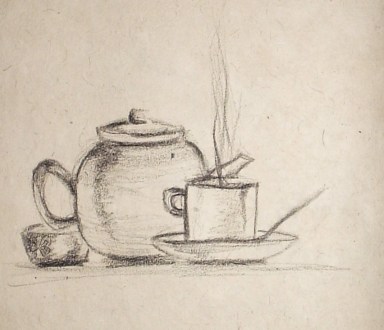
We read the menu pasted on the wall, and ordered ourselves ‘Hot Cream Coffee’. A little while later, the waiter kept a pot of coffee for each of us, with cups, spoons, and a small bowl of sugar.

A Sketch Of Our Pot Of Coffee

As we poured out our coffee, and stirred in the sugar, I found myself looking towards the opposite side of the road.  A number of state emporia lined the street.

‘You know, there is a huge flower market here. It opens early morning, and winds up before breakfast.’ I looked towards the pavement. A large number of people were walking there, shouting slogans and carrying banners. It was hard to tell what they were campaigning for, though.

‘We used to come here on Sunday mornings, when we were in school.’

‘I know, you told me.’

‘We would get up lazily, and go about our morning routine reluctantly. And then, our father would ask, ‘Do you want to go to the flower market?’ And just like, that our faces would brighten up, and we’d get ready within no time!

It was such a treat! And I don’t mean just visually. We’d pick up a few flowers – usually roses, or orchids. The orchids would last much longer than most other flowers. And then we’d head over to the nearby McDonald’s. We hardly went to McDonald’s back then. It was a novelty. That particular branch used to open very early. And we’d always order a McShake with our breakfasts. Nah! The McShake was the breakfast. Of course things have changed a lot since then…’

My friend waited patiently, till I realised I had to shut up, and then suggested, ‘Maybe you should blog about it.’

* * *

*Connaught Place is now officially named Rajiv Chowk.

Going through WordPress’ freshly pressed entries, my eyes fell on a familiar image – flower sellers. The post ‘Where guys give roses’, about the flower markets in Delhi, refreshed some memories for me.

More Coffee:

The Delhi Walla’s photo essay, Indian Coffee House
Wikipedia loves the coffee at the Indian Coffee House

Categories
Miscellaneous

Dastkar – A Craft Lover’s Paradise!


If you’re in, or around Delhi, or are likely to be there any time soon, stop reading this post, and go see it for yourself! Dastkar, the nature bazaar, is on till the 9th of November 2012.
The colours, textures, sights, sounds, and smells… there is something for all the senses.

I visited the bazaar this past weekend, and it was an absolute delight. I saw first-hand, the art forms I had hitherto only read about, and learnt the existence of many more. This mammoth gallery, is only a small part of the whole experience.

Hope you enjoy!

Categories
Stories

The Old, Beneath The New


A gallery tour of Ugrasen ki Baoli – not really on a tourist’s itinerary. But then, not even locals are aware of its presence!

Ugrasen ki Baoli

Delhi has been loved, and loathed, by people for centuries. She has been built, razed to the ground, and rebuilt, by the same people who destroyed her.

The city has always been the favourite city of successive rulers. The proof of their love, lies in the monuments they constructed, that are spread across the city. Most of the newer buildings were constructed at the site of older structures. So the Fort of Rai Pithora, was razed to the ground, only for the Qutub Minar to be built.

Purana Qila (Old Fort) was built by Humayun, only to be destroyed by Sher Shah Suri. Sher Shah built his own capital at that site, only for Humayun to return! But even before the battles between these kings, an ancient civilization existed there – excavations of objects and pottery dating back to 1000 BC proving the antiquity of the Fort.

Besides the most obvious monuments, there are several smaller ones – those that are not on a tourist’s itinerary. They are hidden from public view. Even locals, never fully explore the city. To peel away the different layers of the city, requires more than just a few days. To understand what makes immigrants fall in love with the city, requires more than a lifetime.

In our quest to explore the ‘other’ side of Delhi, a few of us visited a baoli.

A baoli is a step-well, unique to the desert regions of western India. Ugrasen ki Baoli, is just off the main road near Connaught Place (Rajiv Chowk), at the heart of Delhi.

A short walk from the Barakhamba Metro station led us to the walls of the baoli. It looked like any other stone wall we’d seen, until we stepped inside. We collectively gasped at the sight in front of us – a long flight of steps leading to the bottom of the well.

There were scores of pigeons happily going about their daily lives, unaware of their historical home; a few groups of people, wanting to ‘hang out’ together; and one youth, working on his laptop, seeking refuge from the harsh heat!

We descended the stairs, to be welcomed by a very strong odour and screeching sounds. We looked up from the bottom of the well, to the ceiling of the tower – bats. We climbed up the stairs faster than we had descended!

The old, the new, and the pigeons – The three elements that define Delhi – A gallery tour

Related Links:
My friend who introduced the baoli to me, posted a few photographs on one of his posts too. Do check them out here.

Categories
Stories

The Guide


It was a hazy February morning. And we found ourselves free for the day. One of us had a car, and the rest of us made ourselves comfortable in it. We decided to visit the zoo. When we reached, our eyes fell on a huge stone wall. We forgot about the zoo, and decided to explore this imposing structure.

We didn’t know exactly where we were, but the main entrance was nowhere in sight. We located an opening in the fence, running along the perimeter of the complex. A narrow dusty path lay between the thick stone walls, and the fence along the main road. There was perhaps room only for two or three people to walk. We followed the path.

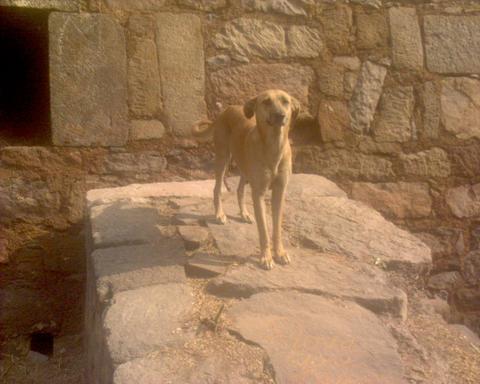
A group of college students were walking ahead of us. And it was only after a while, that we realised that a stray dog had been following us since the time we had entered. We paused, and the dog passed us by.

The path split into two, one of which, descended towards a lake. We resumed our walk along the narrow path next to the stone walls. The path was on higher ground, and we could see the lake beyond the trees.

We climbed down to catch a glimpse of birds on the lake. When we returned to the path, we found the dog waiting for us. It wanted to catch our attention. And it succeeded.

Our focus shifted from the monument, to the dog. We paused, and the dog paused as well.

It walked up a stone step, and looked into one of the openings in the wall. It knew we were watching its movements. So this time, we were waiting for it. It stood still, while one of us took a photograph. Once the photo-session was over, it walked ahead.

Meanwhile, the group of students walking ahead of us had turned back. We realised why, when we hit a dead end. There was a stone wall ahead of us, the lake was gone, and there was a thick cluster of trees in its place. Our friend, the dog, casually walked into this ‘forest’. On an impulse, we decided to follow it.

We climbed down the cliff, and reached the bottom. It was marshy, but our friend guided us along a thin strip of solid ground. At the end of the ascent, we found ourselves at the magnificent, towering entrance of the Old Fort!

After our initial amazement, we turned around.

Our guide was long gone…

The Guide
The Guide

Photo By Anand – used without permission (but I’m sure he wouldn’t mind :))

Categories
Musings

The Constant Migrant


The city has embraced migrants for centuries, and become home to a huge variety of people. Not many can claim to belong to Delhi, yet, anyone who comes here, belongs to it. People who live here are known for their generosity. They welcome visitors with wide-open arms. This is perhaps the reason why the city has come to be known as ‘dill walon ka sheher‘*. It has embraced different cultures and has a long history – which is evident from the staggering number of monuments.

Over the recent past, its image has been that of an unsafe city. I believe this is because non-residents have taken the lovely people here for granted. But even so, it is a city that I call home. Despite its shortcomings, I love it. If I were told to move out of Delhi and live elsewhere, I would be devastated. And therein lies the problem.

For all my attachment to this city, deep down inside, a small part of me feels like I am a misfit. I need the typical South Indian cuisine, the tunes of Carnatic classical music, the sights and sounds of the intricately decorated temples. Perhaps its partly genetic, partly because its a novelty here, and partly because I do not know much about it. But mainly, because it forms a part of my own identity.

Even though I have grown up in Delhi, my childhood was dominated by stories about life in the villages. Anecdotes about hundreds of family members, whom I have never met, and probably will never know either. It used to be a small world. Everyone knew everyone else. There were so many traditions and customs that I struggled to explain to my north Indian peers. I hardly understood the local culture, and they refused to accept ours. Our native traditions and customs were more numerous and filled with elaborate explanations. I found those much more interesting than any of the local folklore. To be honest, I felt superior, and pitied my companions who did not understand.

But time and circumstances changed many things. The city of Delhi was evolving, and was beginning to accept people from all parts of the country. I began feeling alienated around family members. I felt like I didn’t belong there any more. I made Delhi my home.

The villages have nothing that belongs to us any more. The ancestral houses were either usurped or sold – I never set foot anywhere near them. We all have moved on to our own lives. But there are some traditions that we have held on to. The kolam** at the doorstep, the offering of food to deities, the keen interest in Classical music and art, the spirituality and sanctity maintained on festive occasions.

Indian philosophy demands that we move ahead – not get caught up in sentiments. And I believe I am one of the millions of migrants who belong to Delhi. But one day I hope to visit the ancestral village – to understand where my roots were – and perhaps quell the thirst for knowing myself.

* * *

*dill walon ka sheher – loosely translates to ‘the city that belongs to large-hearted people’
** kolam –  form of painting that is drawn using rice / white stone powder (full wiki article)

Categories
Musings Stories

Rebellion


As the year draws to an end, most people have been trying to summarize the events of the year gone by. Arguably, revolts and revolutions have been the most significant part of the year. A common thread connects WikiLeaks, revolts in several African and middle-east countries, the Occupy Wall Street Movement, and closer home, heightening protests against corruption. Perhaps Mother Earth too is getting frustrated after such prolonged abuse. Rebellion, it seems is in every human’s blood.

Keeping in spirit with the theme of the year, here is a piece of frustration shared by several women who travel by public transport in the Capital…

The Delhi Metro is one of many things a resident of the city is proud of. State of the art technology, on-time performance, and (gasp!) cleanliness. So when the first compartment of the train was reserved for ladies, it was another hurrah moment.

With jam-packed trains, the first compartment of the train provided a huge relief for women against a rather unruly and unsafe public. While it provided a sense of security, there was still something disturbing.

Very often, men would enter the compartment and stand at the divider between the first coach and the rest of the train. If a lady wished to enter the first coach, she had to move past a wall of men. It was virtually impossible to get past this human barricade without a huge struggle. Very often, the whole train would be empty, and only the second coach of the train would be over-crowded.

One morning, things got out of control. The ladies’ coach was brimming with men. Women spoke in hushed voices, speaking about the crowd. But no one seemed to object openly. And then a girl screamed. She pleaded and wailed to move past a huge group of people. No one yielded. Some hooligans in the crowd began hooting when a few women made some noise. They refused to move away, even when told to do so.

And then something amazing happened. A couple of women blocked the gate to the entrance of the coach and shouted. ‘This train will not move till the women’s coach has men in it’. The doors of the metro train are programmed to open automatically when there is an obstruction.Taking advantage of this, the ladies held up the train.

Even after this move, men refused to budge, even shamelessly smiling at the ladies. Then a few ladies, getting frustrated began manually pushing men out. Most of the men complained saying there was no space in the train. But a few minutes later, we came to know that they had magically found some space in other parts of the same train!

Soon order was restored and the train was allowed to move. A few ladies, unknown to each other, formed an instant union and coordinated with each other to get rid of the men in the compartment. It was heartening to see such unity among women, who are willing to step up and fight for themselves. No knight in shining armour needed. But how did we get into this mess in the first place?

In a way, we are responsible for it. When men started entering the compartment, no one said anything. Only when it reached a tipping point did something happen. And even then, it was only a handful of women who managed to get the courage to do something about the situation, while the majority just stood watching.

From the very beginning, girls are told to learn to adjust to their surroundings. Sacrifice and selflessness are virtues that are the hallmark of a lady. It is all very well. But then subconsciously, the feeling of inferiority, and subservience is instilled into them. And most often, women themselves propagate such ‘values’. It is most unlady-like to do certain things. There are unwritten, yet deeply entrenched rules regarding the behaviour of a lady. Yet, the behaviour of the other half (the majority, to be more precise) is unchecked.

Women themselves have brought upon this situation. By allowing people to trample over us, we cannot really complain. But it is time we stepped up and stopped being bullied. If a lady is not offered the courtesy and shown the respect she deserves, there is absolutely no reason for her to still act lady-like (read meek and docile).

Gandhiji was an advocate for empowerment of women. During the freedom struggle, men and women fought beside each other. When Ms Indira Gandhi was assasinated, it was looked upon in horror. ‘Stree hatya!’, they said. The worst crime that can ever be committed. How then, did India reach this low? If we look back at the lessons from our historic texts, one cord that is common to all is this: The land where a woman is disrespected, is doomed.

Categories
Stories

A Game Apart


My brother and I attended an event, and it was a great experience. Writing about it, has, however, been rather challenging. This post is an attempt to write about the pleasant time we had, but I found myself hitting the backspace key more often that I would have liked. I hope this post conveys the message I intend it too!

A little over a year back, we attended a rugby 7’s match. It was during the Commonwealth Games. As far as I can remember, we had to buy tickets, wait in long queues, undergo heavy security checking, had to ‘deposit’ any coins we had, and were not allowed to carry video cameras. The ground was lush green, there were two giant screens, and there was excitement in the air. We managed to get good seats and saw international athletes play at close range. We had a wonderful experience.

Fast forward to this afternoon. We went for a rugby match.

The Venue : A Local Ground

Entry was free, there were no security checks, we could sit wherever we wanted, and after the match we could even enter the field.

About two years back, the ground was barren, slums lined its perimeter, and there were at least two large wild pigs. But today, the grass was green and the slums were out of sight (I’m sure there are still a few left, though I couldn’t see them). The ground had nets, goal posts and chalk markings. There was even a temporary stand for the audience. The local ground was no longer just a piece of land, it was a full fledged sports complex. The transformation wasn’t overnite. And it was a pleasant surprise.

The Event : All India Club Sevens Championship

Yes, that’s correct. It was a national event, with teams from all over the country participating! There were no journalists covering the event, no glamourous stars. There was one official photographer, who happened to be a player for the host team’s full rugby squad.

The experience of today’s match was quite different to the international match we witnessed last year. But the modest surrroundings and the low-profile nature of the event did not take anything away from the competition. The quality of the games was very high. The ambience was definitely not as noisy as a high profile international event, but there was good humour all around, and a small section of the crowd cheered the local team.

The presence of international players added some colour to the tournament (no pun intended), and the ‘local’ hero, Pierre stole the event as he danced with some of the kids at the end of the match.
Players going to meet the Coach
As for me, I had the opportunity of standing in the middle of the ground after the match, as the players were moving off the field, towards their coach. It was the kind of view only a person wielding a camera, can have the privilege of experiencing in a professional match.

And it was the pleasure that I could experience today, standing next to my brother. Now where else can one get that!

Rugby is a minor sport in India. For a long time, it was only associated with a Hindi Cinema Actor (who was formerly the captain of the National Team). India currently ranks 75, out of 95 teams in the IRB World rankings.

The state of the sport in the country is best left for professionals to explain. From an ordinary person’s view though, I hope the tide is turning.


While I don’t have much knowledge about rugby, it seems that the sport is beginning to receive some attention. Although there wasn’t any media coverage, the event was sponsored by Harley-davidson motorcycles, United Colors of Benetton, Fox Traveller, and Kingfisher.

The tournament here made me curious enough to find out a little about rugby in India, and it felt good to know that sponsors are beginning to step forward, and the game is developing at the grass-roots level.

Photograph by R. Karthik.

Categories
Musings

The anonymous bus conductor!


The world can be very harsh, but if we look close enough, there are little little positives for us to feel good about.

Of late, things have been rather gloomy. The print media seems to be enjoying a golden spell of bad news. Every single page had nothing but depressing stories. Scandal, corruption, crime, dirty politics, natural disasters… the list is endless. As far as news channels are concerned, quite frankly, I’ve lost hope on them and stopped watching TV altogether.

Seeing all this gloom only has a compounding negative effect on our lives. How our life is, and how happy we are, is plainly a matter of perception. If we choose to look at only the negative aspect of things, then that is all we will end up seeing. We act as magnets. The more we think about bad events, the more we end up pulling bad things towards ourselves.

A few days back, I too suffered an attack of negativity, and everything around me seemed very very evil. There seemed to be no good left on this planet.

But life has very subtle ways of bringing us back on track. And when I say subtle, I mean very subtle.

One day, while I was travelling aboard a local bus, the conductor got up an announced to all the passengers that they would have to get off the bus. He said that the bus had to go and pick up some students and that they were late. As it often happens with the DTC buses that ply on Delhi’s roads, routes are cut short, or altered, or bus stops are skipped at the will of the driver and conductor.

So as usual, there were a lot of angry passengers shouting at the driver and conductor for leaving them stranded.

The conductor instructed everyone to get off and said he would make arrangements for us to travel in another bus that would be approaching shortly. And soon enough a bus did arrive. But it didn’t stop at the bus stop (nothing unusual). The driver got pretty frustrated because they were pretty late (or so they claimed).

As the other bus sped away, the conductor paused for a few seconds, and all of a sudden instructed everyone to get into the bus immediately. ‘If we’re late, we’re late! It’s just too bad!’ And so the bus resumed its journey, albeit with quite a sense of urgency and the conductor told the passengers that he would drop them off and then pick up the students.

He could have easily left us at the bus stop, and it would not have affected him in any way. On the contrary, going so late to pick up those students would surely land him in big trouble. And none of the passengers would ever bother about him for his troubles. But he still completed the route for the benefit of the passengers.

I know it is a very very trivial incident, but somehow, it made me feel good. I felt relieved that all is not so evil in the world 🙂