We took to the roads early morning and checked into our hotel just before lunch. While our rooms were being readied, we confirmed our safari booking. We then picked up the keys and headed towards the rooms.
Our rooms were towards the back of the property in a separate compound. On entering, we were greeted by a small lawn with a cluster of bamboo plants in the centre.
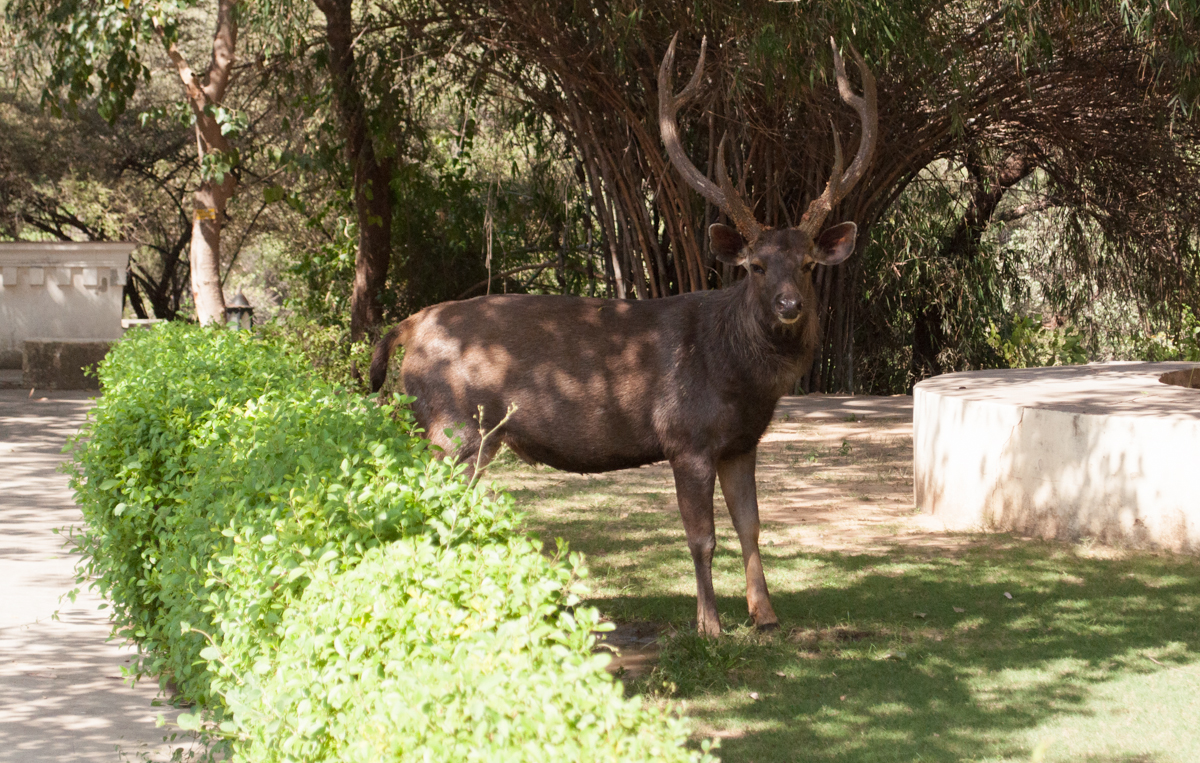
Near the edge of the lawn stood a Sambar deer with the most majestic set of horns. What a welcome!
We rushed to our room, dumped our belongings and went to meet our host.
Not wanting to frighten him away, we maintained a fair distance. Having clicked away to our heart’s content, we moved closer. The deer didn’t seem to mind. We walked further ahead until we were less than 2 metres away.
He humoured us for a while, patiently posing for portraits for a good fifteen minutes. He probably got bored and slowly began turning back. He scratched his horns against some bushes and then disappeared into the thickness.
That thickness was an opening into the Sariska Wildlife Reserve.
Being at the edge of the forest, we were told it was not advisable to go out alone at night. And for good reason. The next morning, our safari guide confirmed that pug marks were found just outside the hotel. One of just 13 tigers in the 800 square km forest had paid us visit while we were asleep.
Last week, I opened an old diary and flipped through its pages. As I read out aloud the vaguely familiar words, my mother stared at me. “What on earth went on in your little mind? How did you retain your sanity?” I never spoke much as a child. Even now, I am terrible at making conversations. Writing was the only way I emptied my head. The poetry was terrible, but it was never meant to be read by any one else. So my mother never knew I wrote.
Reading all those words written as a young adolescent so many years ago, I felt like I had entered a time machine. Oddly though, almost everything in those pages dealt with the frustration of subtle social sexism and blatant natural destruction.
I was particularly amused by one of the poems, which, in a sense, is the most revealing. To me at least, it reveals the struggle against established stereotypes, moulding racist and sexist mindsets. And between the old Grimm tales and the newly unveiled magic of J.K. Rowling, it reveals the struggle of an adolescent caught between two different worlds!
Written on 31st January 2004 at 5:30 pm*, enjoy!
Once there lived a grumpy ol’ witch
Her hair a mess,
And her clothes of bad stitch.
She hated spring times
When the birds and the bees would sing in rhymes.
One day she went out to collect poison ivy.
But near the bush lay a blue eyed baby.
May be some other witch would have eaten it with delight.
But this witch just screamed with fright.
For she had always lived in the forest
And never came across an infant.
She scrambled back to her cottage
Hidden ever so cleverly amongst the foliage.
She looked at a picture
Hanging on the wall.
Her picture — when she was so small.
She had lived her entire life all alone
In the cottage made of stone.
She had longed for company.
And it seemed as if God had gifted her a baby — for company
Although she was a witch — a grumpy old witch
She had a heart
As sweet as tart
And so she went back to the bush of poison ivy
And saw the blue-eyed baby.
The baby smiled so sweetly
And the witch picked it up carefully.
And ever since then
She was never the same again.
*My grandfather (mother’s father) once told me to always jot down the date and time I wrote anything. I don’t remember if I questioned him, but I followed it religiously, and am thankful for that wonderful piece of advice.
The photograph featured in this post is the original poem written in a diary which was gifted to me by my aunt.
Photo edited in BeFunky
PS. I can’t help reading the story it in the tone of a narrator of a children’s movie 😛
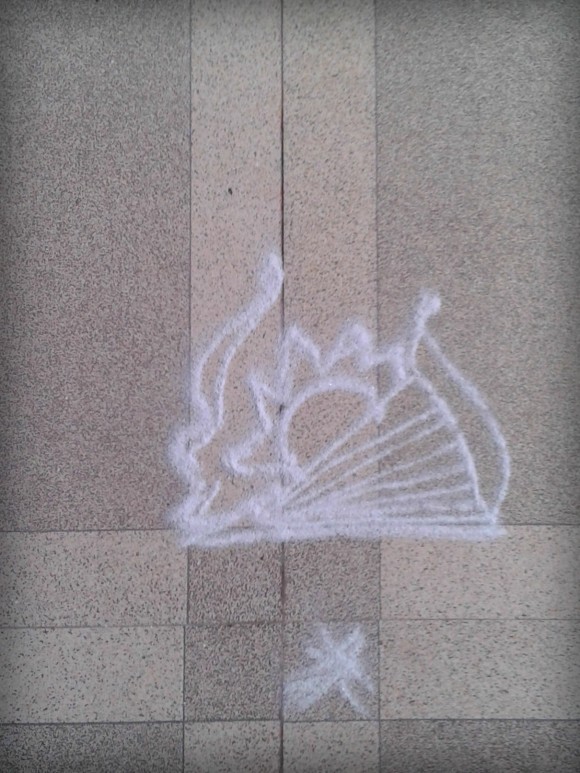
As I prepare to step outside, I keep my phone camera handy.
Click!
I turn around and tell my mother how I interpret her drawing. In the 30 seconds it takes to get down the staircase, we have had a full conversation of the different ways in which we perceive the world around us.
Amma‘s drawings on the floor are my inspiration – a world of art that flows effortlessly through the stone powder – a new one, every single day.
My grandmother often says that of the several artistic abilities our family possesses, the ability to throw, is the one that we need the most! At our home, when things break, our instinctive reaction is that of fixing them. So for this week’s photo challenge, broken, I had quite a few options at home! Except, of course, they had mostly been fixed, or have become something else. For instance, the beads from several broken bracelets and necklaces have now become a gypsy-style garland. And all the broken seashells from our collections have now become a decorative wall hanging.
* * *
We were in Old Delhi to meet relatives and decided to explore Qudsia Bagh in the evening. Clean jogging tracks surrounded by palm trees and Laburnums in full bloom, the park was a sight for sore eyes and sun-drained explorers like us. Large pots of water and benches with bird feed attracted birds by the dozen.
“What are you waiting for? Take out the camera!” It took me a little while to react. My brother nudged me as I stared at a kite sitting atop the earthen pot. Before I could take a clean shot, it flew above us and onto a tree branch. Another one swooped down and flew low, before joining its friend on the branch. They didn’t seem to mind the people around them — little children swinging on monkey bars and groups of evening walkers.
We continued walking, and it wasn’t long before we spotted a wall behind a few trees. An old building! After several months, we discovered something old in Delhi. An entrance gate of some sort, with a staircase on the side leading up to the roof; an old locked up lodge that seemed appropriate for some mystery novel; and a mosque under renovation — we hopped from one building to another, trying to cover as much ground as possible in the little time we had left in the day. But with daylight fading and our stomachs grumbling, we had to head back.
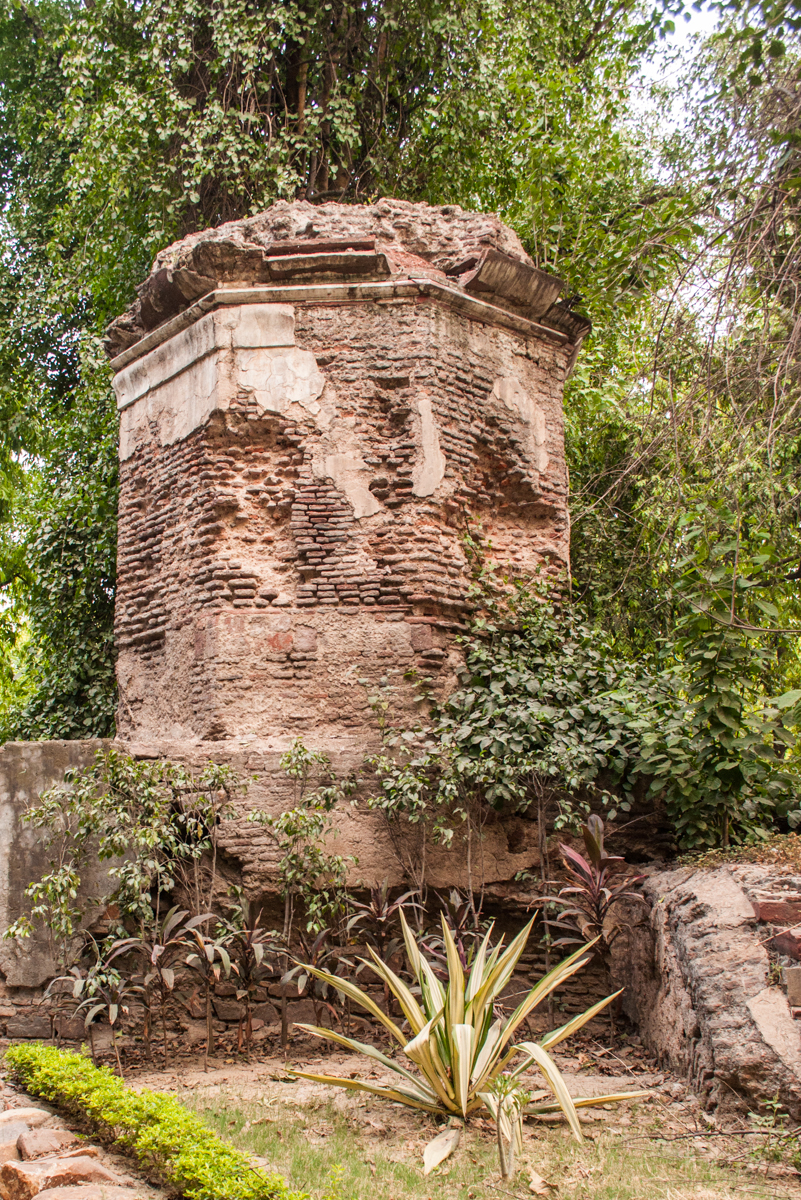
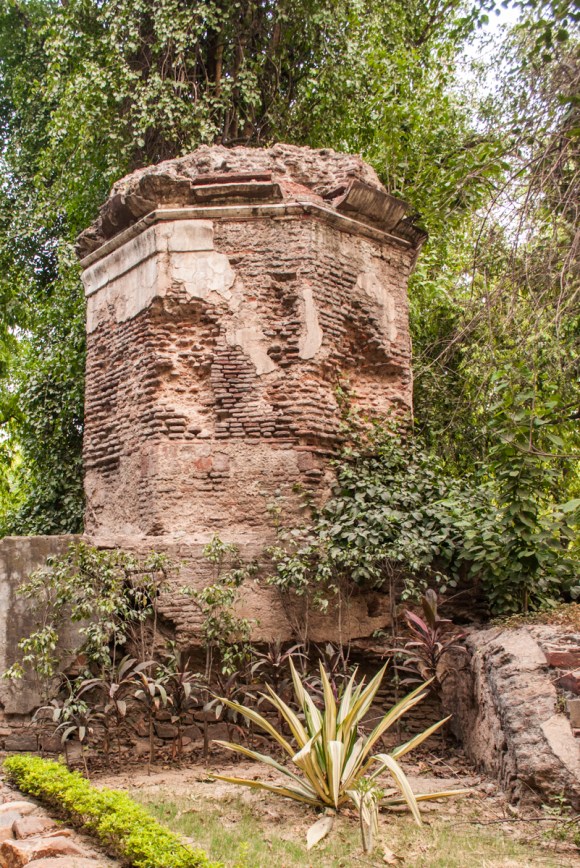
As we were returning, I noticed this minaret-like structure. It turned out to be at the exact same place we saw the kites earlier. In our excitement of seeing the kites, I’d missed this one entirely.
Minaret at Qudsia Bagh
I clicked a few more photographs of the park just as a peacock came out for its evening walk.
We may go and visit Qudsia Bagh again. We might climb the gate, inspect that old house more closely, and perhaps, find more treasures.
From Wikipedia: Qudsia Bagh is an 18th-century garden complex and palace located in Old Delhi, India. Constructed in 1748 for Qudsia Begum, this complex was largely destroyed during the Indian rebellion of 1857.
The sky was overcast and a gentle wind greeted us as we stepped out to buy a mango shake.
‘It won’t rain, ma’am. These clouds do not bear water,’ the office boy said.
We were going to return within 10 minutes. But I took my umbrella, to be safe.
As we soon found out, it wasn’t the umbrella we needed, but goggles.
On our way back, the wind grew stronger, kicking up dust all around us. I covered my glass of mango shake with a lid the juice vendor gave.
We couldn’t see much around us. Partly because the air was saturated, but mostly because we could barely keep our own eyes open.
With the dust coming straight at us, we tried to shield ourselves with our palms and narrowed our eyes as much as we could.
Only a short distance to go, we walked as fast as we could with our eyes closed and turned into the street in front of the office building. The dust storm ended a little while later, with a light drizzle cleaning the air.
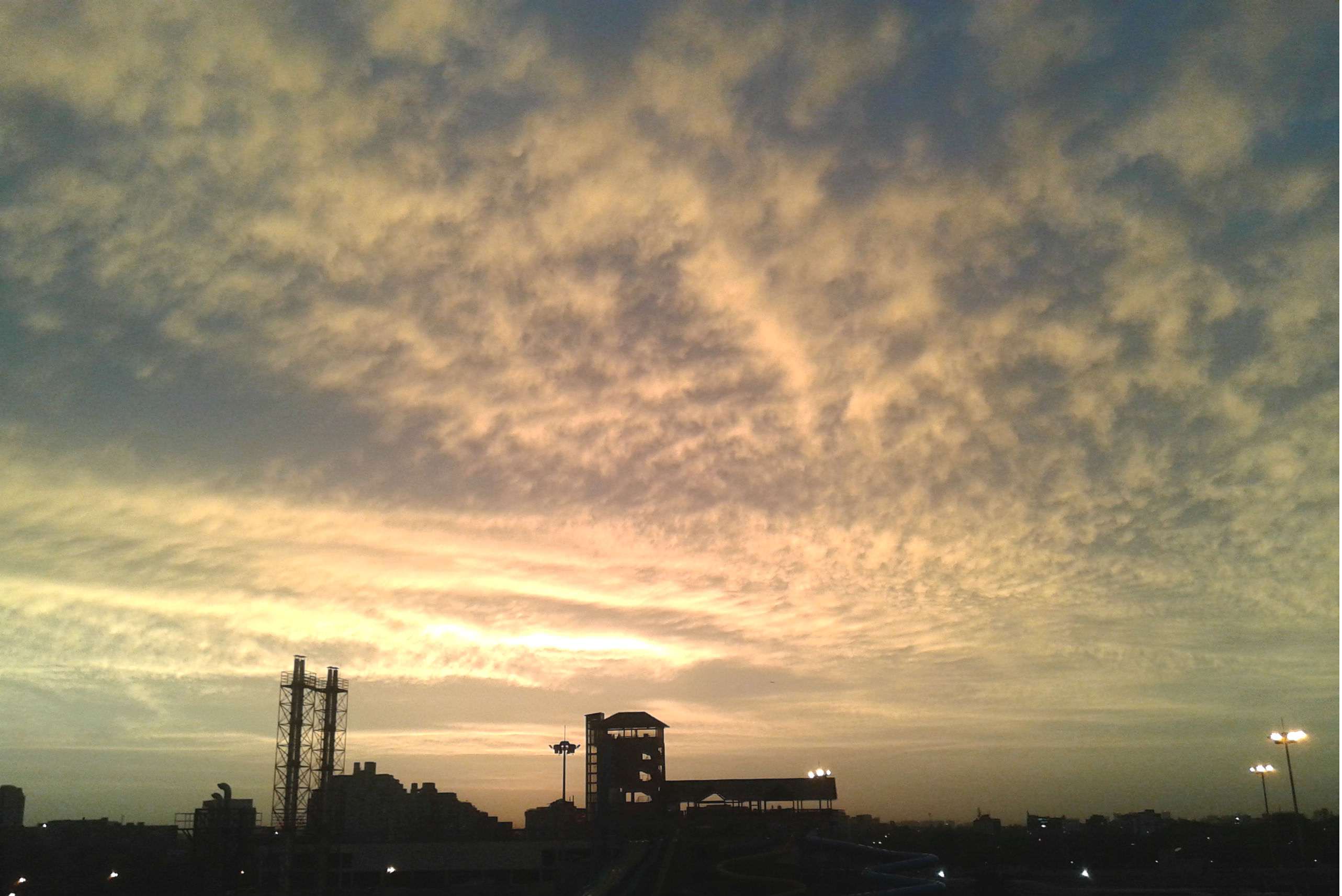
That evening, we headed home covered by a fine layer of dust from head to toe. The evening sky though, was a treat for our dust-laden sore eyes.
Enveloped
We later found out that the wind speed was around 80 kmph. Tree branches had fallen all over the city. A streetlight had fallen on a metro power line, crippling the public transport system.
We left Chennai on Christmas eve. After a short visit to Chidambaram and overnight at Vaitheeshwaran Koil, on Christmas morning we set off towards our destination — a small village named Komal.
I remember my grandmother mentioning Komal several times, but beyond the name, I knew nothing. To me, Komal sounded out of place. It was too north-Indian a name, to be a village in Tamil Nadu. In fact, for a long time, I thought it was in Myanmar!
We knew no-one in the village. The house was sold several years ago, and my father hadn’t been anywhere near Komal for forty years.
We had no address. Back then, my father told us, people never had addresses. Everyone knew everyone else in the village. Each house was identified by its occupants. How, then, were we to find that house? “I’ll know it when I see it. I’m told it hasn’t changed one bit,” said my father.
One of my father’s cousins gave us the name of a person who could help us locate the house, just in case.
“It is near a temple.”
We followed the highway leading towards Kumbakonam and asked for directions from locals. Our landmark was a temple. We found one. And another. And another. But my father could not recognise anything. “There should be a bridge, followed by a row of shops. I don’t understand. ”
My father asked a few local people about the person my uncle had mentioned. “No brahmins live on this street,” said one man with a glare. He pointed towards another street, and told us to ask there.
On the other street, we were told that only Iyengars lived there, no Iyers. They pointed towards the end of the street and told us that some of the residents had been living there for years. Perhaps they could help.
At the end of the street, we stopped outside an old looking house, that my father thought looked familiar. Unsure, he knocked on the door, and asked the residents if he could take a look. A few minutes later, he came out and told us that it was not the one.
We had been going around in circles for over an hour. The sun was beating down on us.
Dejected, and frustrated, we were planning to return to Chennai, when we saw an elderly gentleman. As a last-ditch effort, we asked him about our mysterious contact person. To our delight, he knew the person. “Oh! Yes, I know him! But he doesn’t live here. He lives in Komal. This is Therazendur.’*
Once we realised we were in the wrong village, it took us barely 10 minutes to reach the narrow entry to Komal.
“The bridge!” my father exclaimed. “I know this! We are here! Those are the shops. Take this turn. Right here. Wait! Stop!” No sooner had the car stopped, that my father sprang out of the car. He looked around the small roads, and then began walking at a fast pace.
There was an old man, walking alongside a cycle, on the side of the road. My father asked him about a house that had once belonged to an uncle of his. “Oh that person passed away many years ago,” replied the old man.
“Yes,” my father replied in an excited tone, glad that someone finally knew about the house. “That was my uncle. My father had bought it from him.”
The old man’s eyes widened. He took my grandfather’s name.**
“Yes! I am his youngest son! Can you take me to that house?”
My father’s steps quickened. His excitement was evident. The minute he laid his eyes on the house, my father pointed towards it and exclaimed, “It is just as we had left it!”
The old man introduced us to the occupants of the house. He must have become accustomed to members of my father’s family coming to see the old house, and graciously allowed us inside.
“This house was the only house in the entire village to have electricity, in those days!” My father was visibly proud. “There used to be a swing. A large swing. Is it still there?”
The owner smiled and said it was there. Everything was just the way it had been. The swing, the large stone grinder, even the light switches and fans!
“This house was purchased in 1940 when the war broke out, and my mother had to move with three of her children along with our grandparents and stay in a largish house. It was bought for Rs. 4000. It was in this house that I was born,” my aunt later told me.
Watching my father almost run around the house, I can only imagine how many memories must have come back to him. Every wall, every pillar, must have meant the world to him — a world very different, and in another time, from that of ours right now.
The owner told us that my uncle once casually asked if it were up for sale.
“So was it?”
“No! It’s been a very lucky house for me,” replied our smiling host.
The house
Kolam outside the Komal house
The porch
The courtyard
The corridor
A stone grinder can be seen on the right
* My grandfather was born in Therazendur. We had practically gone around the whole village a couple of times, and it is likely that we passed by one of the houses that may have once belonged to his family. But we will never know.
** That old man, we later found out, was a distant relative of my grandmother!
About the photographs: These photographs are of someone’s house. They graciously allowed us to enter their private space and I request these photographs not to be used elsewhere.
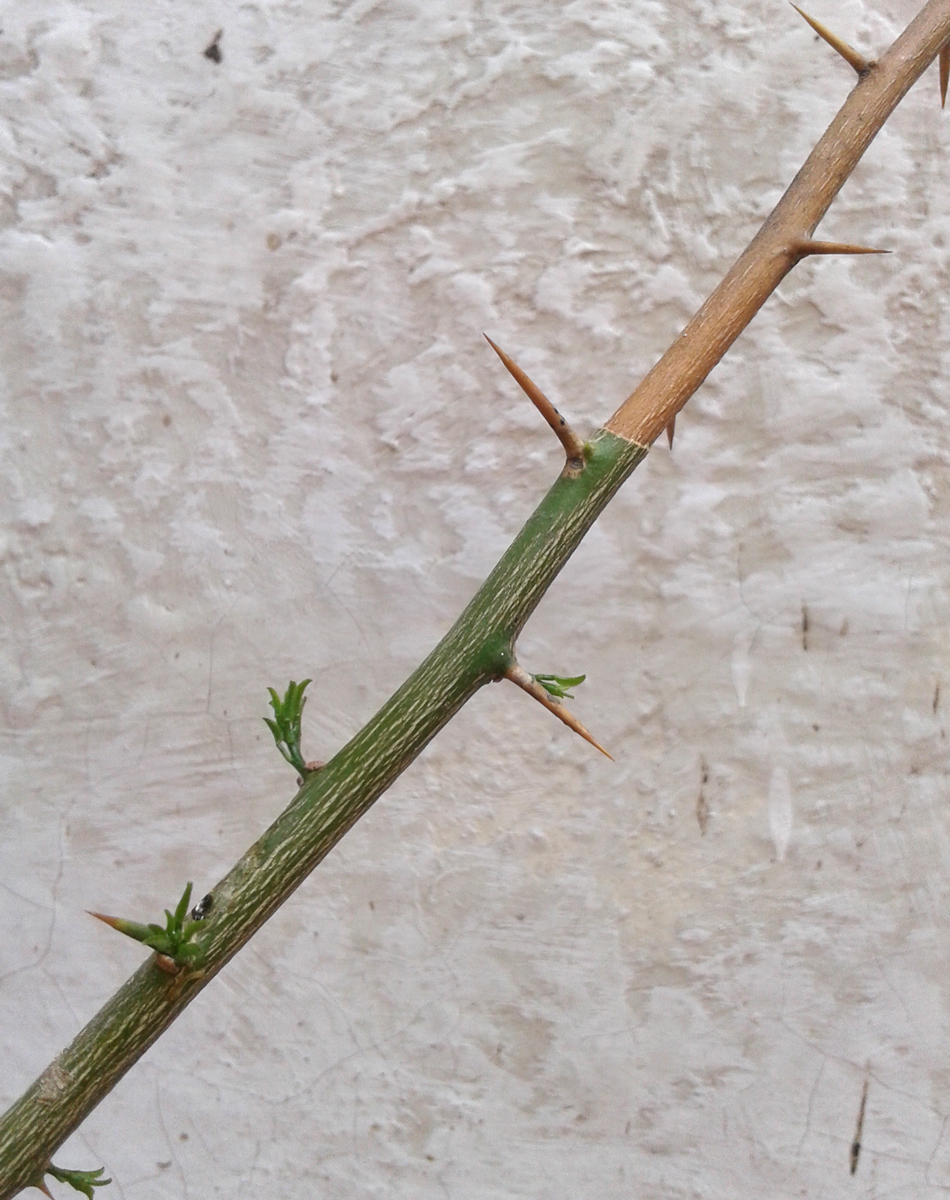
For several years, we’ve had a lemon tree in our balcony. I don’t quite remember when it was planted. My guess is that it’s been with us for over fifteen years.
One of the oldest plants in our balcony, it had spread its branches wide. It occupied a lot of space, but not our attention. Not for the right reasons anyway. And like a child seeking affection, it tried to make its presence evident. Every time we went near it to hang the clothes out to dry, it would scratch our hands with its thorns.
Apart from the scratches, the only time the lemon came into our conversations was when our neighbour’s lemon would bear fruit. In its entire lifetime, ours never bore fruits.
My dad brought some fertilizers on the recommendation of our green-thumbed neighbour. Those chemicals were apparently for making the tree bear fruit. But that didn’t work. And so we gave up.
Perhaps it would never flower. It wasn’t supposed to be in a flowerpot anyway. It belonged to the earth. And so we began contemplating getting rid of the tree.
But we couldn’t bring ourselves to uproot it.
We heard our own voices, and it sounded like disappointed parents thinking about throwing their child away. Thankfully, my father refused to throw it.
As if expressing joy at my father’s faith, the following year, the tree surprised us with two small flowers. But that was it. The flowers fell off without turning into fruits.
Last year, a towel got caught up in the thorns of the lemon. Nothing unusual, except this time, the cloth caused our lemon flowerpot to fall and break. We quickly transferred the plant to another flowerpot. But the damage had been done. A few days later, the leaves dried up. Two weeks later, the tree was gone.
For many months, the leafless frame of the tree stood in the flowerpot, showing no sign of coming back. My father refused to clear it out. It would return, he said.
But my mother and I had no such expectations. We’d pretty much begun ignoring the remains of the tree.
Until a few weeks back. Springing to life
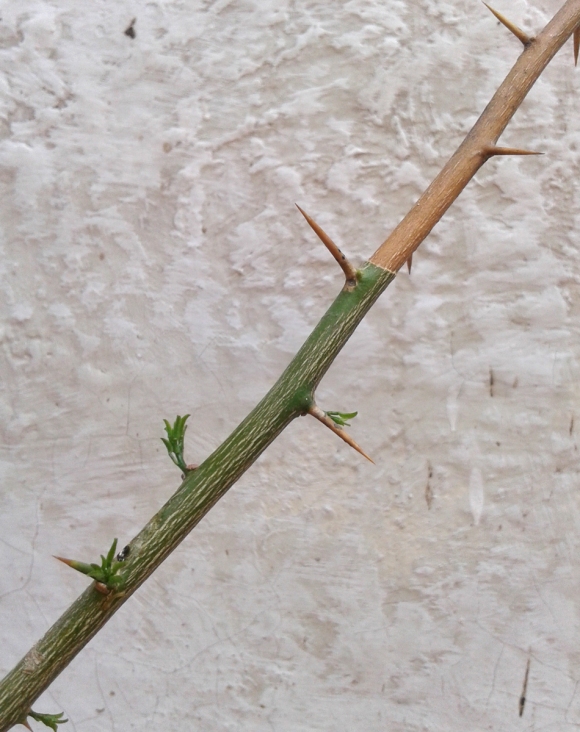
The brown branches were beginning to wear a green coat, with tiny leaves peeping out from underneath the wooden blanket—after a long long winter’s slumber, the lemon was springing to life.
Whether or not it flowers again, it doesn’t matter. We’re just happy to have our lemon back.
The image featured in this post is my entry for this week’s Photo Challenge : Rule of Thirds. Check out more imagery at the Daily Post.
PS: I recently completed four years on WordPress 😀
While I was in Chennai last year, I received a message from a friend of mine:
‘So are you coming tomorrow?’
‘I’m in Chennai right now’, I replied.
‘Ooh Margazhi. Have fun!’
I didn’t understand what she meant by that. I had visited Chennai during the winter months a few times in the past, but apart from the pleasant weather, I couldn’t think of any other reason to enjoy. I soon found out.
The Tamil month of Margazhi* is considered highly auspicious. For those who are religiously inclined, Margazhi is a month of lots of pujas — temples open much earlier and devotees visit in large numbers for the special pujas. But that was not what my friend, an ardent follower of performing arts, meant.
Margazhi is a cultural extravaganza, a haven for fans of the classical arts, with hundreds of Kutcheries — music and dance concerts — organised throughout the month. Margazhi is, in fact, now synonymous with the music festival.
Chennai takes its music seriously, and audiences don’t clap unless the performance is very good. I found that out on our last day in Chennai, when we spent close to six hours in one auditorium, listening to back-to-back musical performances (for free)!
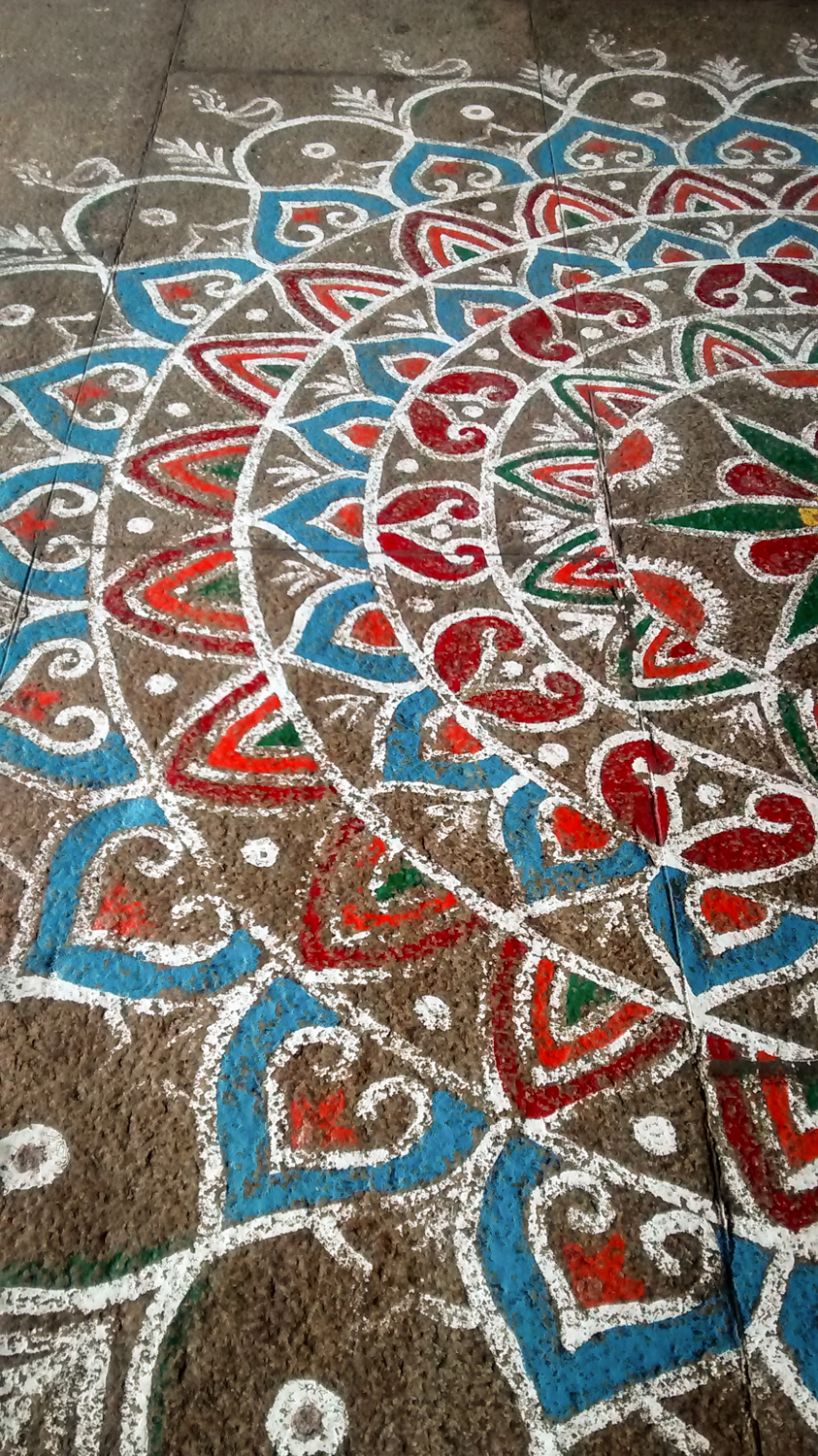
Even those not interested in the arts — and there are probably few of those in Chennai — cannot escape the Margazhi season, for the art overflows on the streets. Take a walk in the interior parts of residential areas. The Kolams that are drawn at door-steps of every house are much bigger and colourful. The kolams at the temples, though, were my favourite. These are from the Chidambaram temple:
Kolam at Chidambaram Temple
One of the twin kolams along the side of the entrance of Chidambaram Temple
And if you are not interested in art, well then there’s always the sea. The cool sea breeze, on the cool sand is the perfect place to relax.
Yes, Margazhi is the time to visit Tamil Nadu.
*Margazhi begins in mid-December and ends in mid-January. The Corresponding Sanskrit name is Mārgaṣīrṣa. After the end of this month, the harvest festival of Pongal (which falls on Makar Sankranti) is celebrated. The festival marks beginning of Uttarayan – the beginning of the sun’s ascent, signifying the beginning of the end of winter.
The images in this post are my entries for this week’s Photo Challenge. To see more symmetrical images, check out the Daily Post’s Weekly Photo Challenge.
A part of the large kolam t the entrance of Chidambaram Temple
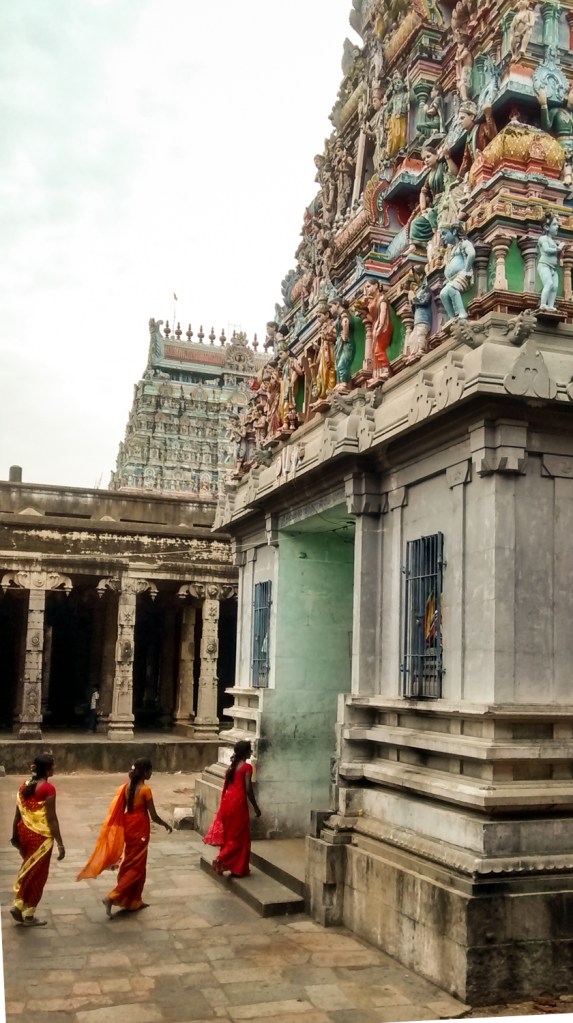
We were on our way to the Vaitheeswaran Temple, when we decided to take a short detour. The magnificent gopuram* of the ancient temple was visible from afar, and it was on an impulse, that we decided to visit the Chidambaram temple.
A part of the large kolam at the entrance of Chidambaram Temple
Opposite the entrance stood an intricately carved wooden structure, being prepared, perhaps, for the grand pooja which was to take place only two days after our visit. A long row of shops – selling flowers, pooja items, idols of Gods, colourful kolam powders and filter coffee – lined either side of the path leading up the entrance. We deposited our slippers with one of the shoe-caretakers (for lack of a better word), and stepped inside.
Beautiful kolams greeted us, followed by the grand gopuram which we had seen from afar. There were more gopurams inside the premises. Hundreds of devotees had come, mostly in crowded buses, from different parts of the country. We followed the crowd.
After a long walk from the entrance, we entered the main shrine. Devotees who were closer to the sanctum sanctorum, bent over the railings; those who were behind, stood on their toes; children sat on shoulders of their fathers, all of them waiting to get a glimpse of Nataraja, the lord of dance. As the curtain was pulled apart, temple bells and folded palms filled the shrine.
This ancient temple, spread over 40 acres, is one of the largest temples in the world (fourth largest, to be precise)**. Intricate sculptures of deities atop the gopurams, stone panels depicting dance postures, halls with high ceilings, all supported by massive pillars embellished with floral detailing. With several shrines and tanks, the temple priest told us, it would take one full day to properly visit the temple complex. An hour, was hardly going to be sufficient to soak in the magnificence and grandeur of the temple.
Every year Bharatanatyam dancers converge in this temple during the annual festival to worship, their offerings in the form of dance. I can only wonder what that atmosphere would be like. Hopefully I will visit the temple once again. And on that day, I will spend more than just an hour.
Devotees heading towards a shrine, Chidambaram Temple
* Gopuram is a monumental tower, usually ornate, at the entrance of any temple, especially in Southern India. This forms a prominent feature of Koils, Hindu temples of the Dravidian style. They are topped by the kalasam, a bulbous stone finial. (Source: Wikipedia)
** The three largest temples are, in order, Angkor Wat, Cambodia; The Srirangam Temple, Trichy, Tamil Nadu: Akshardham, Delhi, India (Source)














 Musings of an eccentric mind