As I was clearing up some old shelves, I discovered some notebooks with hand-written stories and amusing self-pep talks. Among those abandoned drafts was this unfinished parody of Billy Joel’s “The Piano Man.” Enjoy!
It’s nine o’clock on a Saturday, The regular crowd shuffles in. There’s a young man sitting next to me Swiping up, his face making a grin.
He says, “Alexa, can you play me a melody?” I’m not really sure how it goes. But it sounded sweet and I knew it complete, When I wore a baby’s clothes.
Sing us a ding, you’re the smart device. Sing us a ring tonight. Well, we’re all in the mood for a notification, And you’ve got us feelin’ alright.
I thought I’d complete it, adapting the rest of the song words, but as I read the lyrics of the rest of the song, it seemed eerily appropriate. It seems like Billy Joel’s bar is similar to any social media app. What do you think?
Here’s the rest of the song, with only the slightest modifications:
Now John on the app is a friend of mine He gets me my likes for free And he’s quick with a joke or to share your post But there’s some place that he’d rather be He says, “Bill, I believe this is killing me” As the smile ran away from his face “Well, I’m sure that I could be a movie star If I could get out of this place”
Now Paul is a real estate novelist Who never had time for a life And he’s talkin’ with Davy, who’s still in the story And probably will be for life And the comedian is practicing politics As the marketers slowly get drowned Yes, they’re sharing a reel they call loneliness But it’s better than scrollin’ alone
It’s a pretty good crowd for a Saturday And the Faang* gives me a smile ‘Cause he knows that it’s me they’ve been comin’ to see To forget about life for a while And the app, it sounds like a carnival And the microphone smells like a beer And they sit on the app and put bread in my cap And say, “Man, what are you doin’ here?”
* FAANG: Facebook, Amazon, Apple, Netflix, and Google
As I get older, I’m finding myself becoming more cynical. I’m sceptical about everything and am quick to assume hidden selfish motivation behind everything people do and say. I don’t want to be like that.
Just a little while ago, someone upstairs put up fairy lights and hung them so they drop into our balcony. My first reaction when the lights turned on, was, “Uh! There goes my sleep.”
There’s probably a very good reason someone put up lights half a year away from Diwali. A joyous occasion, no doubt. Shouldn’t a neighbour be happy for them? I checked my bitterness. Don’t be that person. After all, wouldn’t I want others to be happy for me, if there was something happy going on in my life?
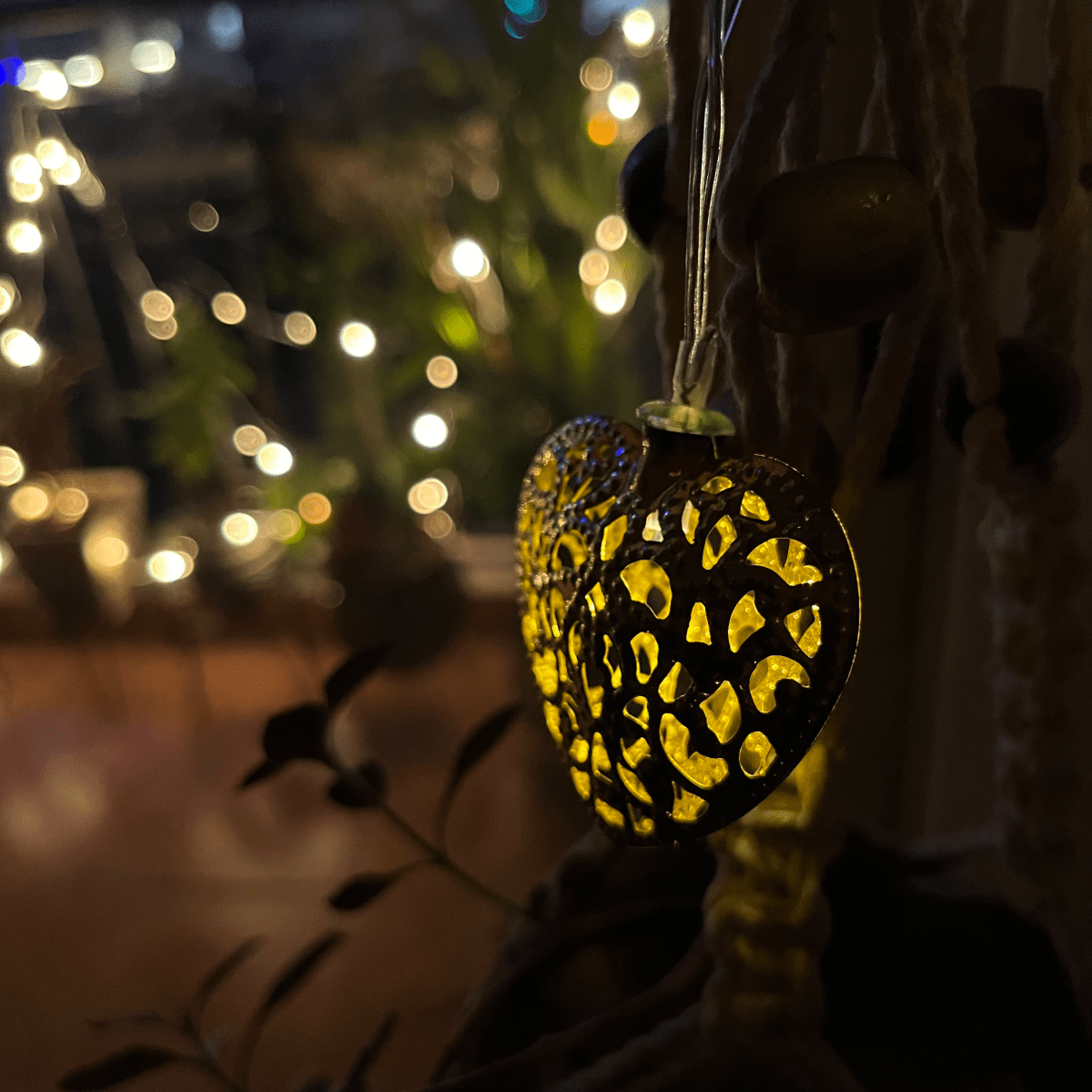
I stepped into our balcony and looked up. The long strings of light, began a floor above. They were spaced evenly and spanned their balcony from top to bottom. Their home glowed beautifully.
The bunched up balls at the end of each string peeked into our balcony more casually and at varying lengths. The scrunched up, messy balls of lights were as pretty, if not, prettier, than the straight lines above. Our balcony was beautiful, too.
Throwback to our illuminated balcony on Diwali in 2022.
We’ve always hacked our way into baking a cake. We didn’t have an oven and I was trying to avoid using refined flour. So, our experiments in cake-baking have been mixed, often ad-libbing and freestyling the ingredients. I learned the hard way that not all recipes were that flexible. So, this time, I decided to follow a recipe that I’ve wanted to try for a long time—the traditional Christmas Cake.
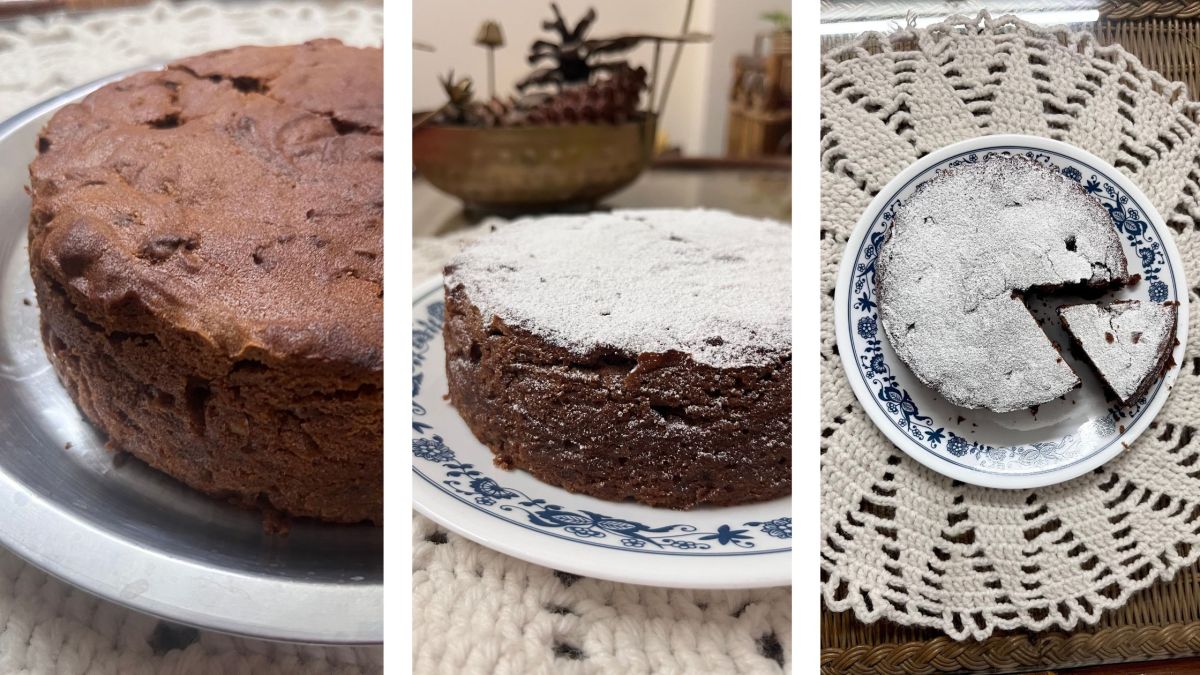
We had a new air fryer and I decided to cave in and use refined flour and white sugar. It’s still eggless, though!
I’ve tried this recipe twice now, and the second time, I substituted half of the refined flour with whole wheat flour. This second cake was a bit more crumbly and we could taste the flour, so, the next time, we’ll try substituting less than half of the refined flour.
For my convenience, I wrote down the ingredient list separately, divided into different parts that I needed to mix separately, so that I wasn’t staring at one long list!
Part 1: Make the Kishmish Merry
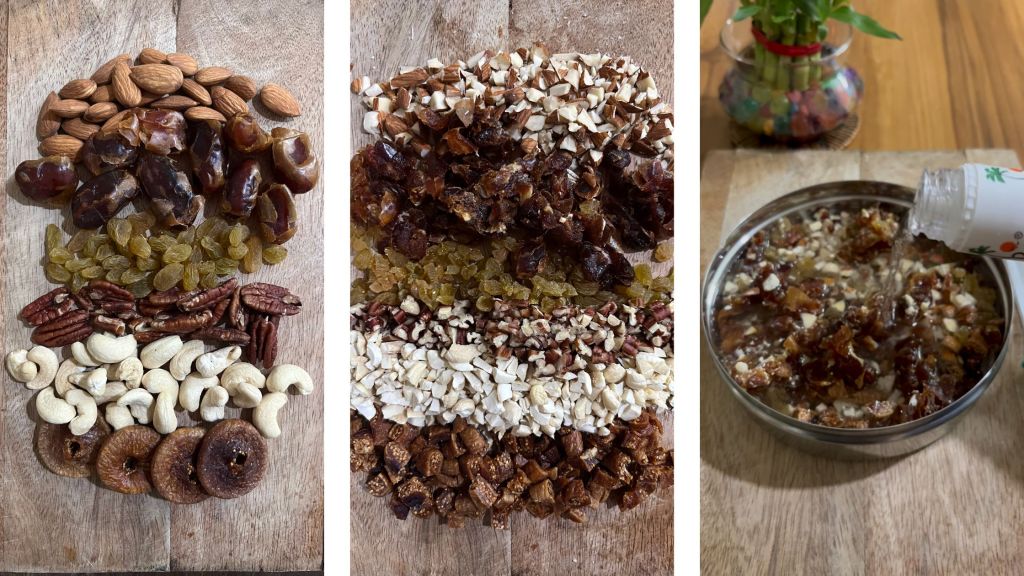
Cashews, Walnuts, Raisins, Almonds, Dates, Figs… Chop whatever dry fruits you have available and soak them in rum (or ornge juice) for a few days.
Store in an airtight container in the fridge if you’re soaking these for more than 2 days.
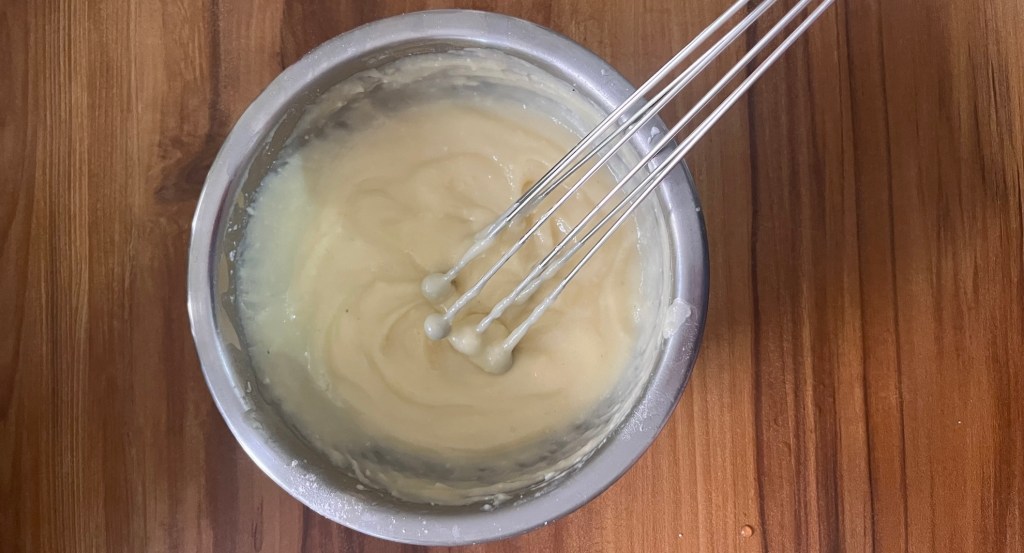
Part 2: Whisk the Creamy Ingredients
1 cup Powdered Sugar
1/2 cup Butter
1/3 cup Curd
Time-Saving Tip: If the butter is hard, use a hot water “bath” to soften it. You can do this right at the beginning and while you wait for the butter to melt, you can gather the rest of the ingredients.
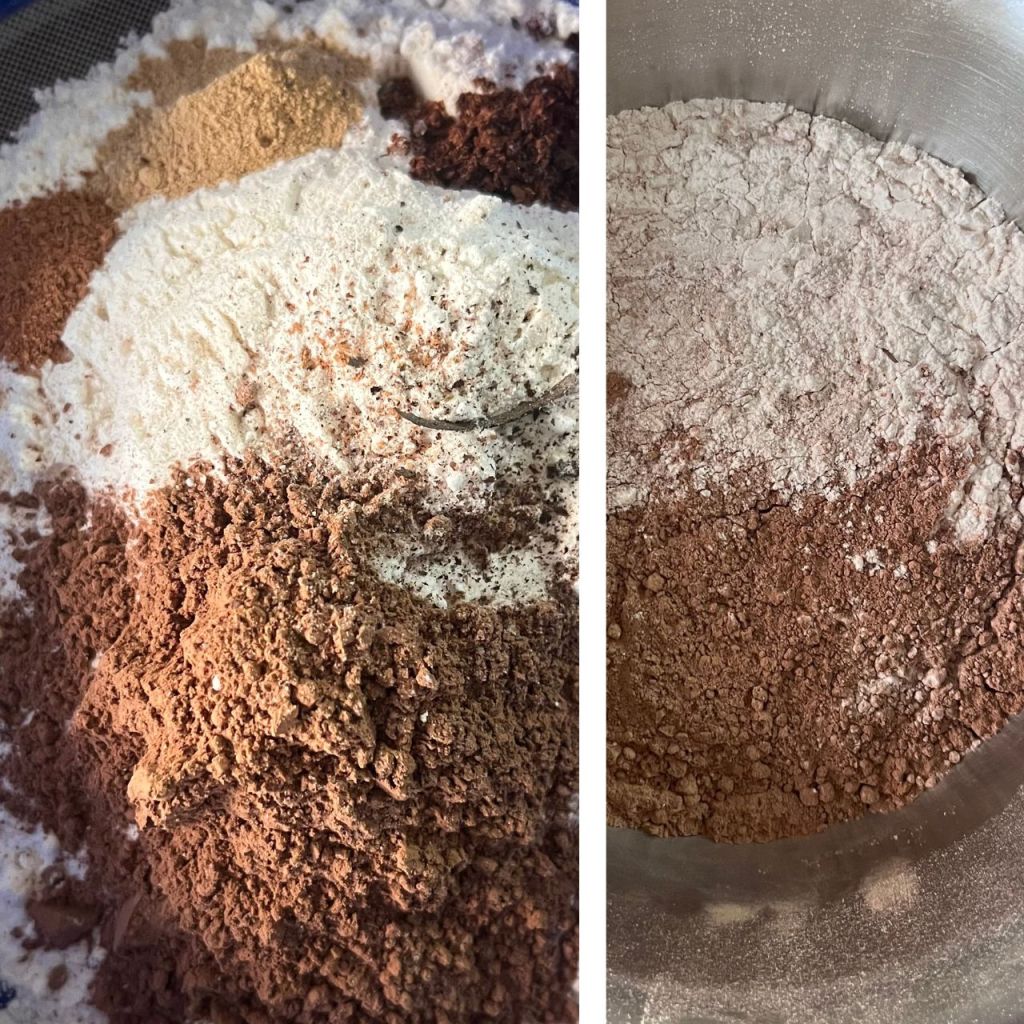
Part 3: Sift the Spicy Ingredients
1 cup Flour (Maida)*
3/4 tsp Baking Powder
1/4 tsp Baking Soda
1/4 tsp Salt
1 1/2 tbsp Cocoa Powder
1/4 tsp Ginger Powder (Saunth)
1/4 tsp Clove Powder
1/4 tsp Cinnamon Powder
1/8 tsp Nutmeg Powder
* For a slightly healthier version, you could experiment with about 20-30% of wholewheat flour instead of just refined flour. But at your own risk!
Part 4: Prepare the Curdled Milk
Adding vinegar to milk will split the milk. I’m still not sure if we should let it sit for a long time, so I do this at the end, lest I have any lumps of paneer in the cake!
1/3 cup Milk
1 tsp Vanilla Essence
1 tsp Vinegar
Part 5: Let’s Get Everything Together!
Now that the ingredients are ready, we can prepare the cake tin and preheat the baking apparatus of choice (a home-style pressure cooker, a covered saucepan, an air fryer or an oven).
Grease the pan and line it with butter paper.
Note to self: Do not keep it inside the oven!
Mix the sifted dry ingredients (part 3) with the creamy stuff (part 2)
Add in the curdled milk (part 4) gradually.
Add the merry fruits (part 1)
Pour into the prepared cake tin. Tap a few times, and then place it inside the baking apparatus.
Wait.
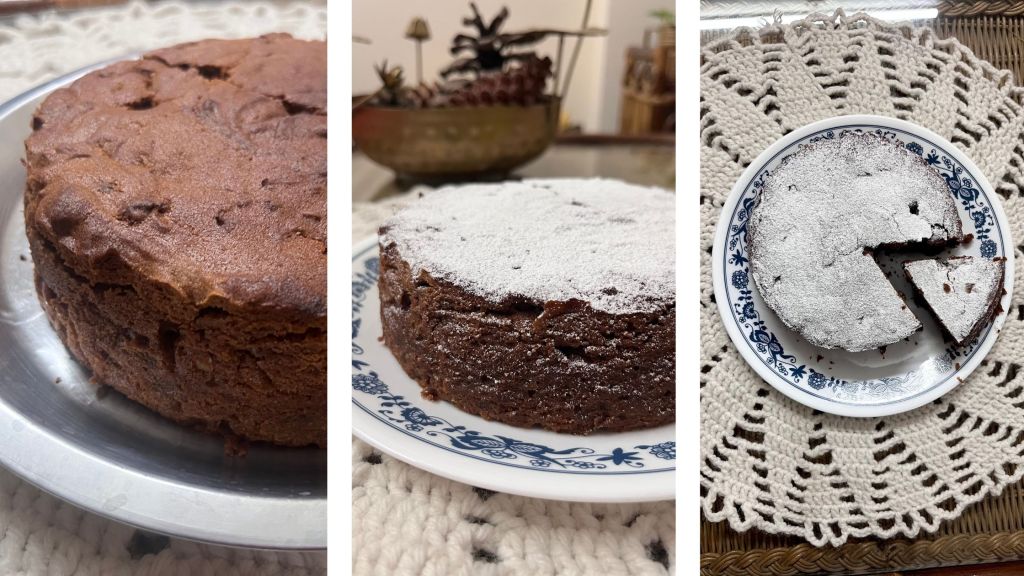
The time to cook varies depending on the temperature. I used an air fryer at 150 degrees C for 40 minutes.
If you’re using a hacked makeshift oven, then you may not be able to control the temperature, so keep a close eye so that the cake doesn’t get burnt or stay undercooked—I’m guilty of both!
Use a knife to check for doneness.
I had some extra powdered sugar left over, so I sieved it over the cake to give it a snowy look. But it will taste delicious even without that.
Enjoy!
How To Get the Measurements Right
The one thing I’ve learned through my little baking experience is that measurements matter! So, I followed the measurements of everything to the “T”.
The ingredients can broadly be categorised into two heads:
The flavours: We can play with the flavours of the cake and freestyle them to taste. These include dry fruits, cocoa, spices and vanilla essence.
The cake base: The wrong proportion of these ingredients can ruin the cake, and so these are absolutely non-negotiable. The flour, milk, curd, sugar and butter along with what I call the “baking potion”—the things that make the cake fluffy! The baking potion includes baking powder, baking soda, salt and vinegar.
Since I didn’t have any proper measuring equipment, I used a tiny medicine measuring cup to first figure out the capacity of the different bowls and glasses we had and used those utensils that best matched the following capacities:
1 cup = 240 ml
1/2 cup = 120 ml
1/3 cup = 80 ml
The Inspiration
This recipe isn’t mine. It is adapted from recipes I found online, and modified to suit what we had available. Here is the original recipe from where I borrowed the measurements and ingredient list:
Sejal stared at her phone. She’d half-typed out the name… S . H . I … and there was his face on the top left corner of the search results.
His broad face, looking in front. A small smile that sometimes made him look shy and reserved. Those who knew him well, however, recognised the spark in his eyes. Shy he was. And that was the best disguise for his mischievous pranks.
Sejal had been angry. She wanted to lash out at Shivansh. But seeing his face, she sighed. No matter how hard she tried, she couldn’t bring herself to confront him. Damn, he always got away with everything.
She scrolled through the chat history. A series of greetings. Happy Diwali. Happy New Year. Happy Holi. Year after year. With nothing in between. Here again was Diwali. She’d been sending out a picture to all her contacts. Just as everyone had mindlessly forwarded the canned greetings.
For Shivansh, perhaps she could type something out, instead of sending one of the hundreds of images she’d received from others. Perhaps a proper text message would elicit a typed response on the other end.
“Wishing you and your family a prosperous Deepavali.”
As she typed, her eyes glanced at this name at the top. He was online! Perfect. She added a few emojis and sent the message.
Sure enough, he immediately reacted to the message with a prayer emoji.
Sejal wondered if she should send something to begin a conversation. A simple, “Long time! How’ve you been?” There was a time when he would call her up and share what he was up to. She’d never bothered to check in on him. But he always did. And she loved that. She knew he cared for her. She did too. He must have known that. Otherwise he wouldn’t have called. Then why would he suddenly become this distant?
She felt her forehead wrinkle. “Well, he was the one who had neglected their friendship.” Sejal thought. “He should be the one to initiate the conversation.” She lifted her thumb from the phone and stared at that hollow greeting and that little symbol showing that Shivansh had acknowledged the message.
He was still online. Surely busy seeing other messages. It was a busy day. And then, as if to answer her wishes, three dots started bobbing up and down. Shivansh was typing. Her hopes went up. He wasn’t just going to forward a greeting to her after all.
The dots moved up and down for several minutes. Perhaps he finally wanted to reconnect and make up for lost time. Maybe he was struggling to start the conversation and was trying different combinations of messages.
Sejal waited patiently. At length, the dots finally stopped dancing. Shivansh had sent the message.
“Thank you, wishing you and your family the same.”
Sejal paused. She then left a prayer emoji on the message and set her phone down.
In mid-2020, while the world was going through an upheaval, I got the opportunity of a lifetime: to turn my passion for writing into a profession. It was a dream come true: combining my love for writing and teaching with my experience in UX design. At the Interaction Design Foundation, I met and worked with some of the most brilliant minds from across the globe. I had opportunities to travel and grow professionally, eventually leading the editorial team.
In three and a half years I grew and changed as an individual. It was the most fulfilling role I’ve had in my life and for that, I will forever be grateful. But it came with a cost.
Some people say that we must not mix passion with profession. We might lose both! Others say that we must be in love with our work so that we don’t actually “work”. I realized that there was another angle to this debate. In my case, I was so much in love with my job, that I lost myself in it. I spent such a long time doing what I love for someone else, that I was too exhausted to work on the stories I wanted to write for myself. I adopted the brand’s voice and lost my own.
Before I knew it, my body started to hurt.
Fortunately, or rather, unfortunately, I could see where I was heading. It had been close to eight years, but memories started haunting me. It was a different time, a different company, but the pain was eerily similar.
I used to struggle with lower back pain. Most days it would be okay. And then every now and then it would flare up. And when it did, it made my life a living nightmare. I couldn’t sit, stand, walk, or even lie down without jolting.
I went to several doctors and popped all kinds of pills. Everything seemed to work for a while. And then, everything stopped working. I continued soldiering through the pain.
I was practically second in command in the company. I couldn’t take too many days off.
My family pleaded with me to leave my job. Angry and in tears, I fought with them. I stood my ground. To them, I was stubborn. In reality, I was scared.
Our society places a premium on being employed. Our worth and the respect we command are based on what we do in life. The last thing I wanted to be was a housewife. Housewife: that word is so demeaning that we now use different synonyms to make it sound like we appreciate that role: a homemaker, family manager, home engineer. But call it what you will, it is subtly associated with someone who doesn’t earn money or have status in public life. Since my childhood, I was conditioned to believe that choosing not to work was synonymous with being useless. The ultimate humiliation.
I needed to work, not for the money, but for my self-esteem.
Meanwhile, my attacks were getting more frequent. There were days when I couldn’t get out of bed. I began missing important meetings. It got to a point where I felt I might be fired. So, I finally took the most difficult decision of my life. I told myself to quit.
Quitting a job without another in hand and with no financial safety net isn’t easy. I had no choice. I needed to fix myself.
Understanding my predicament, my employer suggested that I take a break, and use this opportunity to start a freelance career. “Take a month off. We can work out a part-time contract. We’ll be your first clients.”
Perhaps it was that reassurance that I’d still have something to come back to, that helped me relax a little. I tied as many loose ends as I could, handed over my work and signed the offboarding documents. I still remember that metro ride home. My body writhed in agony every time the train stopped. My colleagues pitied my plight.
The first few days of my unemployment, however, had a profound impact. To my surprise, I felt like a big weight was off my shoulders. More importantly, I realized that being employed wasn’t the sole purpose of life. Contrary to what I expected, I even enjoyed being at home. “You look happy,” my uncle remarked when he saw me shortly after my newfound freedom.
I also learned that patriarchy—that thing that I always complained about—was helping me. When I met an ex-colleague a month later, he remarked, “You can afford to quit because you’re a woman. No one would say anything to you. I wish I could also quit my job.”
I am not going to defend patriarchy. But I can better explain feminism. It is not about men being subservient to women as revenge for centuries of oppression. It’s about men and women both being allowed to live their lives the way they’d like to, without having to live up to certain expectations from society or being judged for their life choices and circumstances.
Workplace dynamics aren’t built for everyone. And I realized that the work environment I was in, wasn’t built for me. I didn’t form any meaningful friendships at work. The office was in a basement, devoid of sunlight. While I learned a lot and did meaningful work, at the end of the day, it didn’t pay as well as a corporate job would’ve paid me. I wished I had quit sooner.
If I hadn’t quit, I wouldn’t have become a freelancer. I began working remotely much before the world discovered it. Money wasn’t regular, but that didn’t matter. I was a master of my time and priorities. I regained my health and felt physically and mentally fit.
I had the capacity to work on side projects that mattered to me—like online workshops in storytelling and composting! I vowed to not work full-time again.
That vow, however, didn’t last long. Three years later, I randomly applied for the role of writer at the Interaction Design Foundation and turned out to be a perfect fit.
Fast forward three more years. My backaches were coming back, and this time, they were bringing more mysterious friends with them. My body was showing signs of unrest. I had to act fast before it turned out to be an all-out revolution like my last full-time gig.
I’d quit once before. It should’ve been easy to take that plunge again. But like the last time, I fought with my family and lingered on. This time, for very different reasons. I loved my job, the people, and well, the paycheck. This was the organization that made me realize my worth. Money sometimes acts like a golden noose. The string is always in our hand, and money makes us pull it tighter around our neck.
I debated hard with myself for several months. Eventually, I decided to pull the plug again. And like last time, it was only after I left that I realised why it was important for me to have done that. I had sacrificed my voice for someone else, and it would take several months for me to regain the courage to write again.
Sometimes it seems the universe sends us messages. Perhaps more likely, we’re looking for help and our subconscious mind shows us the way.
I’ve come to believe that we often don’t communicate well enough with ourselves. We usually have the answers to many of our problems. We just don’t hear it well. So when we see something that seems to be the answer to our problems, it’s indeed our mind pointing us in the right direction—we are actively seeking the answer in our environment.
There are times when I can’t decide between two alternatives, and I try to let a coin toss make the decision for me. If we are truly indifferent to the choices, a coin toss wouldn’t matter. But if we favour one outcome over the other, the coin toss will reveal the one we actually want. I’ve often ended up ignoring the coin toss because I immediately felt disappointed with the way the coin landed!
The TV series Big Bang Theory turns this idea into a gag in an episode where Sheldon decides to leave all trivial life decisions to a roll of the dice. During lunch, his dice tells him to eat corn succotash. When his friend asks him what he’s thinking about, he promptly answers hamburger!
Over the past few months, I’ve stumbled upon a few unsolicited pieces of advice—things that I didn’t know I needed to hear. Here are two that stuck with me:
The most powerful word you can say to yourself is “yet.”
I saw this advice in The Medium’s Newsletter’s issue #172.
At the beginning of the year, I set myself a few unwritten goals—unwritten because I’m superstitious. I didn’t achieve them, but that doesn’t mean I didn’t try or make any progress on them. Adding the word “yet” to those goals reminds me that just because the year is coming to an end doesn’t mean I’m not closer to them.
Replace “What if” questions with “Even if” Statements
This advice on how to talk to ourselves was in issue #184.
It helps to change the narrative. As much as online content pushes us to think the world is ending or that we’re not moving along as fast as every other person is, our lives aren’t the same as others. We cannot be held ransom to timelines and expectations, even if we set them ourselves. Most of us are bad estimators. Life is unpredictable. And humans are highly adaptable. There’s always another way out.
There’s a common theme behind these bits of unsolicited wisdom. I’ve been very hard on myself. Perhaps you have too? Being constantly surrounded by data, news and updates about what others are doing can make one feel inadequate. These messages seem to be telling me to forgive myself.
I may not have that tangible thing to share, yet. I may not be able to share them by 31st December, and that’s okay.
What if I don’t complete that project I started? Even if I don’t complete that project, I can take a few more days to finish it. Or if it isn’t working, I can hand it over to someone more capable of completing it.
What pieces of unsolicited useful advice have you stumbled upon?
I have a bunch of half-written blog posts, waiting for that little push over to the edge of the “Publish” button. My over-ambitious brain wants everything to be perfect. All the details must be just right; the images edited professionally. With every passing day, my heart loses interest in picking up those threads.
Every day, I tell myself, “Today is the day!” When life gets in the way, I sigh, “Better luck tomorrow.”
Today, I just thought I’d say how much I love the Medium Daily Newsletter. In an age where all email is selling something, I have finally found something worth reading.
I’ve been here long enough to recall that famous WordPress-featured home page, where I’d randomly discover amazing life stories. I met new people online through their blogs, some of them in person too!
Today, everyone is just peddling the same formula to gain eyeballs, and ultimately make a quick buck. What used to be a community, is now a platform. We had playful prompts to make us write silly things without a worry in the world. What was a creative outlet, a hobby, is now a profession to be milked with every last SEO-ed word.
Looking at everything around me, I wonder, is writing still worth it? Who even reads stuff anymore. And then, I see this breath of fresh air in my inbox, that I want to read. Something more than “10 ways to do something right.” A real human being sharing an idea worth sharing with a friend. It’s one of the few things that makes me want to read and write again. To stop overthinking. Even if it’s that one thought that sounds like a status note on a social media site.
Is this diary entry worth reading? Probably not. Will people search for it? My AI assistant sidebar says no. But did I need it for myself? Absolutely.
It was a huge garage—at least to me. The ceilings were high. Despite the old pale blue Premier Padmini and a bicycle, there was enough space for aluminium trunks—the quintessential Rajai boxes that most families owned back then—some painted black, and all of them with a serial number. My mother had cut out the dates from a calendar and pasted them on the boxes, so we knew how many we had. It made life easier for a family that had to move every few years. Years later, it was this small labeling tip that helped us as we moved from our first apartment.
As a child, I was obsessed with seashells. As was my mother and her mother. Hoarding runs in the family. And it was for these seashells that I was rummaging through the garage. I’d caught wind of a treasure of shells, and I was determined to find it. One of these boxes had to have them.
At last, I found them. Out came one large clam—the size of my palm. And another, this one with layers. And they grew bigger, two of them so large that I could carry only one with both my hands. What on earth were these huge clams doing inside a dusty, cob-web-covered dark corner? And what’s that? Coral! My heart sank when I saw that some of them had cement stuck in them. Maybe it’ll come off with some cleaning, I reassured myself.
Looking back, I can only imagine what it must have been like to move a fully furnished household across the country with 2 small children in tow. The two of us struggled when we moved with our spartan belongings within the city. But at the time, I was livid. How could these precious items be so neglected?
Back inside the house with my haul, I set about cleaning them as best as I could. The dust eventually came off to reveal the creamy skeleton. The cement stayed. Maybe time will wear down the cement. After all, they do eventually peel off from our walls.
As my father saw me lugging around my new playthings, he quietly slipped in a little fact. You know, in the deep sea, there are seashells the size of bathtubs. I saw a faint twinkle in his eyes. Seashell hoarding wasn’t just a part of the ladies in the house.
Those clam shells and corals still sit in my parents’ house, displayed on a shelf. And with them, a dream that one day, I’d see those bathtub-sized shells.
My cab driver replied, when I asked him if we were on the right route. The criss-crossed, perfectly planned, roads of Lutyens Delhi all looked the same to me. And their names — the names of kings and their ministers — that we struggled to memorise in our social studies class in school. It was a struggle then. And it continues to be a struggle, all these years later, to distinguish between the roads named after them.
But my cab driver had circled these roads for several years. And he knew them well. He also noticed something.
“You see these trees here?”
Lutyens Delhi has beautiful tree-lined roads.
“Yes, that’s what I love about this part of town,” I said.
“They’re tamarind trees. And never once, have I seen flowers or fruits on them,” said the cabbie.
And his explanation was simple. It’s because the trees are surrounded by politicians.
I try not to talk about politics with cab drivers. But that comment on the tamarind trees helped me open up about my opinions, and through the rest of the journey, we continued our conversation around modern politics, agreeing with each other’s assessment of how low Indian politics was.
“You must show them music.”
We were visiting my aunt in Bengaluru. She has a lovely garden, filled with bonsais and orchids. And her betel-leaf plant, has no rival anywhere on this planet — in its appearance, and taste!
She was sharing the secrets to her green thumb. They are very sensitive, she said. And they love music. Don’t play them the same music every time. Mix it up, rock music, Bollywood, bhajans… Keep them happy, she said.
I love pine cones.
Ever since I first saw them as a little kid, when my father took us for a vacation, I have been fascinated by them. We’d picked up a couple that we found on the ground during that vacation, and I hadn’t had the joy of picking up another.
So when I saw a pine tree in the college, I was excited. But during the three years I spent there, it never bloomed.
I continued to visit the college, as part of the Alumni Association, for the next several years. Every time I visited the college, I’d look up, only to find needles. No cones.
And then, one day, I saw them. Several of them.
“This pine tree has cones in it!”
I jumped for joy, as a teacher and a couple of students looked at me. I can’t say for sure, but it’s likely, that they were amused by my childlike behaviour and my explanation. I told them:
This tree is happy! This tree is responding to the energy around it. Truth be told, when we were in college, this place was dead. No energy, and a lot of negativity. But now, it is so lively. There is so much energy around here. And now this tree has cones in it!
“This tree was planted when I joined this college,” replied the amused teacher. “It’s twenty-five years old. Back then, I didn’t think it would even survive this weather,” he added.
“Well, if we didn’t kill it, maybe our lot wasn’t that bad, then?”
Back in college, I went with a friend of mine, to a debate being held in another campus.
We located the room in which the debate was to be conducted, and then waited, as the participants trickled in. The room was large, the ceilings high. Perhaps, it could have comfortably seated a hundred people. Multiple doors and large windows on either side ensured there was good ventilation and ample natural light. On one side of the room, was an open passage, that overlooked a beautiful, large lawn. The other side, also had an open passage, that overlooked an atrium.
The room began filling up, one by one. There were, perhaps, thirty students, in all, when I began to feel a little uneasy.
It was early winter. There was that wonderful Delhi-winter sunshine around us. The room was large, and people, fewer than half capacity. And yet, I felt suffocated. I couldn’t understand why.
“Oh, we’re not participating. We’re just here to see,” I don’t recall which one of us replied to the participant’s question.
“Oh, no wonder you look so relaxed!” she replied.
And that’s when it struck me. That uneasy feeling wasn’t within me. It was in the air.
The collective tension was being spread by the participants, that, being an objective observer, I had experienced externally, as opposed to internally.
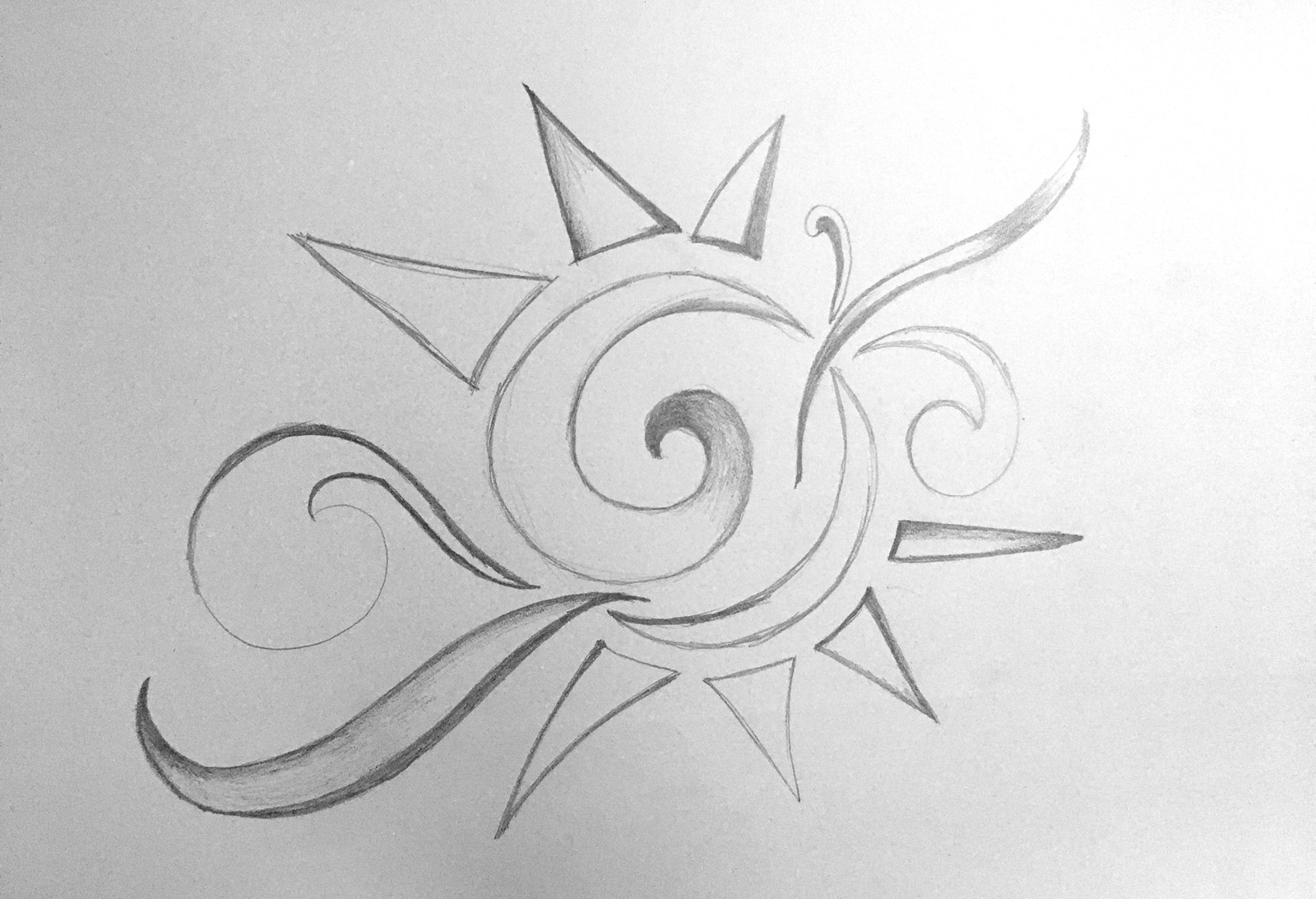
The deluge – pencil sketch drawn many years ago
They say, that man’s best friend is a dog. I believe, that humanity’s best friend is practically everything under the sun, except another human being.
Plants and animals can understand human energy, better than other humans. And that’s because humans have that one ability — no, handicap — that other creatures don’t have — telling lies. We lie to others. And we lie to ourselves. And we spend a lifetime on this planet just trying to figure out the truth about ourselves. For some, that truth comes through reading, or speaking with close family and friends. For others, it comes through art. Humans invented psychology to help figure out the human mind. And science, to explain energy. And for anything that couldn’t be explained by either, there was religion.
While we are still figuring out ourselves, plants and animals can see right through us. They don’t speak our language. They don’t need to. They just sense.
We are all bundles of energy. We reflect light, and produce sound. We feed off energy. And we disseminate energy.
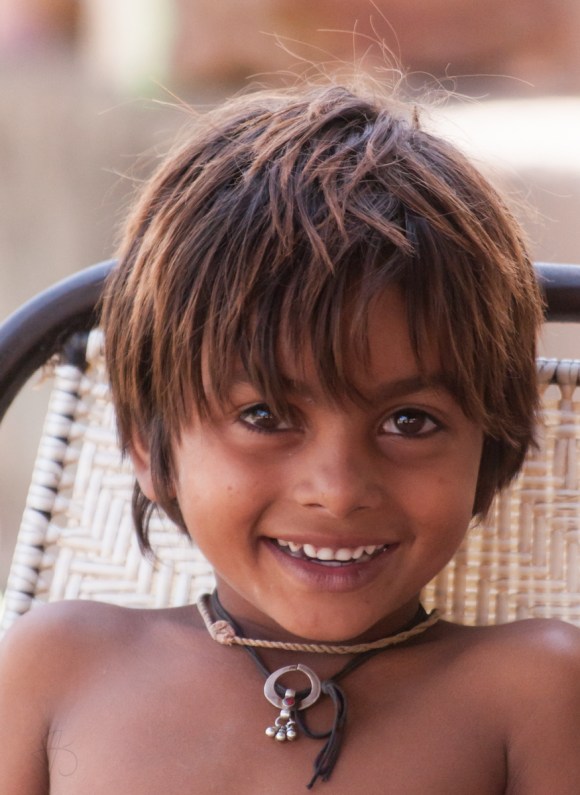
Vitamin D is known as the sunshine vitamin, because it is produced by the body with the help of sunlight. Sunshine, is also associated with happiness. Perhaps that is why tropical countries tend to be depicted by photographers through smiling portraits. Because even in poverty, the sunlight makes people happy. Sunlight is energy — quite literally.
I once read that looking at flowers, first thing in the morning, makes us feel good. Plants that get ample sunlight, convert the light energy into beautiful flowers. Those flowers are a manifestation of energy.
Those flowers are happy, and we feed off their energy.
And when we feel happy, we spread that energy.
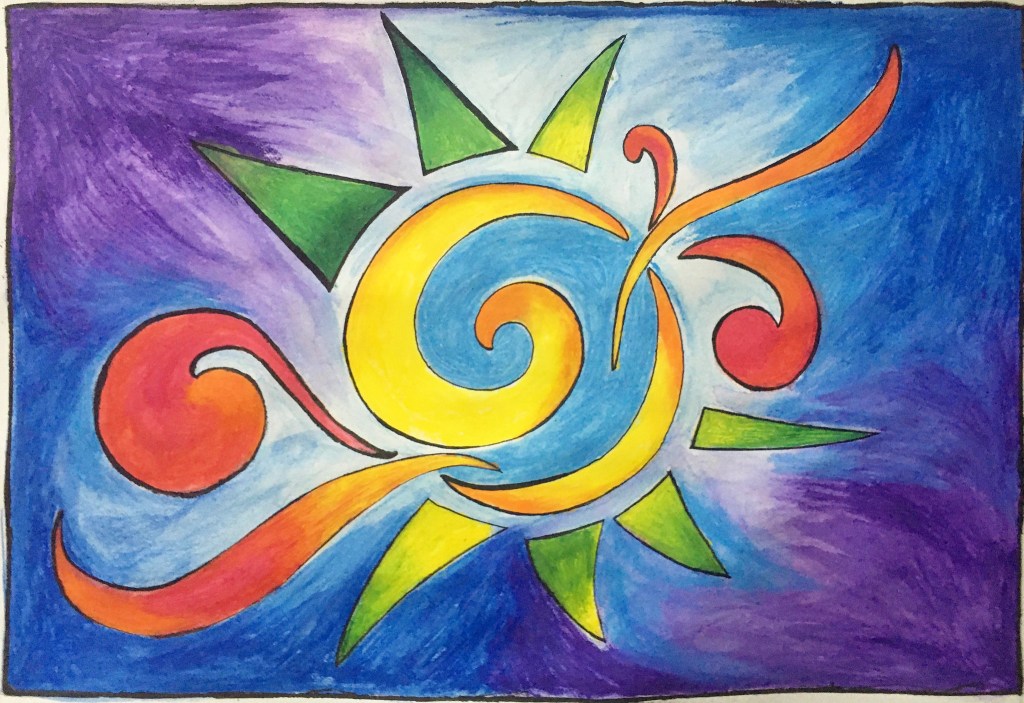
All these disjointed memories, and energy that binds them, came to me after I shared a painting “A Ray of Hope”.
We’re all bundles of energy. We helped create the current pandemic. And we can all feel the after-effects of it. Perhaps for the first time in history, the entire world, is sensing the same type of energy — fear, helplessness, uncertainty, and hope.
Let’s turn this pandemic into an opportunity. To spread positivity. And treat nature — plants and animals with respect. We feed off their energy. We disseminate energy back to them. And the cycle repeats.
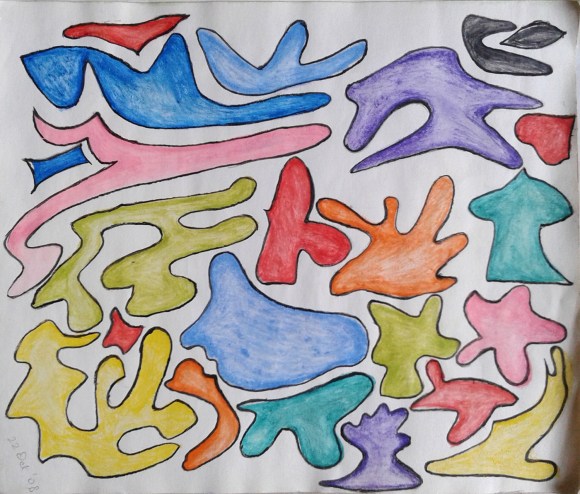
I took out the sketchbook from my cupboard, and began drawing. I don’t quite remember, why. I didn’t set out to draw anything in particular. Perhaps, I had just wanted to rediscover what it felt like, to put pencil on paper.
After about an hour, I felt happy with what I had drawn. I wrote down the date and time below the drawing, 27 November 2019, 9:30 PM – 10:30 PM. And then I went to sleep.
Setting the mind and body free
For several years, my sketchbook has been gathering dust in our cupboard. Why? Because I was afraid. Afraid that I would ruin a perfectly clean sheet of A3 drawing paper. That I’d draw something that was not worth showing to anyone.
That November night, I felt that I had achieved something. I had drawn something that looked half decent, and not ruined the sheet. And I slept soundly.
What I didn’t realise then, was that I slept happy, because I had let myself loose and enjoyed the process. I just wanted to draw. And the outcome, just happened to look nice to me.
This realisation hit me earlier this month, when I enrolled for an online sketching class.
For five days, I studied one-point perspective, drawing lines that vanished into the horizon. I spent several hours a day, trying to complete each of the assignments in time. Initially, I fretted over getting each of the lines neat and straight. By the time I had completed my twenty-fifth drawing assignment, I began worrying less about what the final outcome looked like. Completing the assignment, was far more important, than making it look perfect. And so, I just began enjoying the process by drawing freehand. I traced over the pencil lines with my pen, without using a scale.
I had removed the weight of expectation off my shoulder, and that left me feeling deeply relaxed.
With this newfound realisation, I reopened my sketchbook over the weekend, flipped over to that November sketch, and then did something I have never done in my life. I began erasing my drawing.
I erased the dark lines and the shading in between. But I left the faint outlines of the original in place.
I chose colour pencils from my kit — colours to represent nature: sun, fire, trees, wind and water. Then I slid open the blade of the cutter, and began shaving away the wood at the edges of my colour pencils. Each stroke peeling away years of dirt, negligence, and guilt.
And then, I let my hand run free. I ran a damp brush over the coloured areas of the drawing. A pastel shade drenched parts of the paper. A few blobs of water dried in place without blending in. I dipped the pencil tips in water, and let them run deep and dark, revealing each stroke. With each dip, the colour ran for a centimetre or two. In no time, the pencil tips shrunk. Another round under the cutter, and more of the colour lay exposed.
A few hours late into the night, and then a few more the next morning, and my drawing was complete.
I shared this picture on social media, and asked friends to provide a caption. Here’s a list of all the suggestions I received.
Sukriti (beautiful creation)
There is a rainbow of hope, life, vitality on our way…
Vapusa (nature, beauty)
Emerging path
Jeevan chakra (circle of life)
Ray of hope (suggested twice!)
The happy sun
Break the cycle
Circuit breaker
Liberation at any step
What surprised me, was that each of the suggestions revolved around nature, beauty, life, and hope.
These are the themes that we are collectively experiencing these days.
For perhaps the first time in our lives, we are living in uncertainty. All these years, we have been taking our lives for granted. We have tortured and exploited nature past its limits.
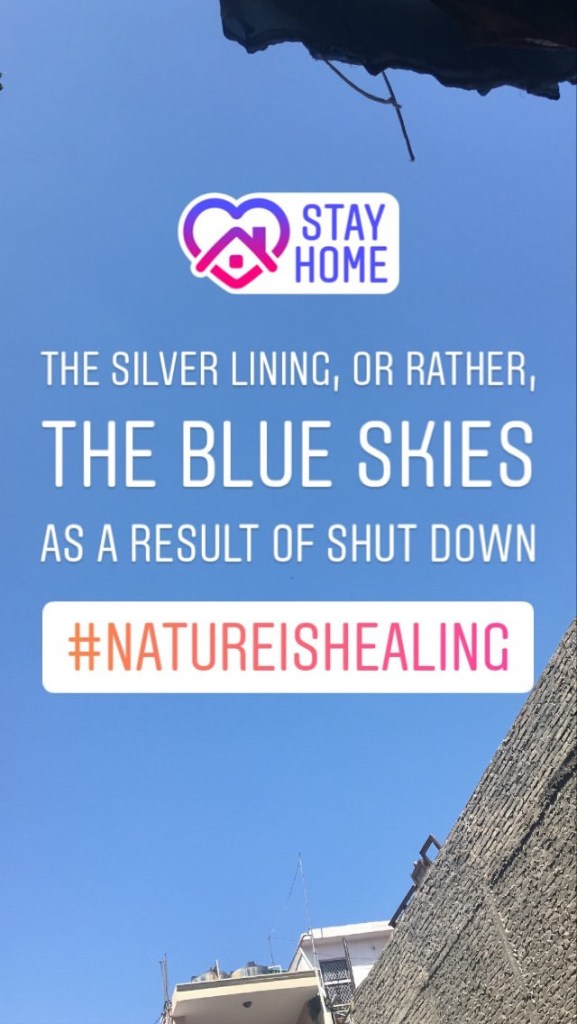
Now that large section of people are forced indoors, I am happy that nature has got a break from us. It had barely been a few days into the lockdown, that we all breathed clean air, saw blue skies, and even saw stars at night.
Clear blue skies and clean air, that prompted some stories on Instagram on 28 March 2020
Earlier today, a weaver bird began building a nest in the balcony of my parents’ apartment! And what a day for this to happen.
Today is the 50th anniversary of World Earth Day.
Yes, our planet is a mess right now. Scientists have been ringing the alarm bells on climate change for years now, predicting that we are already too late to turn things around and make amends.
But, if there’s one thing I’ve learnt over the past few weeks, is that we have hope. Given a chance, nature can recover (and perhaps forgive us).
Here’s hoping you are safe and healthy.
Here’s hoping our planet remains safe and healthy.
More stories from other publications
Here are some stories I’ve written for different publications over the past few weeks, all related to the current Covid-19 Pandemic, how it’s impacted our life, and what we can learn about how to live sustainably in the future.
I’ve been looking at this scenario as an opportunity for companies to go fully remote. Most freelancers, including me, have not had to change our lifestyles much, as we’re used to working remotely. We’re already using technology all around us. If we could reduce our commute to work, we’d significantly reduce the fuel emissions from transportation…
In our hyper connected world, and the ease with which we can now travel, it seems difficult to be confined to a small area. Yet, it is some of the technology behind this hyper connectedness, that makes it possible to remain connected, while being distant…
So here we are, in 2020. Quarantined due to a pandemic. Travel, as we knew it for the last few years, and to a large extent, took for granted, has come to a grinding halt.
I can’t help but think that this is some grand cosmic conspiracy, to put us in our place — literally. To slow us down.






 Musings of an eccentric mind