An astrophysicist, a Vedic scholar and an earthworm walk into a room.
Before I complete the story, here’s a question for you:
Do you believe in a higher power? A celestial being that’s constantly keeping a watch over us?
I used to, but now, I believe that we delude ourselves into thinking the universe cares about us. Stars don’t align for us. They just go about their lives, and we simply get caught in their world. We are, but mere cogs in their grand scheme.
Men In Black Movie ending sequence where the universe is revealed to be a marble in the hands of an alien.
The moon revolves around the earth, and it sways our mighty oceans with its movement. We, too, are just bags of warm water. Surely, the moon must have some impact on us. We get life-sustaining energy from the sun. And it’s such a long way from home. Surely, other stars must have their secret powers.
Ancient Indian astrologers had probably cracked some of the codes of the universe. But like much of our wisdom in other disciplines, it has been tossed out in our English-medium world that’s out to make some money off our ignorance.
What I lost in ancient wisdom, an American TV personality packaged into a shareable quote:
The four most common chemically active elements in the universe—hydrogen, oxygen, carbon, and nitrogen—are the four most common elements of life on Earth. We are not simply in the universe. The universe is in us.
This quote reminded of two types of universes: the more observable physical one, and the abstract, spiritual one that’s hidden within.
The Observable Universe: My Compost Pile
I started composting some seven years ago, and it has been the most rewarding, meditative experience. Composting gave me a glimpse into an entire self-sustaining ecosystem. At times, I felt like God, overseeing a world, controlling what goes in, and when it’s ready to harvest. But most of the time, it made me realise that we too are tiny insects in the compost pile of a higher force. We’re all transient creatures taking part in a grand spectacle called nature.
My compost pile is made up of organic material. The brown stuff has a lot of Carbon, the green stuff is rich in Nitrogen, and since kitchen waste tends to have a lot of water content, the other two components of Hydrogen and Oxygen complete the quartet. With each harvest, I see the universe in action.
I took whatever I learned and turned it into a small online workshop. Here’s a recording of a session done during the initial pandemic lockdown. I hope you enjoy.
The Hidden Universe Within: Aham Brahmasmi
The Brihadaranyaka Upanishad, one of the first Upanishads dated to 7th century BC, has a popular phrase, Aham Brahmasmi. It translates to “I am the Brahman.” The Brahman here is an abstract concept that may be interpreted as being the universal truth, cosmic energy, perhaps even God.
Side Note: This Brahman is not to be confused with the caste, which is pronounced differently. One’s caste is defined by one’s profession—and is neither discriminatory not hereditary. But that’s a different misconception to be dealt with by more learned scholars.
Aham Brahmasmi is a phrase that’s close to my heart because it instills a feeling of being complete, without relying on any external validation for our existence. We hold immense potential within us. If we channel it well enough, we can accomplish anything.
I love this Mahavakya (phrase) so much, that I even have a ring with the phrase written in Devanagari calligraphy.
So what happened to our astrophysicist, Vedic scholar and the earthworm? The two humans spent the whole time arguing over who was right, while the earthworm just chewed its way around the room till there was nothing left except life-sustaining matter.
The featured image at the top is of Netaji Subhash Chandra Bose Island, where nature has reclaimed man-made buildings, creating the most stunning root displays. Location: Andaman and Nicobar Islands, India.
It was my first visit to Dubai, and I wasn’t handling the timezone difference very well. On most days, I found myself waking up at 4 am.
Tossing and turning around in the soft hotel bed, try as I might, I couldn’t sleep. Fortunately, the hotel was walking distance from the Jumeirah beach. If I was going to be groggy during the meeting hours, I may as well enjoy some time with the waves. So I strolled up to the beach every morning and watched the waves crash on to the silent shore, waiting for the sun to rise.
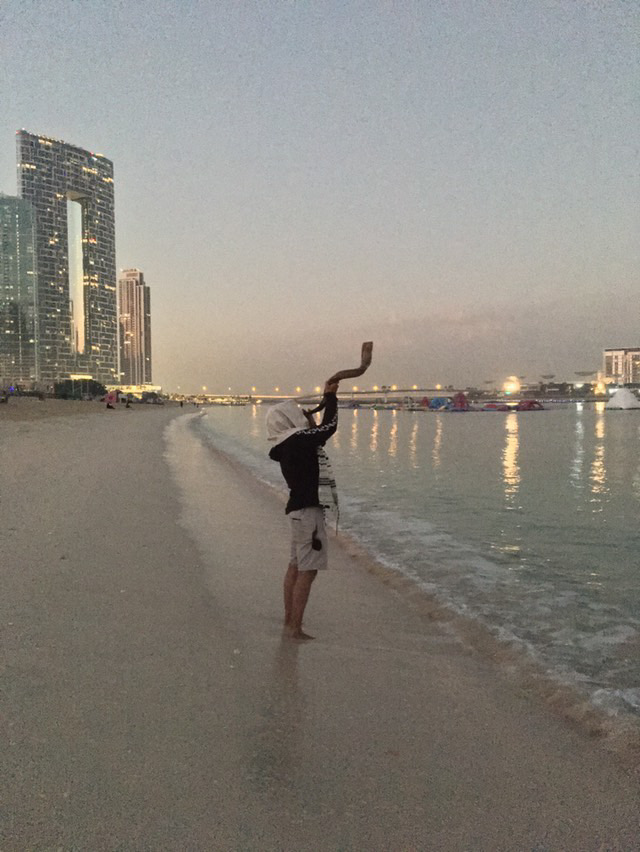
On one of the mornings, I heard someone play music. It wasn’t hard to locate the source. Still dark, I could make out the outline of a man, his head covered and in his hands a giant horn-like instrument. I sounded something like a bugle, but not quite.
Vernon playing the Shofar at Jumeirah. Picture taken with permission.
I waited for him to finish his piece and mustered up the courage to talk to him. “Where are you from,” I asked. “India,” he responded.
It took me a while to recover from the surprise revelation. “So am I! Where from? And what are you doing here?” I rattled off the questions in quick succession.
He told me his name was Vernon, and he was from Mumbai. By profession, he was a personal trainer.
His client was sleeping that morning, and he decided to extend his stay at the shore.
He then explained to me the significance of the instrument he was playing. The Shofar is an Israeli wind instrument. He played it early morning by the beach, before beginning his day.
Vernon explained a few verses from the Bible and how the instrument was his path to spiritual cleansing. We continued to speak about vibrations and how everything in nature is connected to different types of “waves”.
When the sun had come up fully, he took leave. I lingered around at the beach a little while, reflecting on our conversation.
“There are no accidents,” he said. “If my client wasn’t asleep, I’d have left a long time ago. God wanted me to play for you.”
The tiny bulb burned itself out. And so did her friends. But the night was far darker than all of them combined.
“Oh what’s the point?” they sighed.
“But that IS the point,” said the divine light.
“Darkness will always exist. In the skies above and in lost souls below. It is your duty to burn as brightly as you can, so that even in darkness, the world can navigate.”
The night is long and bitter and it has only begun.
Shine. Shine as bright as you can. Till darkness gives up.
Sometimes life can be frustrating: Perhaps a loved one is unwell. Perhaps your own health is troubling you. Perhaps you miss old friends. Perhaps your manager spoke in an unjust manner… The list of things that can rattle us is endless.
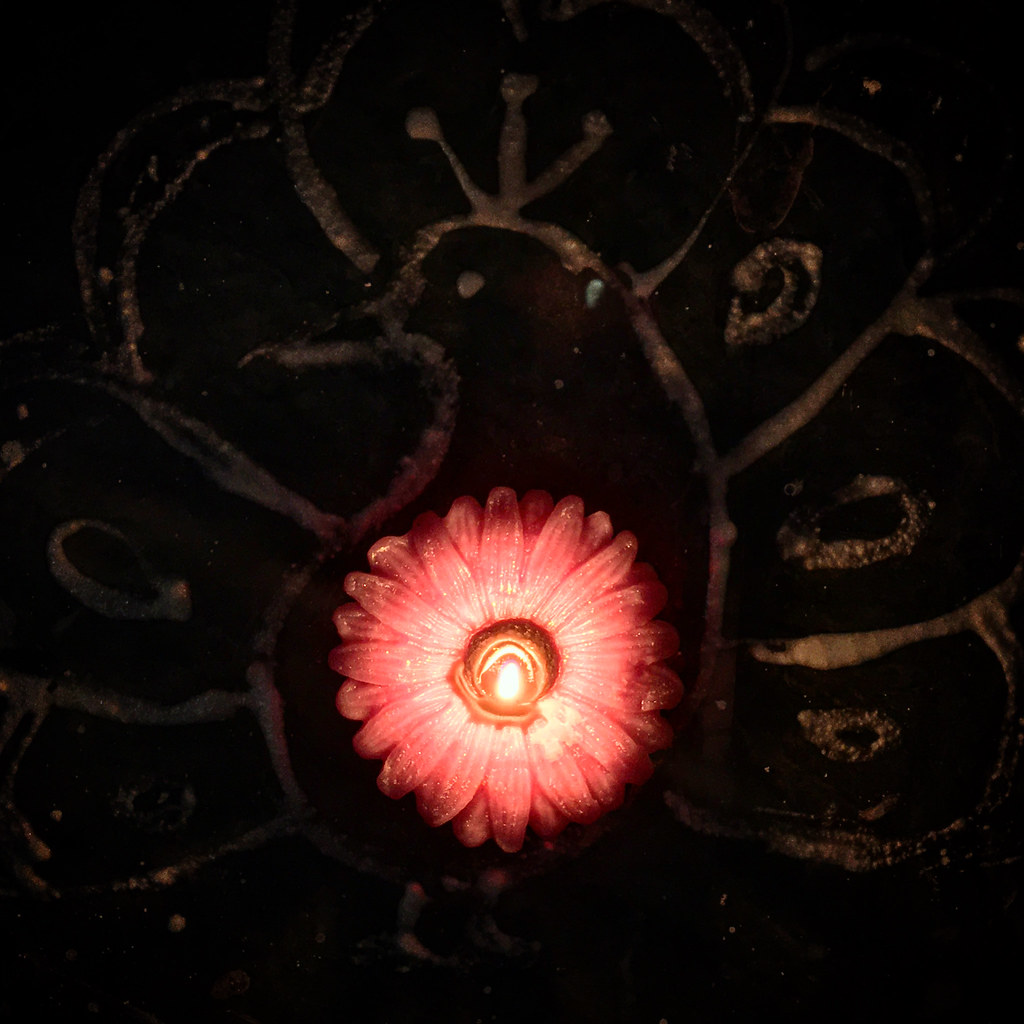
It had been one such frustrating evening, not long ago. Being the night of Kaarthigai Deepam, I tried to put the day behind and hastily set out to make a kolam. It didn’t turn out too well, making me feel even worse. And then I lit a beautiful wax candle. Suddenly, everything seemed to be alright.
There’s something about a flickering flame — be it from an oil lamp, a wax candle, and to certain extent, fairy lights — that brings us happiness. Perhaps that’s why we light lamps at places of worship.
This post is inspired by two posts on Instagram, separated by time and context, and yet connected by light.
One of the strongest memories of my childhood is that of AM Radio. It would begin playing on the ancient transistor even before I woke up. Sanskrit mantras recited by M.S. Subbulakshmi, followed by the railway timetable, and finally, news in Sanskrit that would end with a few beeps. The last of the beeps would be longer than the first few — the clock had struck 7 AM.
I’m not sure if the order of the programs is right. There’s no way for me to verify either. We don’t listen to radio anymore, unless we’re in a car — and even in a car, it’s FM, or a USB stick, or internet radio that’s streaming from a smartphone — not AM.
Back then, on Sundays, the radio played Vishnu Sahasranama Stotram — the thousand names of Lord Vishnu. Towards the end of the half-hour long recitation, is a conversation between Goddess Parvati and Lord Vishnu. The Goddess asks, dear Lord, what might a lay person do, in order to pray to you. Not everyone can possibly recite all the thousand names every day. Is there a shortcut to this? And the Lord obliges. He says, repeat this one verse three times, and it is equivalent to reciting all the names. I am paraphrasing, of course.
I learnt this one specific verse very early in my life — long before I learnt about its significance. I learnt it because every single Sunday, at precisely the moment that this verse was recited, I would wake up. One could say, I learnt it by accident, or divine intervention, or coincidence — I leave it to you, to decide, which of these is more accurate.
I don’t think I am very religious — certainly not to the extent my parents or grandparents are. I don’t perform the elaborate pujas that my mother performs. Nor can I recite any of the Sahasranamams the way my grandparents can. But religion does interest me.
True to the stereotypes of TamBrahms, as children, our summer vacations were spent touring temples. We were taught Sanskrit shlokas (couplets / verses), that I can still recall. I was also taught how to perform a basic neyvedyam (sacred offering). I pride myself in knowing what little I do. And I wish to learn the proper neyvedyam that my mom performs on special occasions. Hopefully, one day, I will be able to perform one of those with the camphor flame… But I digress.
What I am trying to say is, I am religious enough to take the shortcut of reciting one verse three times, as opposed to 108 verses.
Over the past few years, I have realised that being religious and being spiritual are not the same thing. Religion, is the path towards spirituality. And spirituality, is the path towards peace of mind. I came to this realisation when, a year into our marriage, Atul began playing a playlist of bhajans.
Knowing him for as long as I did — he who who wasn’t particularly interested in going to temples or explicitly praying — he was playing bhajans.
He wasn’t listening to the lyrics of these songs, he said. The melody just made him feel relaxed. It gave him the peace of mind that is so essential in today’s rage-infused society.
This inclination towards peace of mind, came up again, when he insisted that we visit the temple I frequented. It wasn’t that he did not like visiting temples at all, he said; he just had not found such peace of mind in the ones he had visited before.
Atul is not an atheist. He is spiritual. I began appreciating his world-view, when he said this: I don’t need to go to a temple, or speak a certain language, to speak with my God. And that was also the essence of the verse in Vishnu Sahasranama Stotram — you don’t have to say all the 108 verses. Just one, repeated thrice, was enough. The Lord himself, was giving a shortcut.
Over the past few months, I have begun my own morning ritual — somewhat similar to what my parents did back then. What used to play as clock-work, every morning on AM radio, now plays on an online streaming service, as soon as I wake up (let’s just say, the morning is a spectrum).
As one wise man said to me, language and form shouldn’t come in the way of spirituality and peace of mind. Hence, I will not share my morning invocation playlist with you.
What I will share, though, is another feel-good playlist that focuses on spirituality and peace. Here it goes:
1. Ma Rewa
Band: Indian Ocean Album: Kandisa Year: 2000 Language: Local dialect of Hindi
It was during last year’s Indian Ocean Concert (in picture) that I first heard Ma Rewa. I swayed and clapped and danced on this number. It was only later, that I saw the lyrics.
Rewa is another name for the river Narmada. And life-sustaining, as all rivers are, Rewa is called Ma – mother. This song praises the holy river, and apparently, was used as a protest song by the Narmada Bachao Andolan (save the river Narmada). There is enough feminism and rebellion in this to become my week-day alarm.
Growing up, this song, and all the songs by the duo (Leslie Lewis and Hariharan) hit the sweet spot for us, bringing together classical music and English pop. We were such big fans, our parents bought two cassettes(!) of their albums — the only band accorded that multi-cassette honour.
3. Kandisa
Band: Indian Ocean Album: Kandisa Year: 2000 Language: Aramaic-East Syriac
This song is familiar. I’ve heard this, yes… Alam Alam Alam… I fished out my memories. “It’s Kandisa,” said Eeshta. And just like that, I rediscovered Indian Ocean. There’s a chance you’ve heard it before too. You can thank me later. Also, this my week-end alarm.
4. Madho
Band: Faridkot Album: Ek Year: 2011 Language: Local dialect of Hindi
“You now owe me some songs!” This was the message Sunaina sent, after sharing the album by Faridkot. If it weren’t for her, I probably wouldn’t have known about this beautiful album.
From where I sat in the office, I was within earshot of everyone in the office (and yes, I could see folks, before they could see me). I’d asked her for the songs after hearing them on her work-station — on loop. Haal-e-dil and Banjaare were her favourites, I think. I liked them too. Eventually, though, my favourite became, Madho. The song is about a devotee, who wants Krishna to come and help her cross the river on her boat.
5. Tajdar-e-Haram
Singer: Atif Aslam Album: Coke Studio Season 8 Year: 2015 Language: Urdu
Because no playlist of melodious music can be complete without Coke Studio. I’ll admit, I am no fan of Atif Aslam’s music (based on the songs sung for Hindi Cinema / Bollywood). But this one is an absolute gem!
6. Gurus of Peace
Singers: A.R. Rahman, Nusrat Fateh Ali Khan Album: Vande Mataram Year: 1997 Language: Hindi, Urdu, English
The stage is set at the school assembly ground. On the left side of the ground is the administrative block. On the right are classrooms for primary students. Connecting these two blocks are two bridges on the first and second floor levels, running behind the centre stage. The music begins playing, and the performers enter. As they begin performing their choreographed moves in perfect sync, more dancers enter in front, and below the main stage. Others stream in from behind the audience. And more fill in the bridges above the stage. This was the first block-buster musical I had seen — long before Kingdom of Dreams was even dreamt of.
The song, Gurus of Peace; the dancers, students handpicked from the primary, middle and senior secondary classes; the occasion, the school annual day; and the audience, an awe-struck set of students, and some very proud parents.
I was in school when this song was released, and it became an instant hit. Perhaps, because it cut across all faiths and cultures; or maybe, because it shattered stereotypes of Sikh musicians, the topics that rock music could cover and the format in which Sufi could be performed; or maybe, just maybe, it resonated with teenagers trying to figure out their identity. “Bulla, ki jaana, mai kaun hoon” (Bulla! I know not, who I am).
This is one of very few songs that I remember seeing. Apart from its deep philosophy, what has endured through all these years is the visualisation of the song.
There are a number of versions of this song on YouTube. The official version is live in concert. There is another version with better audio quality and lyrics. But I’d rather show you the original music video (you can check out the better audio later).
For the rest of the songs, check out the playlist on Gaana here: Playlist for Peace.
PS: I know there are only male singers in the playlist. I’d love to hear more female voices in this space — if you know any, I’d love to listen to them. In the meanwhile, I have my morning invocation, dominated by M.S…
PPS: Happy Thanksgiving everyone. Here’s wishing for a peaceful dinner, and world 🙂
Featured Image: The stage for Indian Ocean’s concert on 23 November 2018. Here’s the story about that concert: Behind the Sounds.






 Musings of an eccentric mind