
Categories
Stories

Recipe for Disaster – Part 1


Where’s the bucket?

Bouquet Tarts
Anna* and I used to fight like cats and dogs as little kids. Our fights would often get physical, and we’d hurt each other pretty badly. Our mother would patch us up more frequently than she would have liked, and grudgingly we would apologise to each other.

To the outside world, though, the story was entirely different. We were extremely well behaved around guests, and even stood up for each other. In family photographs, we looked like the sweetest sibling combination.

Maybe there was something there that the photographs captured, that we couldn’t comprehend. It was perhaps due to our silly childish stubbornness, that we chose to ignore the obvious. Despite all the petty fights and bashing up, we made one heck of a team – if we wanted to.

It was a week before our parents’ anniversary. I was very small – maybe eight or nine years old. My brother had saved up a little money. I have no idea how,  but that was not of any concern to me. Anna and I went to a local florist, and we chose a beautiful bouquet for them.

On our way back, anna kept the bouquet a little further away from the staircase leading up to our apartment on the first floor. He asked me to go in first.

Our house was seldom locked at the time, and we went in and out of the house without having to disturb anyone to close the door.

My job was to enter first and distract my mother, while anna would come in later and hide the flowers somewhere inside the house. And then we had to wait – till one of them found the hidden gift. It was a perfect plan!

I did my part of the job, and anna did his. So good was the execution of the plan, that even I didn’t know when and how my brother hid the flowers. The hardest part was waiting for the bouquet to be discovered.

And we waited for a long time. I grew fidgety and restless. After what seemed like aeons, when I could no longer control my impatience, I pulled my brother into the kitchen, and asked where exactly he had hidden the gift. In my excitement, I blabbered ‘Where is the bucket?’. He gave me a bewildered look.

‘Where is it – where did you hide the bucket? They haven’t seen it yet!’ I continued, ignoring the strange looks.

He looked past me, and refused to answer. ‘What are you looking at?’

I turned around, and found our mother standing right behind me. She looked down at me, and unable to control herself any more, burst out laughing.

That day went down in our family’s history as the ‘bucket fiasco’ and the source of laughter for years to come.


* Anna is a Tamil word meaning elder brother.

Image based on Photo by Meg Zimbeck CC-BY-2.0
Categories
Stories

Just For Joy


In our school, starting from the fourth standard, all students were put in ‘houses’. Each house had an associated colour – red, yellow, blue and green. Inter-house competitions were organised across several disciplines, and at the end of the year, one house was declared the overall winner.

Now I’m not sure if there was a sorting hat involved while deciding which students to put in which house. But I was suspicious. Invariably, the yellow house had awesome athletes, the green one had students who were artistically inclined and did well in cultural activities. The red one had more intellectual students.

And the blue one, well, it had the rest of us. We were never really expected to do well overall, but we sprang a surprise every once in a while.

During one particular year, we had a Sufi Kalam Competition. We had a tough time preparing for it. Unlike other times, there was no one to teach us. Our teacher in-charge gave us a cassette, and we had to listen to the tape in order to learn the song. Fortunately the lyrics were written in the folds of the cover of the album. Our teacher explained to us, the meaning of the lyrics, and we chose the paragraphs we understood.

I don’t remember what the other groups sang. I’m not sure if they also listened to a recorded song and learnt it by themselves. But I remember our song. I remember how we would look for quiet places to practice. Mostly we went to the basement. And if it was closed, we sat on the staircase leading to the basement. We would play the tape and listen intently. The other groups practised in the open, flaunting their songs with pride. And we’d feel tiny in front of them. Everyone was sure the green house would win – and so were we.

The day of the competition arrived. We went over the lines one last time, and clarified which line had to be sung how many times.

As the program started, I began feeling the nerves. I had to sing the opening tune – solo.

A few of the girls tried to comfort me and tried to get me to relax. My mind went blank. My heart pounding, threatening to escape. Our team name was announced, and we went on stage.

As soon as we were seated, the music teacher played the tune. My voice refused to come out. I looked at our music teacher. The expression on her face was crystal clear. ‘Why aren’t you singing? Come on now sing!’ She played the first line again.

And this time, I did sing.

What happened thereafter, was amazing. The whole group joined in at the chorus in unison. A couple of boys got up on their knees and began clapping and dancing. The other girls gave the best of their smiles, and sang with infectious energy and confidence. I was surprised. There were smiles all around, and everyone genuinely had fun while singing. Some students of our house cheered as loudly as they could. Soon the audience joined us in clapping, and we got a great applause at the end.

Our group had some really awesome singers – that year every house had their fair share of singers, but I was extremely proud of our team. We were not really friends, and I struggled to have a decent conversation with them. As I write this, apart from the three girls who sat in the front row next to me, I don’t even remember who were there in the group! But somehow, at that moment, we came together beautifully, and managed to pull one out of the hat.

I don’t remember if we won. I’m too lazy to fish for the certificates. But honestly, I don’t care who won, we, or the green house. I took part in several competitions, and my little box of certificates swells with pride at how many we won, or nearly won. But this one stands out – not because of the outcome, but because we had fun, we felt the song, and the audience loved it.

* * *

Recently, Kozo at Everyday Gurus wrote something about ‘getting the point’. As I sat down typing a comment, I realised it was getting too long. I decided to write a short post. It started with a series of rants, and then this story popped up!

Categories
Stories

Protected: The Journey


This content is password-protected. To view it, please enter the password below.

Categories
Hobbies Stories

The Sultan’s Cave


Delhi is often described as a graveyard, due to the vast number of Tombs that are spread across the city. Most of them look alike, but some stand out.

A small sign along the main road indicated the path towards our destination. It was a narrow dust road, with trees on either side. We walked a short distance before hitting a fork in the road. Short shrubs, open fields, and grazing goats in front of us, city buildings and afternoon traffic behind. But there was no hint of a historical monument in sight.

We asked the man standing next to the goats, where we could find Sultan Ghari. He paused for a while, and then asked us if we wanted to visit the Dargah. We nodded, and he pointed towards the road on the right.

The tomb is a revered place for devotees of both Hindu and Muslim religious communities of the nearby villages of Mahipalpur and Rangpur since they consider the tomb as the dargah of a saintly ‘peer’; a visit to the tomb is more or less mandatory for newlyweds from these two villages. – Wikipedia

These words made me curious…

It wasn’t very far, but hidden behind the trees, the building seemed to magically appear out of nowhere. And the moment we first saw it, we were surprised. It did not look like a tomb at all. In fact, had we not known it was a tomb, we would have assumed it to be a fortress.

Sultan Ghari was built by Iltutmish, for his eldest son Nasiru’d-Din Mahmud – Raziya Sultan’s brother. It was the first Islamic mausoleum built in India.

Considering how old it was, it was beautifully preserved, and looked like it was built just yesterday. We bought our tickets – five rupees each – and climbed up. We were asked to take off our footwear before entering the stone courtyard.

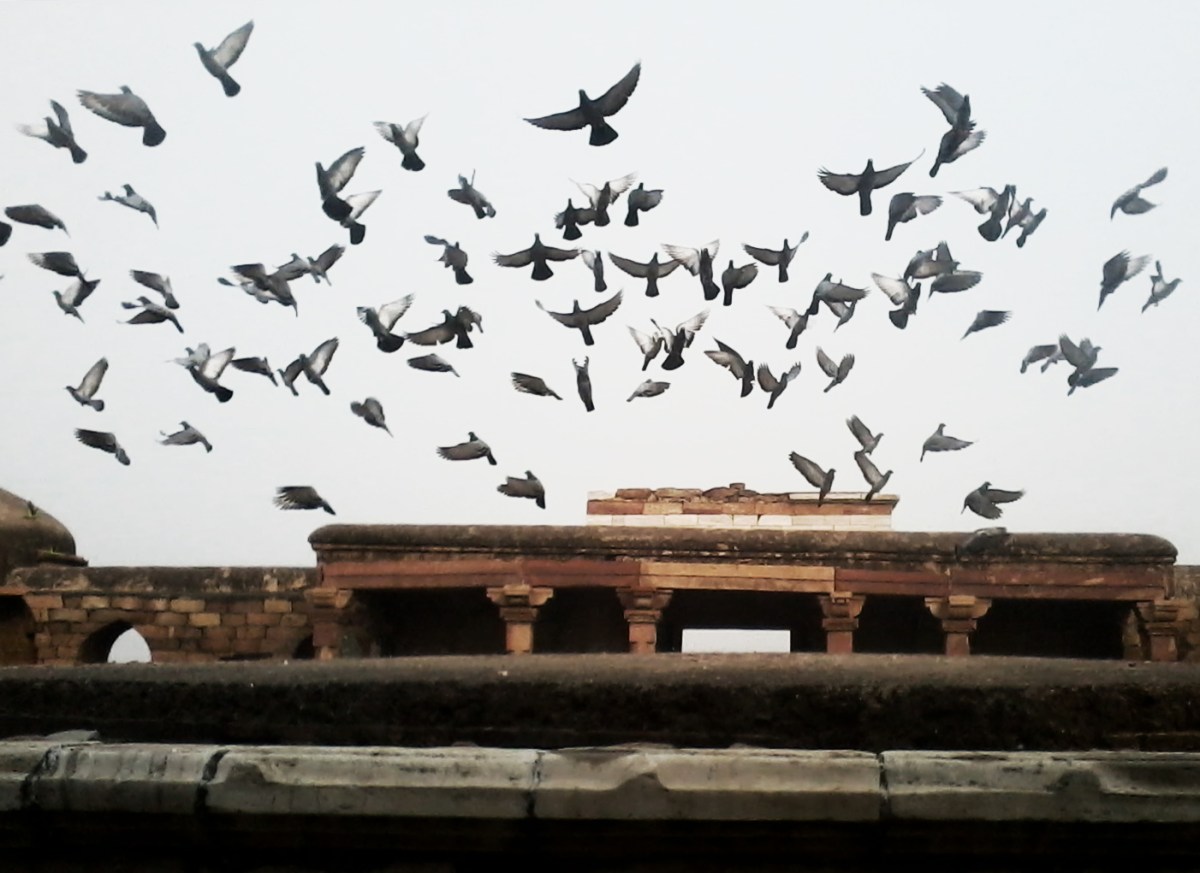
In the centre of the courtyard was a huge octagonal platform, on top of which dozens of pigeons were feasting on seeds. The walls of the fortress had huge ‘windows’. One of the walls had a narrow, steep, open staircase. Standing atop the wall, we caught a bird’s-eye view of the city, as well as ruins from another time.

The actual grave of the prince was beneath the fortress. On one side of the central platform, a small opening lead downstairs to a small chamber. Lit only by oil lamps, it was extremely dark. We felt our way around and stepped down the stairs cautiously. The air was heavy with incense.

A green chadar was spread on the ground, and bataashas were kept next to it – symbols of both Islamic and Hindu faiths.

There was complete silence inside the chamber. So silent, the two of us spoke to each other in hushed tones. While the world boils and burns, fueled by religious animosity, it is places like these that provide hope that peace will one day prevail.

Back outside, we climbed up the stairs along the wall, to get a birds-eye view of the whole complex, as well as the surrounding ruins.

Here are some photographs of Sultan Ghari.

With the main purpose of our visit achieved, we had decided to have a little fun with the pigeons. I must say the pigeons were extremely cooperative, and willingly flew away the moment one of us went near them!

PS. Apologies for the poor quality of images…

Categories
Stories

The Unsung Hero


Crumbling Haveli
Crumbling Haveli

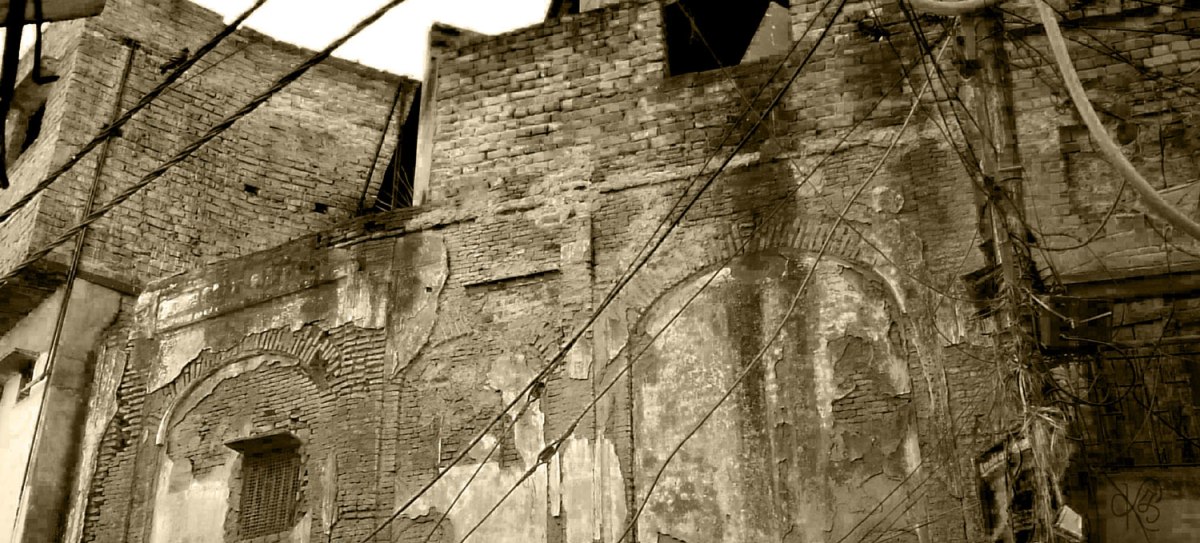
The city of Delhi is often referred to, as a burial ground – of emperors and nobles, princes and princesses, saints and warriors. After visiting a few tombs, one gets the feeling that all the tombs are alike. That might be true for most, but there are exceptions.

This past week, I tagged along with a group of heritage-hunters, and headed towards Chandini Chowk. A friendly local offered to guide us through the uneven paths, deep within the bazaar. We went down narrow and dark lanes, past crumbling havelis and butcher shops, and even hopped over a sleeping goat! We approached a sharp turn in the path, which revealed perhaps the smallest, and the saddest tomb in Delhi.

The only three women who were ever elected to the throne in the Mohammedan East, reigned in the thirteenth century.
– Lane-Poole

Raziya Sultan was the daughter of Iltutmish*, and the only woman to have ruled over Delhi. Her father had chosen Raziya as his successor to the throne. This was obviously not welcomed by her brother, as well as the majority of noblemen.

Iltutmish claimed that his daughter was better than many sons. And it did not take long for the citizens of the kingdom, to realise this. Raziya was appointed ruler by the common people.

Sultan Raziya was a great monarch. She was wise, just, and generous, a benefactor to her kingdom, a dispenser of justice, the protector of her subjects, and the leader of her armies. She was endowed with all the qualities befitting a king, but she was not born a man, and for that reason, in the estimation of men, all these virtues were worthless.
– Minhajas-Siraj

Raziya Sultan’s tenure as a ruler was a short one. A female monarch, appointed by common people did not go down well with the establishment. The fact that she showed her face in public, and was tolerant towards the Hindus, made her case weaker. She was assassinated after three years at the throne.

There is a conflict, regarding the actual site where she was buried. Claims include Chandini Chowk in Old Delhi, Siwan in Haryana, and Tonk in Rajasthan. The site at Chandini Chowk, was a jungle during the reign of Raziya Sultan, and there is no engraving to identify the souls resting there. A part of the mausoleum has been converted to a mosque.

Raziya was a person born well ahead of her time. Unfortunately, her story is overshadowed by others who came after her. A hero for all ages, may her soul rest in peace.

*  *  *

* Iltutmish (alternate spelling Altamish) Full name : Shams-ud-din Iltutmish

The third ruler in the Slave Dynasty. The first was Qutb-ud-din Aibak, and the second, Aram Shah. The Slave (Mamluk) Dynasty was the first of five unrelated dynasties to rule over Delhi, in what is referred to, as Delhi Sultanate.

Sources and suggested reading:

Razia Sultan Was Far Better Than Her Brothers – Sunday Guardian
Chapter 5 – Raziya, The Mohammedan Empress of India, History of India – Volume 5 – The Mohammedan Period as Described by its Own Historians – Edited by A. V. Williams Jackson (Selected from the works of late Sir Henry Miers Elliot)

The Daily Post asks readers to write about their heros. I have paid a tribute to Unniyarcha before. Raziya Sultan is my answer to The Daily Post’s prompt.

Categories
Stories

The Scarf


The winter is upon us, and all the woollens are out. Amongst these, is one precious scarf.

Before I turned into an obnoxious and stubborn teenager, we wore sweaters knitted by my eldest aunt. Knitting, and crochet were like second nature to her. I used to admire her skills. It seemed almost magical, the things she could create with wool.

So when our crafts teacher asked us to bring wool and knitting needles to school, I was excited. I envisioned myself becoming very proficient in knitting. I was already imagining showing off!

I carefully followed instructions, and ensured I did a neat job of making the loops. After a couple of classes, we were told to finish it off at home, at our own convenience.

Little did I know, that it would turn out to be quite a disaster.

Under the watchful eyes of my mother and grandmother, I continued my knitting. My grandmother demonstrated a different type of loop. And so we decided to add a little design, alternating between different types of loops.

It wasn’t long, before I forgot about the design, and then it was just a mess of randomly placed loops. It didn’t bother me, though. I was knitting for the first time.

Twenty-two loops, is what I started with, and after a few rows, it somehow became twenty-eight. That was also fine by me. I was just a child. I allowed myself to goof-up.

Then one day, my mother pointed out that I had missed a loop. Before I knew it, she removed all the loops that I had knitted with my little hands.

Although I had to start from scratch, we no longer had the problem of mismatched styles and varying number of loops. All seemed to be well again.

And then I missed another loop. The loops were removed, and like the ‘Itsy Bitsy Spider’, I began again. It seemed like I had entered a vicious cycle – one that continued for a long, really long time. I knitted, missed a loop, and then started all over again.

Days turned into months. I soldiered on for as long as I could. It was obvious that knitting was not something I could possibly do, and my persistence only made the wool weaker. It had been abused long enough. It was now much thinner, and was begging for mercy.

I abandoned my project, and my mother decided to finish what I had started. Needless to say, she went further than I had. But she did not complete it. She probably still hoped that I would complete it. It was shelved, and soon forgotten altogether.

* * *
Several Years Later

We relocated, and came to live next door to a joint family. Four generations shared one apartment. Biji, as they all called her, was the eldest member of the house, a great grandmother. She took a liking to us, and we took a liking for her as well. My father’s mother had passed away only a few years before we moved, and the void that was left in the house, seemed to be filled by biji. It seemed like our grandmother had come back to us.

One winter afternoon, we saw biji sitting in the sun, knitting. My mother casually mentioned my abandoned project to her. We showed it to her, and she smiled and said, ‘I’ll finish it for you’. In a couple of days, she pressed a beautiful scarf into my hands.

She looked at my mother, and said, ‘I found a little problem with the loops, so I removed the whole thing, and knitted it from scratch!!’

Categories
Stories

Conversations Over Cream Coffee


It was a chilly Sunday. And the best way to spend it was sitting in the winter sun.

We decided to visit the Indian Coffee House at Connaught Place*. We climbed up to the second floor of Mohan Singh Place. There were only a few people on the terrace. Empty tables were spread randomly, while plastic chairs were piled up, one on top of another, along the entrance. We grabbed our chairs, pulled up one of the plastic tables, and sat down to bask in the sun.

Apart from the outfits of the waiters, there really isn’t anything that looks fancy at the Indian Coffee House. Even the food isn’t really great. But the coffee is good, and its cheap! The main reason why I keep going there, however, is that it is absolutely laid-back. There is no such thing as spending too much time here. When most cafés will eventually ask you to leave, no one here will even hint at that. You are more likely to see people stepping in, than stepping out – even if you spend hours. Like my friend said, ‘It’s like being at home!’

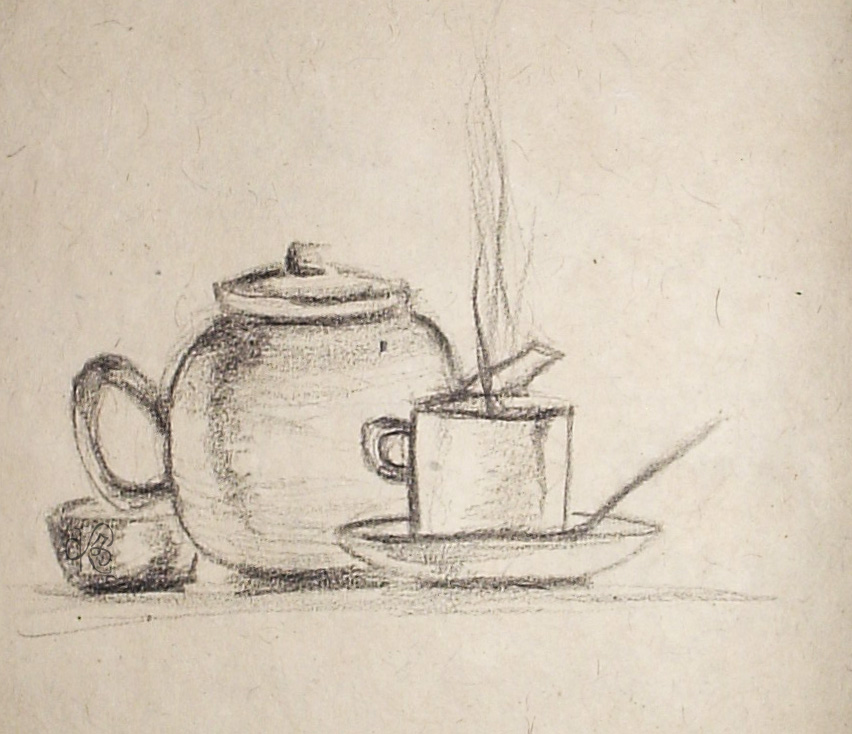
We read the menu pasted on the wall, and ordered ourselves ‘Hot Cream Coffee’. A little while later, the waiter kept a pot of coffee for each of us, with cups, spoons, and a small bowl of sugar.

A Sketch Of Our Pot Of Coffee

As we poured out our coffee, and stirred in the sugar, I found myself looking towards the opposite side of the road.  A number of state emporia lined the street.

‘You know, there is a huge flower market here. It opens early morning, and winds up before breakfast.’ I looked towards the pavement. A large number of people were walking there, shouting slogans and carrying banners. It was hard to tell what they were campaigning for, though.

‘We used to come here on Sunday mornings, when we were in school.’

‘I know, you told me.’

‘We would get up lazily, and go about our morning routine reluctantly. And then, our father would ask, ‘Do you want to go to the flower market?’ And just like, that our faces would brighten up, and we’d get ready within no time!

It was such a treat! And I don’t mean just visually. We’d pick up a few flowers – usually roses, or orchids. The orchids would last much longer than most other flowers. And then we’d head over to the nearby McDonald’s. We hardly went to McDonald’s back then. It was a novelty. That particular branch used to open very early. And we’d always order a McShake with our breakfasts. Nah! The McShake was the breakfast. Of course things have changed a lot since then…’

My friend waited patiently, till I realised I had to shut up, and then suggested, ‘Maybe you should blog about it.’

* * *

*Connaught Place is now officially named Rajiv Chowk.

Going through WordPress’ freshly pressed entries, my eyes fell on a familiar image – flower sellers. The post ‘Where guys give roses’, about the flower markets in Delhi, refreshed some memories for me.

More Coffee:

The Delhi Walla’s photo essay, Indian Coffee House
Wikipedia loves the coffee at the Indian Coffee House

Categories
Stories

Waiting at the airport


Boarding pass in hand, the family waited to board the flight. There was one seat less, and the young teenager sat on the baggage trolley. Perhaps even if there were enough seats, she would have preferred to sit on the aluminium structure and slide around. She was getting bored. They had been up early in the morning, but the flight was delayed.

She looked around, trying to amuse herself. Near one of the check-in counters, she caught two gentlemen picking up their passes. Gosh they looked awfully familiar! Where could she have seen them? The one nearer to them was slightly shorter, with a moustache and a short beard – much like that of a goat. The other one was much taller, and…

Her eyes grew wide. She called out to her mother, “Look!” She pointed in their direction. “Look who’s here!”

The two men saw the excited girl. One smiled, and the other waved his hand slightly – perhaps they felt a little embarrassed…

She smiled ear to ear, and looked at her mother, “He waved to me! Loy waved back to me!”

Perhaps, Mr Ehsaan and Mr Loy, you are used to this sort of attention. You must have encountered fans giving you such horribly wide-eyed looks several times. You may not remember that little girl on the trolley at Chennai International Airport so many years ago, but you sure made her day!

*  *  *


Even Wikipedia is a fan! Shankar-Ehsaan-Loy

Categories
Stories

Taking Payal Home


She was standing at the base of the stairs leading up to the main road, in the subway*. She wore a checked kurta and salwar. A neatly folded dupatta was slung across her shoulders formed a ‘V’. Her hair was braided, tied with ribbons. A huge school bag completed her school uniform. She may have been in middle school. It was lunch time, so it was not unusual to find school students wandering about, and I would have never even noticed her presence.

She held on to the railing, and took one step on the staircase. She dragged herself slowly, up one step. It was then, that I observed her. Her entire body was shaking, as if she had Parkinson’s disease.

I tried not to make her feel like she was out-of-place, and pretended to have not noticed her. I suppose I failed at that. As I walked past her, she spoke, ‘Excuse me Didi! Time kya hai?‘ I looked at my phone and informed her of the time. She then asked me, ‘Aap ek  phone call kar sakte ho?‘ I agreed immediately. She called out a number, and asked in Hindi, ‘Please ask my father to come and pick me up… My name is Payal^.’

She was still holding on to the railing of the staircase, taking one slow step at a time. I dialled the number she called out. It was unreachable. She dragged herself up, and I walked beside her, trying to match her pace. I tried to call the number a second time – still unreachable. Perhaps the network was poor. Maybe I could try once again after exiting the subway. A young man climbing up the stairs looked back, and enquired what the matter was. He seemed a little sceptical, and asked if she came this way everyday. He kept looking back, as I called the number once again.

Once we were on the footpath of the main road, with no more railings to hold on to, she held on to my hand. The young man asked in Hindi, ‘Shall I put her in an auto**, so that she can reach home?’ I ignored the man. Even though I had just met her, I felt responsible for Payal.

I asked her where she lived. ‘I live just behind that’, she said, pointing towards a bend in the road. Her father’s number was still out of reach. ‘Shall I take you home? Do you want to go in an auto?‘ She paused, and then nodded her head. She said we could walk.

She had just met me, and she trusted me enough to put her safety in my hands. I held her hand and we took a few steps. It didn’t take long for her to realise it would be a very long walk. In a soft voice, she asked, ‘ham auto le len?’

I agreed and stopped an auto on the road. I asked the autowallah# if he could take us to her house. I pointed towards the bend in the road. No autowallah would travel such a short distance. The expression on his face, upon looking at my new friend, changed. ‘Baitho,’ he said, gesturing towards the seat. I asked him for the fare. He waved his hand, as if to say, ‘don’t worry about it…’

We hopped in. Payal began feeling a little comfortable around me, and attempted to speak in English. She asked me my name. ‘Its a nice name. You going to office? College?’ She gave directions to her house. It was perhaps a kilometre, and I wouldn’t have minded walking. But for Payal, it would have been a huge struggle. I asked her which school she was in, where it was, and how she ended up at the subway. She told me her school bus dropped her off there, and she was waiting for her father to pick her up.

When we neared the apartments. She smiled widely, and said, ‘Welcome to my home! Please come home.’ We got off the auto. I asked the autowallah how much was the fare. As I paid him, Payal cried, ‘Wait, I will get money from home. No you don’t pay.’

I told her its okay. He had charged only the minimum fare.

I gave Payal a silly excuse to leave. She repeated herself, ‘Welcome to my home!’ I followed her up to the doorstep of her house. Her mother stepped out of the house, and clearly alarmed, asked Payal how she came, who I was, and why she didn’t call. It’s hard to tell if she was angry, or if her natural tone was like that. She tried to give me an explanation, for why no one was there to pick her up, as if she were, in some way, accountable to me.

I hastily said goodbye to Payal and left. On the way back, I couldn’t help but feel sad for Payal. She was such a small girl, and she had to face such huge challenges on a daily basis. At the same time, her courage to put up a brave face, and smile so sweetly, was inspiring.

As I walked back, I caught myself smiling, just as I had caught the autowallah smiling, when he was about to leave.

*  *  *

^Name changed
*subway : also known as underpass –  a walkway that passes underneath an obstacle such as a road (Wikipedia).
**auto : short for auto-rickshaw; also known as a tuk-tuk – a three-wheeled vehicle.
#autowallah : the driver of the auto rickshaw.

Categories
Stories

The Rare One


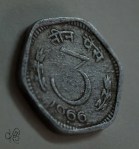
If the value of the three paisa coin has appreciated, then I am perhaps responsible for the fortunes of another girl 😀

Coin Album
Coin Album With An Index

I loved collecting coins as a kid. I’m not sure when and how it began. Perhaps it was the discovery of a small bag of coins at home, or a few foreign ones left behind by visiting relatives. At first, it was restricted to ten paisa coins and cents – we had an abundant supply of them.

As word spread of my interest in coins, friends and family members, who had been travelling abroad, generously donated currency. I was even given a coin album. It had clear plastic sheets with small pockets to store individual coins. I arranged my coins and added small notes about the country, year, and the symbol and slogans on the coins.

Three Paise
Three Paisa Coin

I had big plans! I thought the collection would grow very large. So using my foresight, I made an index of the countries and currencies to manage the treasure.

I even began keeping coins and notes, which were still in use – I was a ten-year old, and I was already investing in currency!

Close Up Of Page
Close Up Of Page

Even as different countries resided within my book, I discovered coins in my own home – one, two, and three paisa coins. I had only one one-paisa coin. But I was more delighted with the three paisa coins. Three was an unusual denomination for a coin, and I took pride in owning two of them!

I spent nothing, and yet owned a lot. My successful collection, soon got to my head. I boasted about the large variety of coins I possessed – far more than I should have. Once, I even took some coins to school, as proof. And that’s when it happened.

A classmate of mine was very impressed with my coins. She asked, in the nicest possible way, ‘Can I take one of these?’

And like a fool, I gave it to her. To this day, I regret that action. I could have traded it for something else – but no! I had to act magnanimous. That’s what happens when you allow ten-year olds to handle so much money!

One Paisa
Holy Coin! One Paisa

A few years later, deep within the depths of my eldest aunt’s huge cupboard, I uncovered a gem – the 1 pice coin. It was older than the Indian democracy, and it had a hole in it! Nothing could have been better than that.

I’m sure there are lots of people who collect coins – and would buy old coins like the one with the hole. In old Delhi, I found coin sellers selling such antique coins on the pavement. The realisation, that the coins I had, were all gifted to me, made me feel great. But my coin collecting days were numbered.

The European Union was formed, and I grew up. The album was relegated to the cupboard, and my collection, nothing more than a lost memory.

A chance discovery of some coins in a piggy bank made me pull out my album, and I found that my foresight was rather too great. I had one, two, and five rupee coins and notes stashed up inside – which I could still use today! Time to add the ten rupee coins I suppose 😀

*  *  *

I had posted some photographs of coins a few weeks back. One of my favourite bloggers, pointed out the scarcity of the three paisa coin… This story was supposed to be a part of that post, but now, is also in response to that comment, and today’s prompt on The Daily Post!