I tell stories - of people, places, and ideas - through words and visuals.
Designer by profession, Writer by passion, and Storyteller by accident (or is that a cosmic conspiracy?)
Digital Nomad, Slightly Eccentric
Walking on the streets of Delhi in the morning, there is a cloud of dust in the distance.
I am on my way to office. A few drivers are wiping away the last few drops of water off the cars. The owners will be out in a few minutes–the early birds who want to beat the office rush.
As I walk towards the dusty path, the outline of a broom wielding person emerges.
Swoosh!
A kerchief over his mouth, a swafa around his neck—beads of sweat, if any, have been hidden under filth.
As I approach, he stops. He waits for me to pass, and then continues to clean up the mess created by fellow humans the day before.
Since the time I can remember, workers like these have worked tirelessly to keep the streets clean. I don’t know who employs them. We’ve not paid them for their services—unless one of them comes to collect bakshish or chanda after Holi and Diwali.
A car passes by me. An empty bag of chips comes flying out. Further ahead, a man casually spits on the road.
We’re supposed to be on a mission to clean up the country. I wonder what these sweepers who’ve been cleaning this urban city for years would have to say about this mission.
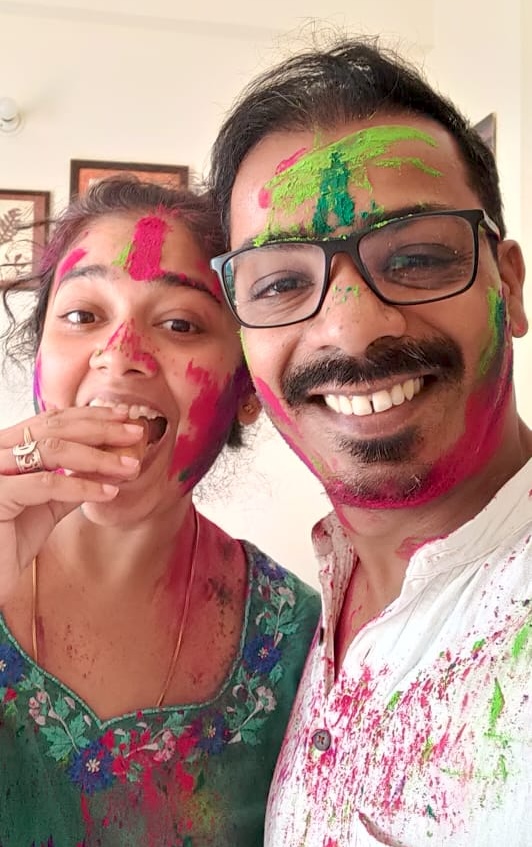
Here’s wishing you a happy and colourful Holi!
We’ll set aside a few Gujiyas for our cleaning staff when they clean up after our festivities tomorrow morning.
Vinodeni had her task cut out. 30 minutes. Her newest clients didn’t have a moment more to spare. She shed her soft-spoken veneer and turned into the Willy Wonka of the Aquarium. “Okay! We have a short time, so I’ll prioritize and guide you through the most important exhibits.” She said, in an excited voice.
“Do you eat seafood?” Him, yes. Me, no. “Oh, no worries! I was asking because we’ll see some of the tastiest fish the Andamans have on offer. But hopefully, you’ll still enjoy it.”
The Aquarium next to the Aberdeen jetty is a small, likely under-funded museum dedicated to the marine life around the Andaman and Nicobar Islands. It wasn’t on our planned itinerary. But seeing that it was right next to our lunch place, and still had 30 minutes before closing time, we figured, why not? It was, after all, our last day at Port Blair.
We were welcomed into the otherwise dull-looking compound by a gigantic skeleton, displayed proudly to entice the casual onlooker. The entry to the main exhibits was through a small door. But first, we had to buy our tickets. And it was at the ticket counter, that my eyes lit up. Even if we didn’t go inside, my day was made. For by the ticket counter was the mythical creature my father told me about when I was a kid. But we had our tickets, and twenty five minutes to race through it all.
And that’s when we met Vinodeni, our museum guide.
Perhaps the word aquarium wasn’t an appropriate one. The inside of the museum looked more like a chemistry lab than a lively underwater showcase. Rows of shelves, stacked top to bottom with preserved specimens of marine life, each several years old. Vinodeni lamented the loss of some specimens during the tsunami, as she continued to show some not-so-appetising seafood in chemical filled jars.
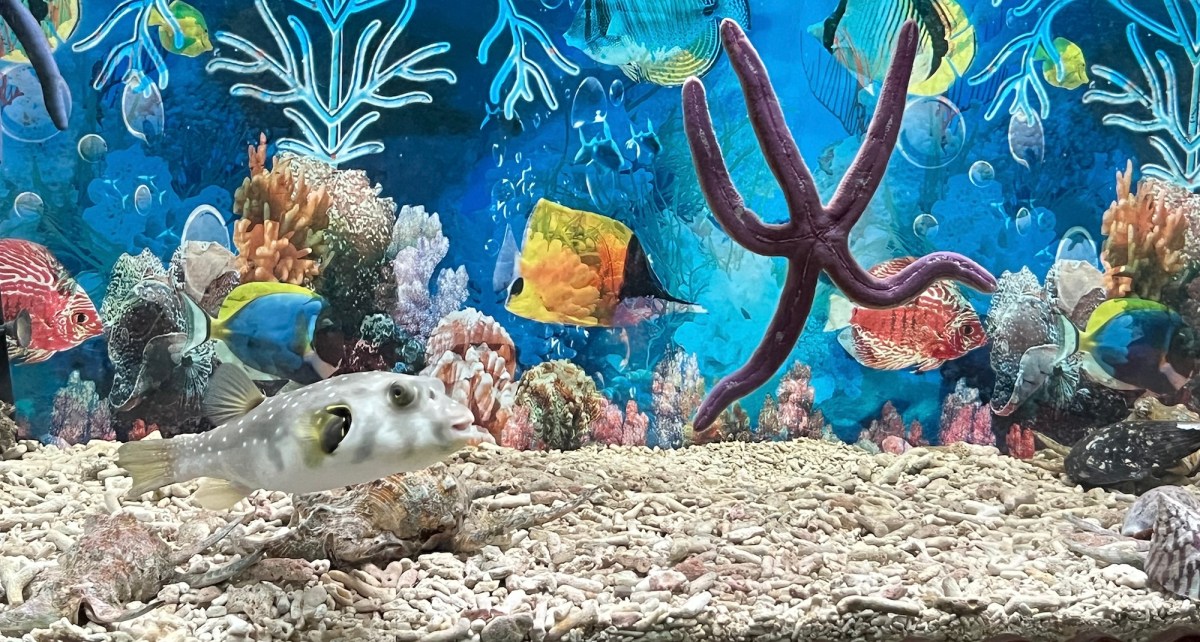
Next up, the living exhibits. Vinodeni requested us to keep the flash of our cameras off, so as to not disturb the marine wildlife. The rooms were dimly lit, presumably to mimic the sea lighting, but the tanks themselves had artificial lights and bright colourful backgrounds.
A fish and a starfish compete for attention on a busy background.
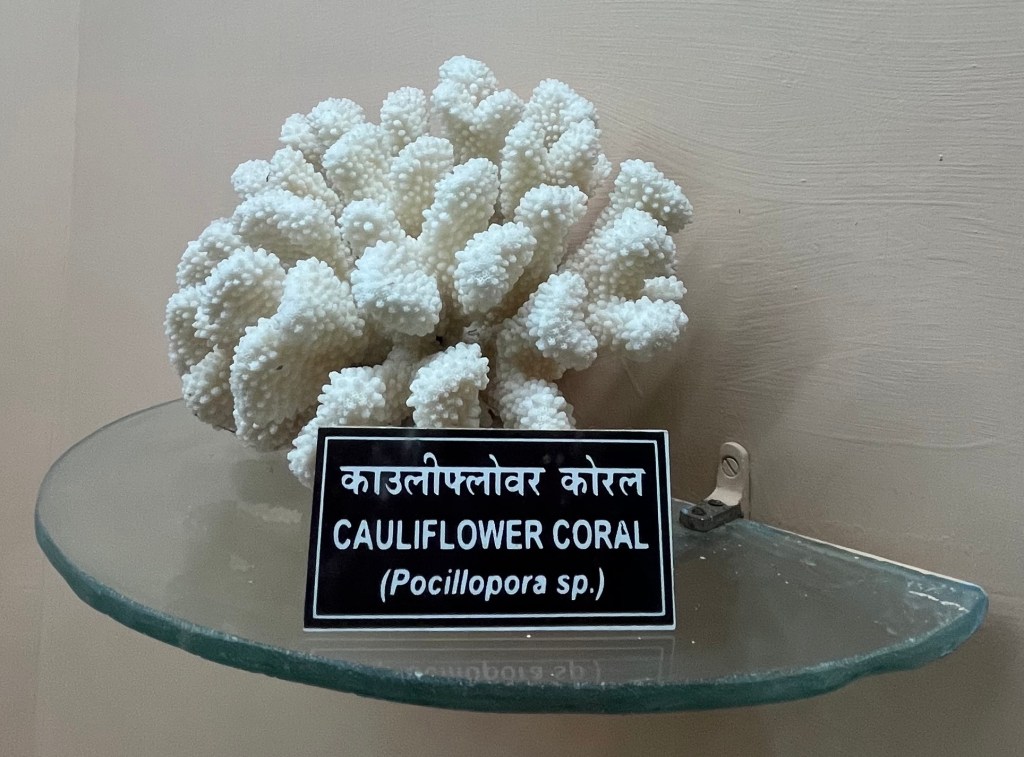
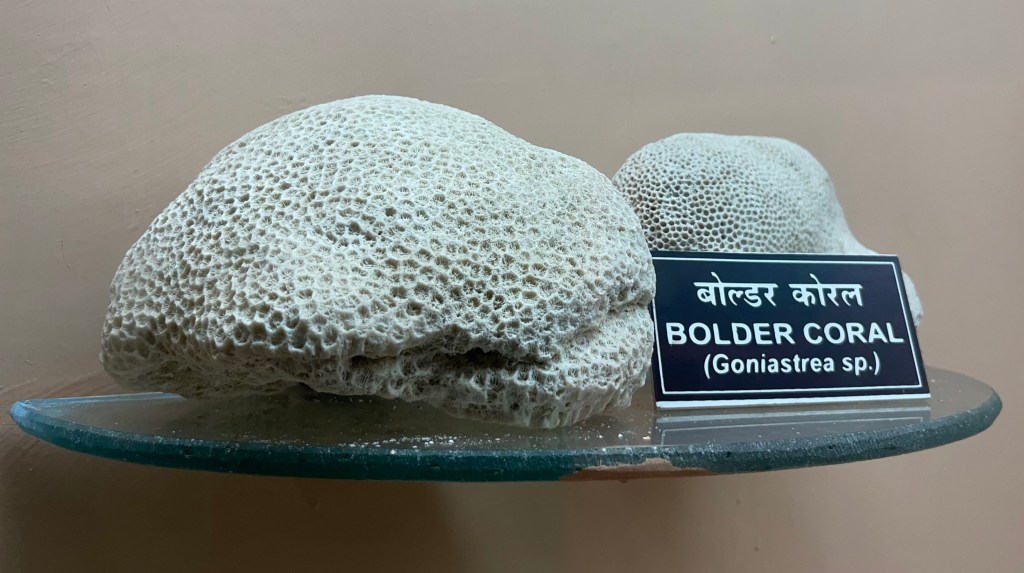
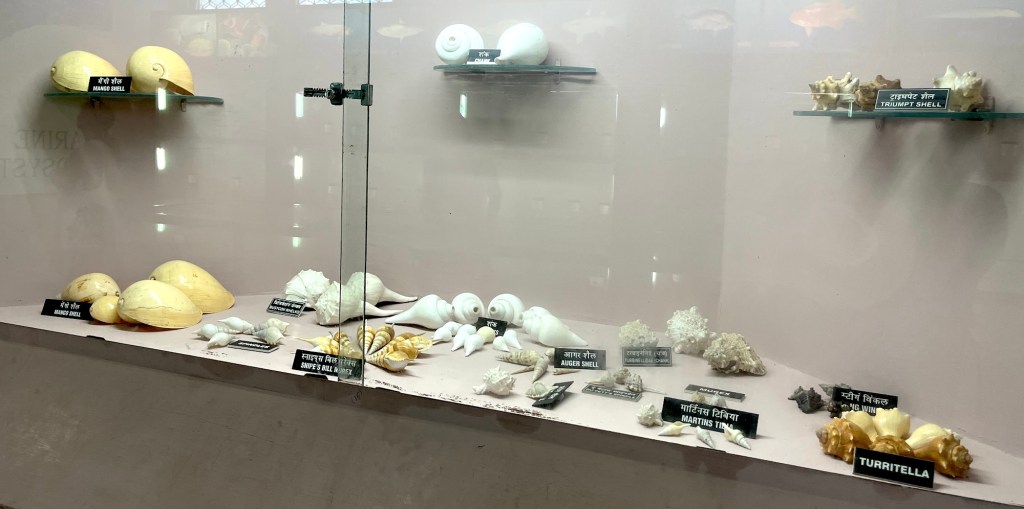
The fishes were beautiful, of course. But the exhibits I was most interested in were the seashells and corals.
I’ve been beach combing from the first time I visited the sandy beaches of Chennai. I’d admired my grandmother’s collection of small, pretty, colourful bones sorted neatly by type and displayed in fancy bowls. My mother’s collection had much larger ones, in various shades of brown. But it was my father’s collection that awed me the most. Almost entirely white and massive, these were deep sea creatures on our mantlepiece.
Several thousand kilometres away from home, in a dingy room, there they were, familiar faces. Now, thanks to the museum, I could give them names.
Vinodeni told us about how these exquisite creatures are now critically endangered. They’d been pulled out from their habitat and traded for their beauty. And now, there are too few of them in the wild. I flinched a little as she continued, “they don’t belong in our homes.” She then reaffirmed what we’d learned just a few days earlier—that even the abandoned seashells on the beach are reused by other creatures.
Vinodeni probably realised that I felt a little guilty, so she changed her tone a little and told us that those who acquired them in the past weren’t aware of what would happen. But now, the Government is trying to fix things.
It is now illegal to trade some varieties of shells. And the airport strictly screens baggage to catch anyone taking seashells and corals out of the archipelago.
Lunch time was creeping up, and mindful of the closing time, Vinodeni ushered us to the exit. “There is one more exhibit that you must see, but you’ll need to step outside in the sun for that.” We obliged. She took us towards the giant skeleton at the entrance of the museum. “This here, is a full skeleton of a Sperm Whale.” She then rattled off a quick set of facts about the creature, including why it was named thus. The way Vinodeni spoke made it abundantly clear that she was passionate about marine life.
With our tour over, we continued to chat for a while. I asked here where she was from, and she said she was from Port Blair. Her ancestors were from Tamil Nadu, but since she was born and brought up there, she considered the Andamans her home. “Wouldn’t you agree?” she asked me. After all, I too had grown up in Delhi, and though my roots lay in Madurai and Thanjavur, I was certainly more of a North Indian.
And perhaps that’s one reason why seashells excited me so much. It was that North Indian kid that was so enamoured by marine life so far away from where she grew up. Which is why I was excited by just standing next to the ticket counter. My seafaring father had told me about the fantastical creatures that lived deep in the ocean, especially the seashells the size of bathtubs. And seeing the Giant Clams in person was a dream come true.
The Giant Clam—almost the size of a bathtub. This pretty much sums up why I’ve always wanted to visit Port Blair. Throwback to when a little girl’s dream came true.
Our trip to the Andaman Islands left a deep impact on me, particularly my relationship with seashells. I still adore them, and proudly display our collection at home. But ever since that trip, I’m mindful to not pick any more. They’re someone’s home, and they deserve to be used for that purpose for as long as possible.
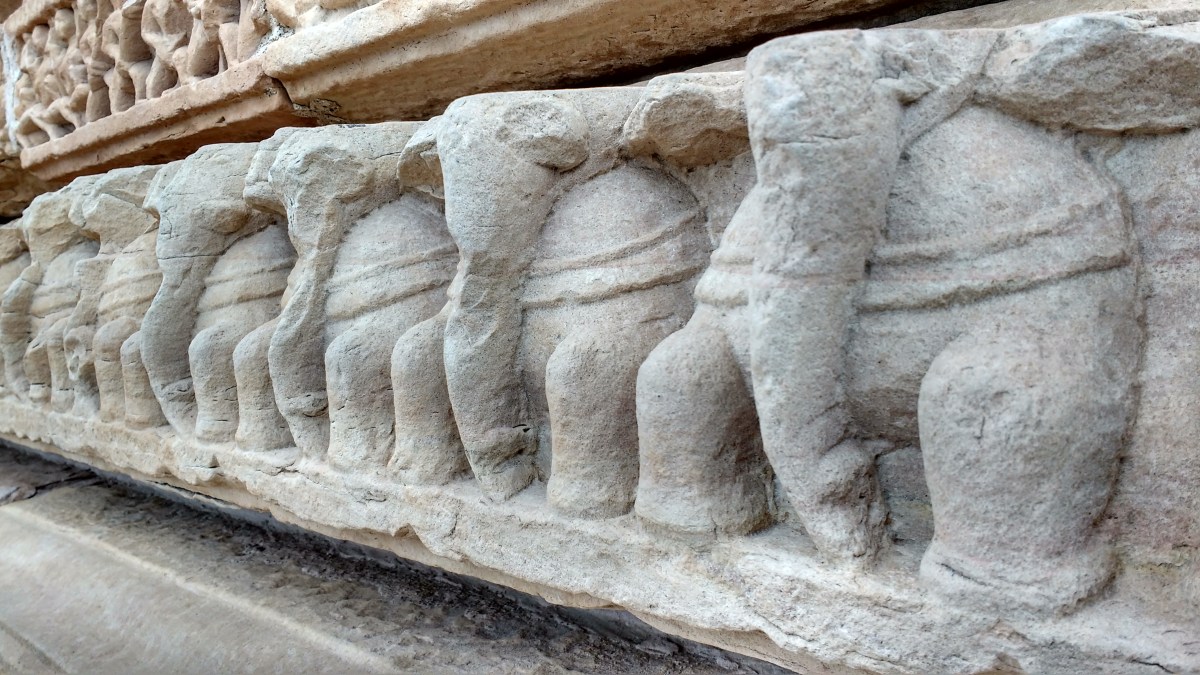
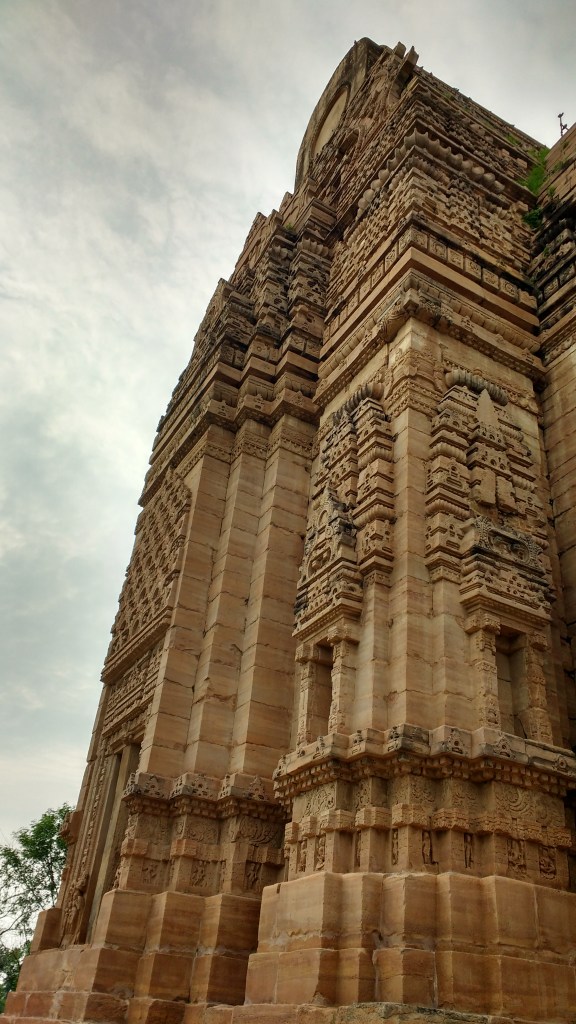
Close-up of the sculptures on the walls, Gwalior Fort Complex, Madhya Pradesh, India.
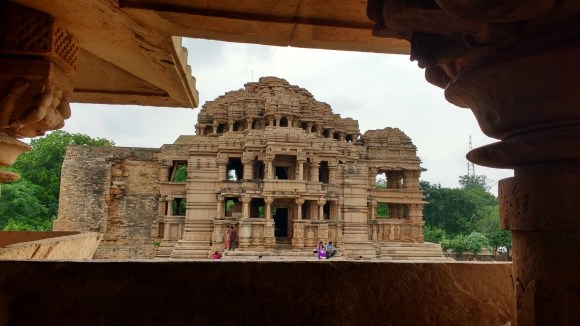
The elaborate sculptures adorning the temples in the Gwalior Fort are too many to count and too beautiful to describe. Many have been weathered by the strong wind. The many kings who fought, captured, and lost the Fort seem to have left the temples untouched.
That they have very strange names takes nothing away from their beauty. The “saas” is big, bod and stands proudly, imposing her might on anyone who dares think contrary to her wishes.
The “Saas” as seen from the “Bahu,” Gwalior Fort Complex, Madhya Pradesh, India.
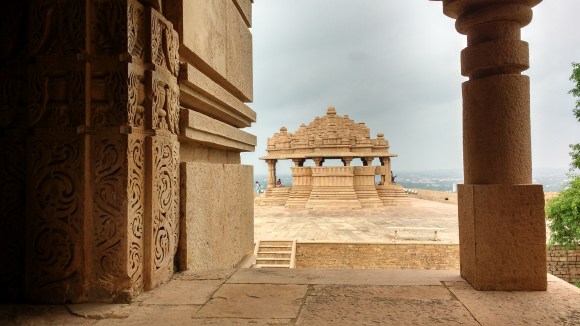
The “bahu” stands at a distance, more towards the edge of a cliff and doesn’t care for attention.
The “Bahu” from the point of view of “Saas,” Gwalior Fort Complex, Madhya Pradesh, India.
Inside the large temple, one gets the feeling of being engulfed by Sahasrabahu, the one with a thousand hands—hands that are dancing, playing music, worshipping, meditating.
Who was the guardian deity of these temples? No one can tell for sure. There are conflicting tales about Shiva and Vishnu. Some claim that these are Jain temples.
Folklore says that the ruling king dedicated the large central structure to his mother, an ardent devotee of Lord Vishnu. The smaller temple was to pacify the king’s wife—a Shaivite.
Tourists take pictures, climb over the walls, and walk precariously along the beams that form the triangles overhead. But few venture close to the sanctum sanctorum.
Teli Ka Mandir, Gwalior Fort Complex, Madhya Pradesh, India.
A short distance away, the Teli ka Mandir stands tall. If the building could speak, I might have said, “I am Dravidian.” As I was imagining the walls speaking to me, a man hurried out from inside the temple, cursing under his breath. He looked livid and frantically looked around so he could vent his rage. When he found someone who looked like a caretaker, he let him have it.
“This is a temple! Why are people wearing shoes and trampling all over? Have you stepped inside? It reeks of bat filth.”
“Such a fine architectural monument and you are letting it go to waste. Is this the devotion this was built for?”
The man’s lament fell on deaf ears. The caretaker gave an indifferent glance. “It is no longer in use, sir,” he said, and walked away.
The sanctum sanctorum of all three magnificent temples were dark portals. Beauty graced all the walls outside and inside the halls leading to the small room meant to be the throne of the presiding deity.
If the walls could speak, they might have been as indifferent to our presence as the caretaker was to their plight. With their structure reduced to architectural candy, and the real purpose long given for bats to live in, there was no longer anything left to say.
Still salvaging old work from the archives, I discovered this story’s handwritten draft from May 2017. This too, is a part of the ebook The Speaking Rock. If the pictures are grainy, it’s because they’re from a phone camera from 2016.
I was both proud and awestruck by my phone camera’s prowess back then. It pales in comparison to what my phone can do now. And digital technology today still doesn’t match up to film camera clarity. But grainy footage notwithstanding, it reminds me of some wonderful memories we made almost nine years ago. Isn’t that what pictures are for?
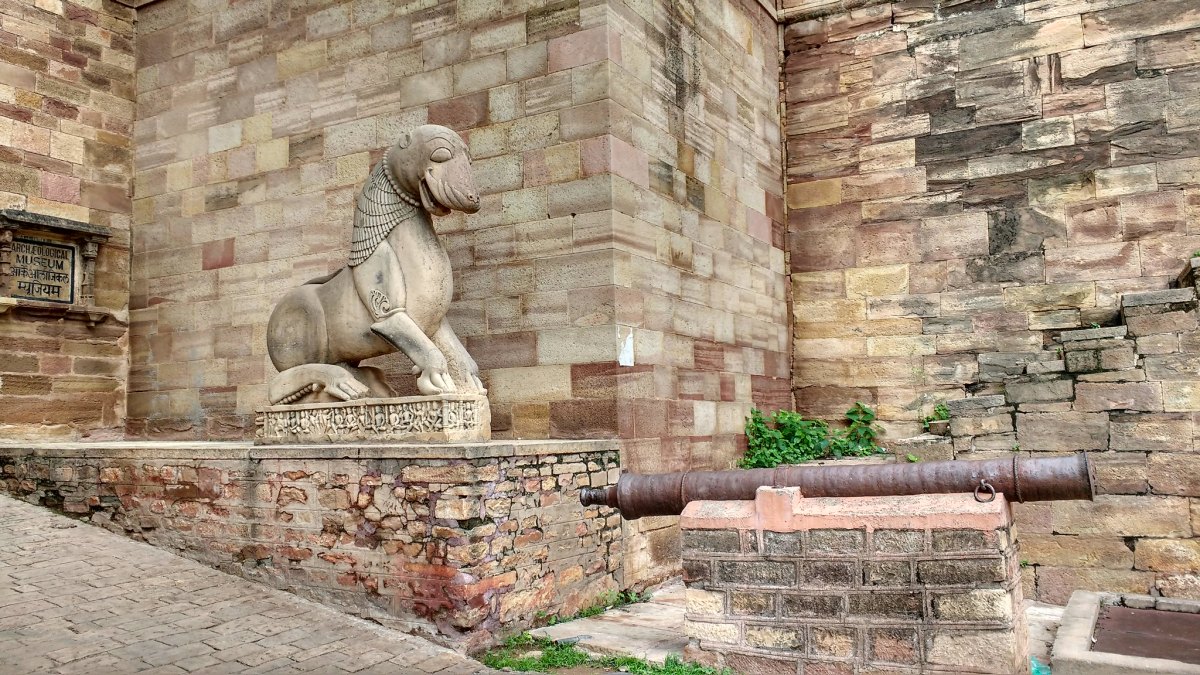
One of the stone lions at the entrance to Gurjari Mahal, Gwalior, Madhya Pradesh, India.
We walked past the stony gaze of the lions guarding the giant entrance. Fresh monsoon grass peered from beneath the sandstone tiles. The wings of the Fort kept a keen watch from above. The ninth Queen of Raja Maan Singh surely must have been special to get this much attention.
We walked on what was the front porch of the Gurjari Mahal and trekked up a steep path leading to the Palace. To our right was a well-manicured lawn. And to the left, a steep rocky path that seemed to lead nowhere.
The Palace had a short and narrow flight of stairs that led to a beautiful courtyard. Intricately carved stone statues of God and Goddesses here, pieces of floral patterned pillars and walls there.
The word museum was, perhaps, not very appealing to most tourists. Even those who strolled in didn’t stay long. The cool breeze only enhanced the peaceful ambiance of the courtyard.
“Do you have a ticket for your camera?” A portly man asked as we began freezing moments for our album.
We showed our ticket.
“Well, then please use only one—either your phone or the camera. Please!” Beneath his small smile, the request was firm.
I put away my phone and smiled sheepishly. Half expecting the man to run back into his administrative chamber after we had complied with his request, we turned to continue our exploration.
“Oh but first you must come and see the Salabhanjika!”
The Salabhanjika is the museum’s prized possession—a miniature statue that epitomizes femininity. We had read about the sculpture being guarded closely and were under the impression that we’d need special permissions to see her. So when the gentleman invited us to take a look, we happily accepted.
We followed him to his office. A small dark room furnished with a simple desk and a few plastic chairs. The medieval walls were covered with yellowing photographs and newspaper clippings about the sculpture. Behind the desk was a cell. Deep inside behind steel bars, stood the small, smiling Salabhanjika.
“She’s called the Indian Monalisa!” His voice was filled with pride at being the guardian of a rare sculpture. Like many of the exquisite sculptures that we’ve now become accustomed to seeing, Salabhanjika was breathtaking.
“When she was first found, she looked like this,” he said, pointing towards a grainy print stuck on the wall. “Her head was found later and was fully intact, so we could piece her together. We were lucky.”
“Look at her carefully. The more you look at her, the more she’ll smile back at you! Look at her from any direction and she’ll look towards you.”
We looked again. And she did, indeed, appear to be smiling more than before.
“Please take a picture. Go on, go closer. Make sure you switch off the flash!”
We leaned in, the lens of our camera wedged between the steel bars. Click!
“She’s been insured for five crores!” our host could hardly contain his excitement.
Five crore rupees. The Monalisa is insured for a hundred million dollars.
Salabhanjika’s smile grew wider.
I wondered, if she had been discovered before the Monalisa, would Leonardo Da Vinci’s painting be called the Italian Salabhanjika?
She stood there silently. Still smiling, and letting the question remain unanswered.
Salabhanjika is a Sanskrit word meaning ‘breaking a branch of a sala tree’. There are many intricate sculptures of Salabhanjika in Hoysala and Bednur. But the one in Gwalior is reportedly the only one that smiles.
This story is part of my digital book, The Speaking Rock.
Originally written in 2017, the ebook was published on the Juggernaut platform.
For those who aren’t aware, Juggernaut was a publishing platform that claimed to democratise publishing. It’s slogan, “You don’t need to know anyone to get published.” It provided writers access to publishing tools and a marketplace where readers could connect with writers directly. The Speaking Rock was one of three ebooks I had published with them. My story Free Bird also won a short story contest and was featured in their anthology collection.
I loved that platform, even from a design perspective. I even wrote a glowing review on Design Tuesdays.
Unfortunately, the platform soon introduced a paywall and put my stories behind a paywall (without offering any royalties). And thereafter, the platform disappeared altogether, taking my work with it, leaving me hanging high and dry. I felt betrayed. I felt bitter. I kicked myself for being naive. Of course, their business model wouldn’t pay their bills.
For a good three years, the site just showed an ugly “under construction” message. No way to get in touch with them. No way to retrieve my work. I had made peace with the fact that I’d lost my stories—until a few days ago, when I found a draft on Google Docs that had one of the stories. And when I saw the draft of the Eternal Smile sitting right under my nose on WordPress, I almost cried.
Funnily, when I opened Juggernaut’s website today, I found that it was no longer under construction. (The internet archive’s Wayback Machine reveals that the site was still down as recently as 5 days ago!)
There is no mention of a writer’s platform, and no way for any one to log in and retrieve their work. Today, the website is just like another publishing site that displays influencers and popular media icons who’ve published with them. So much for democratising publishing!
As for me, I’m happy that I can finally share Salabhanjika’s smile with you. I’m still looking for that photograph we took. I’m sure it’s there somewhere in our virtual closet.
In our quest to capture virtual memories, we've built physical spaces to be Instagrammable.
How do you do it?
How do you manage to read all those tweets, post comments on YouTube, react to Instagram stories, finish the long reads on Medium and WordPress and catch up with emails? All while having a day job, socialising with friends, managing a decent workout and being up to date with current affairs and pop-culture.
I know I can’t.
I was a very, very late adopter of social media, primarily because I felt it was meant for lesser mortals, those who indulged in gossip. The narcissist that I am, I didn’t quite care about what other people did around me. I only wanted to write and share my thoughts to as wide an audience as I could.
I sceptically joined Facebook in mid 2013. And it wasn’t till 2017 that I joined Instagram. These occasions were so significant, that I wrote blog posts to confess about these mis-adventures. The only reason I have a Twitter account (I don’t care what they call it now, but I refuse to call it by any other name) is because my employer demanded I create one. Without that coercion, I would probably not have created it in 2014.
Then there’s LinkedIn, Flickr, Pinterest, YouTube, Behance… the list is far, far too long.
Over the years, I have tried to keep up with these services in patches and failed. I wonder how other people do it. And it bothers me that I am so digitally incompetent. I am everywhere, and yet, nowhere. At any given point of time, I can keep up with only one service. Everyone else is active everywhere.
When I think about all the different services that aim to ‘connect’ us in the world, all I see is this relentless barrage of information, and how miserable it makes me feel.
One More Thing
In 2019, I tried an experiment. I called it, the “Reverse Social Media.” I wanted to stop using social media, and instead focus on creating a community. I’d send out emails to people so that we could start one-on-one conversations. Needless to say, that experiment failed. I had ended up creating yet another digital footprint that I couldn’t manage. If you’re interested, you can find the archives of this experiment on Design Tuesdays.
In these first two decades of the twenty-first century, a certain Mr. Jobs made a catchphrase his own. “One more thing…” he’d say, at the end of his keynote, and announce something new. Steve Jobs’ characteristic style of delivering keynotes even has a name: Stevenote!
A side note: To me, those words will always belong to Uncle from Jackie Chan Adventures. The series aired during a time when information wasn’t as free-flowing as it is today, and when tech was only for geeks. What use was a business presentation to a teenager? So please allow me to indulge myself with TV memories from the early 2000s.
Source: Imgur
With the newsletters, I had created Uncle’s one more thing. More recently, that one more thing is Threads, from Meta. Sure, I’ve ‘created’ the ghost account, but it holds no meaning for me. To me, it’s just another username that’s gathering virtual dust.
The Digital Cobwebs
Remember the old days when we had hard disks and had backups of folders and backups of backups? Ah, those were simpler times. Those hard disks are gathering dust in a shelf somewhere.
Our digital clutter, on the other hand, is invisible, but several times worse. This digital clutter that we’ve chosen to create haunts me. Over the past few years, I’ve lost very close loved ones. But their profiles show up in recommendation feeds on social media. I don’t want to tell these behemoth companies that those are my dead relatives. The large tech companies have no business knowing this private information. But, at the same time, I don’t want their click-hungry algorithms to be so insensitive.
In my curiosity to explore the internet, I wonder how far my own footprint has landed. Who has my email address? Which database has a username attached to me?
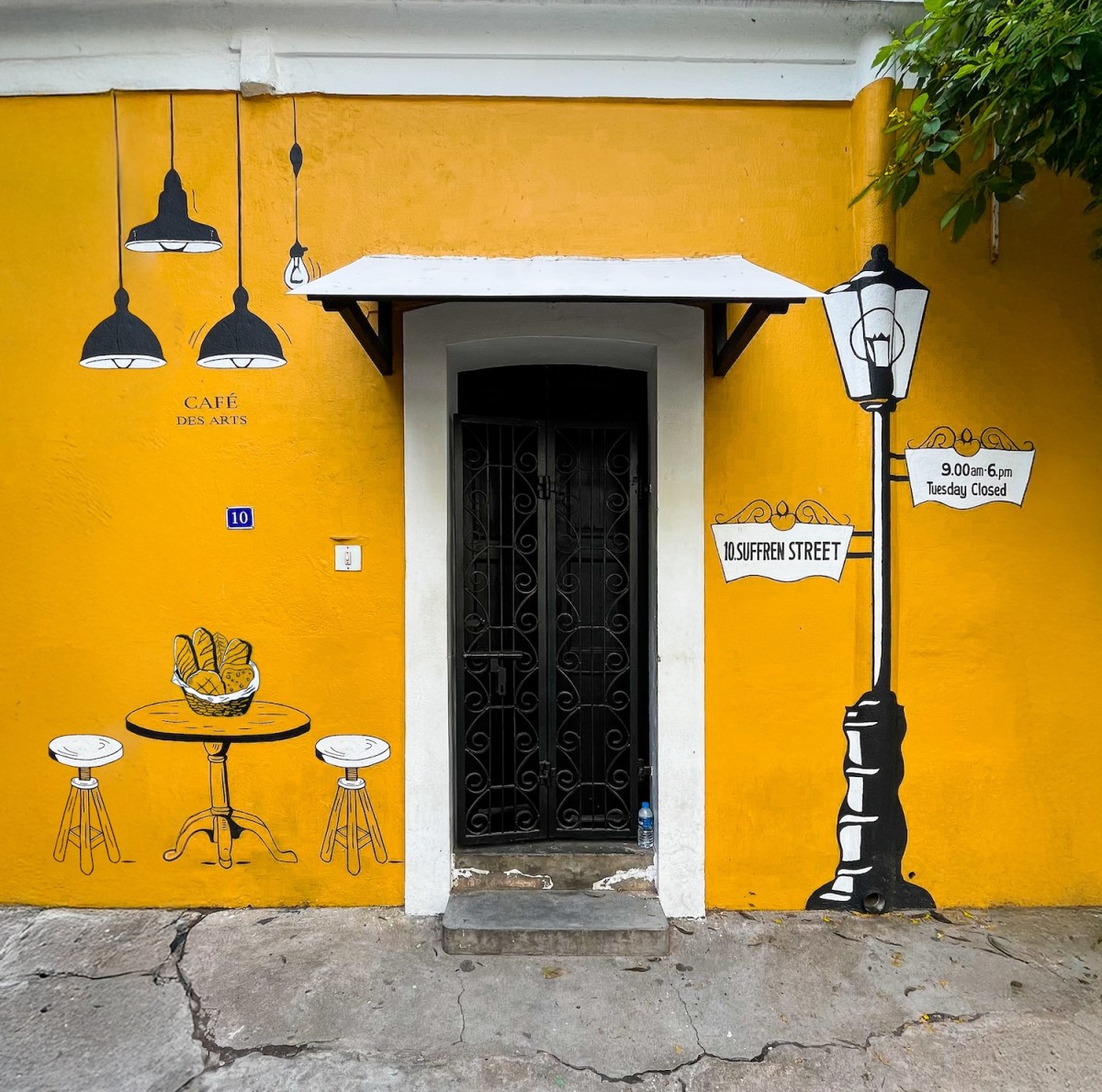
In our quest to share virtual memories, we’ve built physical spaces to be Instagrammable. How many people would have half-squatted to “sit” on the painted chairs on this pretty yellow wall? Guilty as charged. Location: Puducherry, India
Worse still are the chains I’ve tied around myself. Those accounts that I do know about, I find it hard to let go. It was easy to delete my Facebook (now Meta) account over three years ago. But Twitter is giving me a hard time. Not because I use it. I don’t. But because once I delete the account, my username will be available for use by someone else. And I shudder to think someone else will take on my identity. So much for me championing reuse and recycle.
There’s so much digital waste we’ve generated. All that waste is sitting on some server. Consuming electricity. Generating heat. And consuming more electricity to cool down. Every little piece of digital information I leave unattended reeks of a hypocritical sustainability advocate.
The Way Forward
I don’t have an easy answer to this mess. In this virtual chaos we’ve created, it’s a daily struggle to decide what to keep and what to discard. Which memories to hold on to, and which to let go.
A couple of months ago, out of sheer frustration, I embarked on a virtual housekeeping project. The task looked insurmountable, but I had to begin somewhere.
So, I looked for low-hanging fruits. I located those physical hard disks. I thought to myself, if I haven’t needed it in the last ten years, I won’t need it again. First, I transferred them to my Dropbox folder, so that everything was in one place, and then I began reviewing them.
So many duplicate photographs. Old portfolio files that I was once proud of, but now find ghastly. And those legacy file formats that I can neither open, nor have had the need to edit. I began hitting the delete key.
As Dropbox later informed me, I had deleted about 15000 files in the span of a week. It was a statistic I didn’t know I needed to hear. And it was so cathartic.
This was just the tip of the iceberg. There are several more files and photographs to go through. I’ve hit pause on that activity because, as I’ve now learned, I can’t focus on one thing constantly. Plus, frustration and adrenaline can fuel such binge-deleting sprees for only so long. But I hope to pick it up in patches.
My current project is to clear up the cobwebs of my blog drafts. Several of my last few posts have indeed been 3 – 4 year old drafts (this one included!) I’m still only 10% in, but seeing some virtual dust being cleaned up is helping me mentally.
I don’t know how far I’ll get. But I’m going to try. It’s a marathon, not a sprint. And the only way to tackle it is to take it one thing at a time.
On an unrelated note, how would you like me to narrate these stories via a podcast?
An astrophysicist, a Vedic scholar and an earthworm walk into a room.
Before I complete the story, here’s a question for you:
Do you believe in a higher power? A celestial being that’s constantly keeping a watch over us?
I used to, but now, I believe that we delude ourselves into thinking the universe cares about us. Stars don’t align for us. They just go about their lives, and we simply get caught in their world. We are, but mere cogs in their grand scheme.
Men In Black Movie ending sequence where the universe is revealed to be a marble in the hands of an alien.
The moon revolves around the earth, and it sways our mighty oceans with its movement. We, too, are just bags of warm water. Surely, the moon must have some impact on us. We get life-sustaining energy from the sun. And it’s such a long way from home. Surely, other stars must have their secret powers.
Ancient Indian astrologers had probably cracked some of the codes of the universe. But like much of our wisdom in other disciplines, it has been tossed out in our English-medium world that’s out to make some money off our ignorance.
What I lost in ancient wisdom, an American TV personality packaged into a shareable quote:
The four most common chemically active elements in the universe—hydrogen, oxygen, carbon, and nitrogen—are the four most common elements of life on Earth. We are not simply in the universe. The universe is in us.
This quote reminded of two types of universes: the more observable physical one, and the abstract, spiritual one that’s hidden within.
The Observable Universe: My Compost Pile
I started composting some seven years ago, and it has been the most rewarding, meditative experience. Composting gave me a glimpse into an entire self-sustaining ecosystem. At times, I felt like God, overseeing a world, controlling what goes in, and when it’s ready to harvest. But most of the time, it made me realise that we too are tiny insects in the compost pile of a higher force. We’re all transient creatures taking part in a grand spectacle called nature.
My compost pile is made up of organic material. The brown stuff has a lot of Carbon, the green stuff is rich in Nitrogen, and since kitchen waste tends to have a lot of water content, the other two components of Hydrogen and Oxygen complete the quartet. With each harvest, I see the universe in action.
I took whatever I learned and turned it into a small online workshop. Here’s a recording of a session done during the initial pandemic lockdown. I hope you enjoy.
The Hidden Universe Within: Aham Brahmasmi
The Brihadaranyaka Upanishad, one of the first Upanishads dated to 7th century BC, has a popular phrase, Aham Brahmasmi. It translates to “I am the Brahman.” The Brahman here is an abstract concept that may be interpreted as being the universal truth, cosmic energy, perhaps even God.
Side Note: This Brahman is not to be confused with the caste, which is pronounced differently. One’s caste is defined by one’s profession—and is neither discriminatory not hereditary. But that’s a different misconception to be dealt with by more learned scholars.
Aham Brahmasmi is a phrase that’s close to my heart because it instills a feeling of being complete, without relying on any external validation for our existence. We hold immense potential within us. If we channel it well enough, we can accomplish anything.
I love this Mahavakya (phrase) so much, that I even have a ring with the phrase written in Devanagari calligraphy.
So what happened to our astrophysicist, Vedic scholar and the earthworm? The two humans spent the whole time arguing over who was right, while the earthworm just chewed its way around the room till there was nothing left except life-sustaining matter.
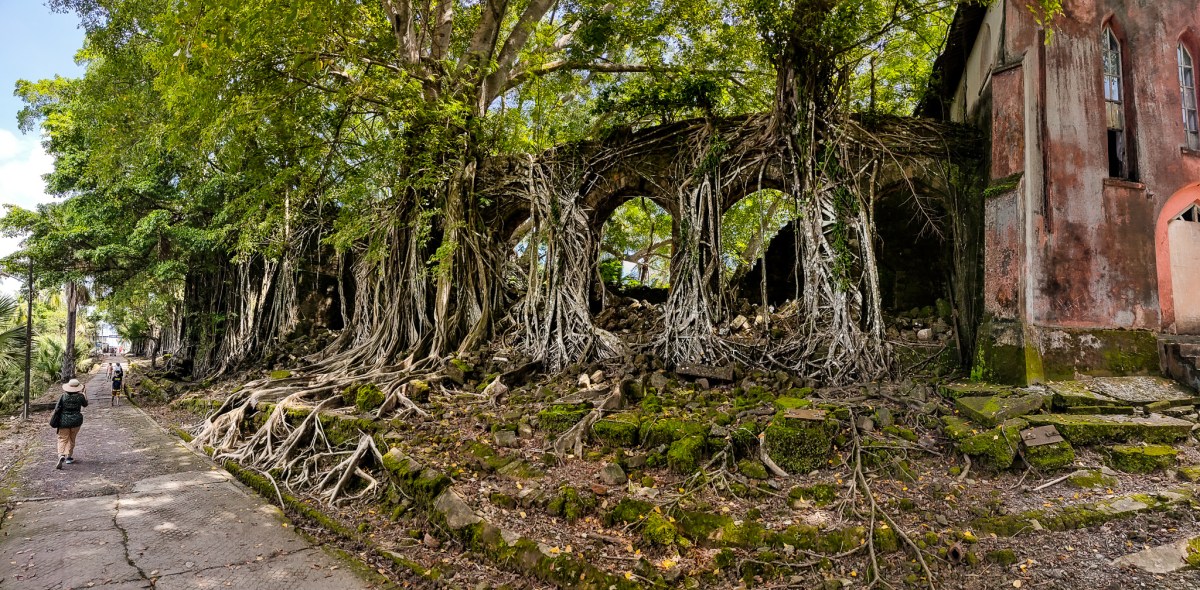
The featured image at the top is of Netaji Subhash Chandra Bose Island, where nature has reclaimed man-made buildings, creating the most stunning root displays. Location: Andaman and Nicobar Islands, India.
It was my first visit to Dubai, and I wasn’t handling the timezone difference very well. On most days, I found myself waking up at 4 am.
Tossing and turning around in the soft hotel bed, try as I might, I couldn’t sleep. Fortunately, the hotel was walking distance from the Jumeirah beach. If I was going to be groggy during the meeting hours, I may as well enjoy some time with the waves. So I strolled up to the beach every morning and watched the waves crash on to the silent shore, waiting for the sun to rise.
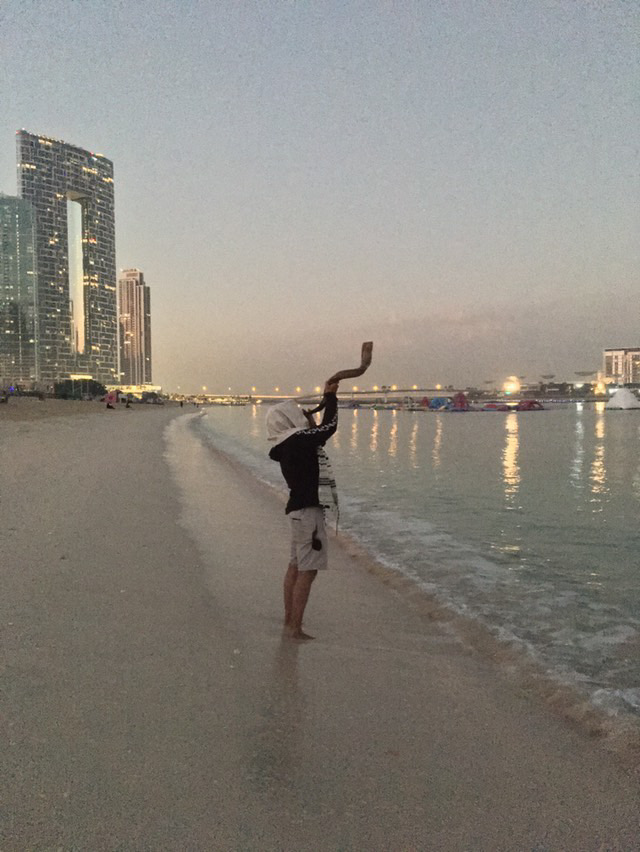
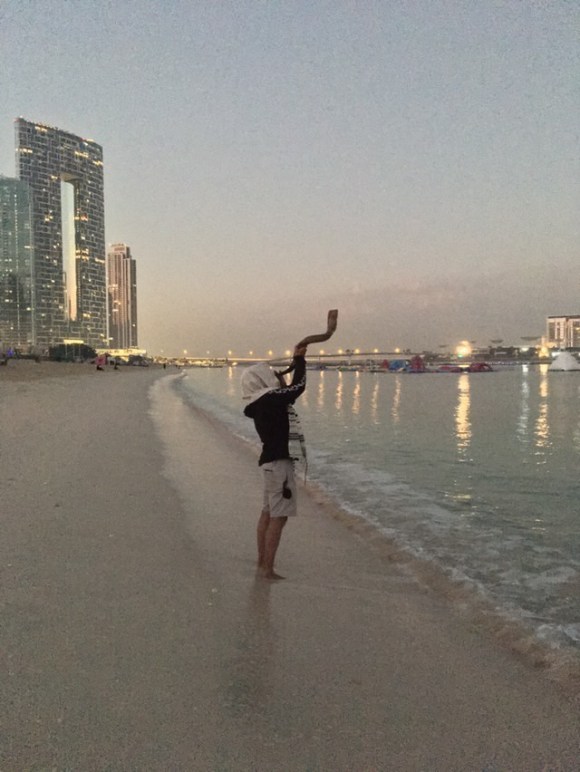
On one of the mornings, I heard someone play music. It wasn’t hard to locate the source. Still dark, I could make out the outline of a man, his head covered and in his hands a giant horn-like instrument. I sounded something like a bugle, but not quite.
Vernon playing the Shofar at Jumeirah. Picture taken with permission.
I waited for him to finish his piece and mustered up the courage to talk to him. “Where are you from,” I asked. “India,” he responded.
It took me a while to recover from the surprise revelation. “So am I! Where from? And what are you doing here?” I rattled off the questions in quick succession.
He told me his name was Vernon, and he was from Mumbai. By profession, he was a personal trainer.
His client was sleeping that morning, and he decided to extend his stay at the shore.
He then explained to me the significance of the instrument he was playing. The Shofar is an Israeli wind instrument. He played it early morning by the beach, before beginning his day.
Vernon explained a few verses from the Bible and how the instrument was his path to spiritual cleansing. We continued to speak about vibrations and how everything in nature is connected to different types of “waves”.
When the sun had come up fully, he took leave. I lingered around at the beach a little while, reflecting on our conversation.
“There are no accidents,” he said. “If my client wasn’t asleep, I’d have left a long time ago. God wanted me to play for you.”
The curry tree—a plant, actually—with its slender stem and a head full of leaves, swings wildly in circles as the wind howls ominously.
Hardly able to stay firm, the plant tries its best to lend support to the young saplings at its feet—a variety of Marigold, I think. They cling to the curry tree-plant for dear life as the sky turns grey: not with the sweet-scented rain-bearing clouds, but with dust.
Not far, a polythene bag rises up in the background of tall, barren buildings. 5 storeys, 6… 7… 8… and out of sight.
This may not be a cloudburst or a hurricane or a tornado or anything life-threatening—unless, of course, there is dust in your eyes or flying sheets of lightweight construction material are rushing towards you.
But it’s sad, and a perfect manifestation of a broken heart.
Stay strong my curry tree-plant. The Marigolds need you.
Wind: 26 kmph. Temp: 38 deg C. Humidity: 15%
Another long forgotten draft finally finds its way to light! I wrote this sometime in March 2021, on a particularly tumultuous day, not just for my curry tree-plant, but for me. I was shaken by some events in my professional life. I refrained from publishing it because it triggered a painful memory.
They say time is a healer. And with the distance of time, I can now recognise that memory more objectively. It was one of those events that shaped who I am today. It shook the naïveté out of me. Well, some part of it anyway! By moving past this memory, hopefully I’ll regain a part of me again.
My old curry tree-plant. It stayed with us a good four years or so. It survived the storms, but unfortunately didn’t survive one extended vacation we took. We’ve not been able to grow another curry plant since.
Cracks on the skin A throat parched The internal inferno And tremors of rage
We fight and lay claim But it’s not “our land” ‘Tis Her grace and divinity Upon which we stand
I began writing this poem on 8th August 2015 and gave up after the first four lines. Perhaps the weight of the subject wore me down.
May Mother Earth continue to have mercy upon us lost souls. We seem to forget that land doesn’t belong to you and me. We’re but transiting tenants in her house.
I envy folks who can just walk into any flea market slipper store and walk away with pretty, glittery foot embellishments.
When it comes to fancy footwear, my feet don’t always cooperate. I have larger than average feet, and a dangerous corn under one of them, that will burn a hole through the most well-crafted shoe, if I find one my size, that is. So, when I do get something that looks good on me, I keep it for as long as I can. The cheaper the better, because my corn couldn’t care less about how expensive the footwear is.
Growing up in a middle class household, we always found ways to repair stuff that was broken instead of buying replacements. Things were expensive, and what we had, was worth repairing because they were built to last. And it was relatively easy to find people willing to fix things, each with their own niche.
Many of these folks had their dedicated street homes. Some would roam around residential areas hawking their services in the most creative ways. There was a person who specialised in pressure cookers, another for sewing machines. One roaming man had a super specialisation for zippers.
This morning, I opened by shoe cupboard to see a pair of cheap glittery slippers I bought several years ago. It had seen many a mochi*. If you looked closely, you could see at least three sets of stitches on the sides of the sole. But viewed from the top, which is hopefully how people will notice my feet, it looked gorgeous. One of the toe straps, though, had given way.
My slippers looked questioningly. “Is it time yet? Are you finally going to replace me?” I won’t lie, I have looked for new footwear, but nothing has caught my fancy.
Nowadays, however, nothing is built to last. After all, if everyone had durable items, who’d buy the next thing a company wants to sell? But the number of people willing to fix things is also shrinking—it’s not a high paying venture.
I looked into at my soles, and went in search for a local mochi. Despite all this fast fashion, there are still a few of these around. Hopefully, I’d find one who knew how to get the job done. And a mochi I did find.
Sitting on the side of the road, underneath a large tree, he had a bunch of tools and some shoes spread out in front of him. His shirt had eaten much dust from the passing cars. His hands weren’t in a much better condition. How else would the hands of someone who handled other peoples shoes for a living look like?
“How much for fixing these,” I asked him.
“Twenty rupees for this one… and eighty for that one. A hundred total.”
A hundred rupees for fixing two slippers. I scanned the QR code in front of his shop and showed him the transaction. I was amazed at how someone could survive on such income. I was happy I could reuse my slippers for a bit longer at a tiny cost. But what surprised me most was the big smile on the mochi’s face once I’d made the payment. He seemed to be genuinely happy to render his services.






 Musings of an eccentric mind