Categories
Musings

The Language Wars


When we were in school, we were taught 2 languages till the fifth grade. Those were English and Hindi.

In middle school, from sixth to eighth, we were introduced to a third language—Sanskrit. In the ninth and tenth grade, we were allowed to choose between the second and third languages, so that we only had two, and in the eleventh and twelfth grade, we were left with just one—the medium of instruction, English.

Coming from a Tambrahm family, I struggled with Hindi. So when the time came to choose, I picked Sanskrit. Sanskrit had logic and made sense. Hindi was just too arbitrary and if you weren’t a native speaker, it was virtually impossible to grasp. Besides, I was waking up to MS Subbulakshmi’s renditions every Sunday. At least I could now start to understand what it was that I was listening to.

A few of my peers switched schools during that time and I learned that the fancy schools offered French and Spanish instead of Sanskrit.

Years later, during a casual conversation with a colleague, the topic of languages came up. I mentioned something along the lines of how unpatriotic it was for those schools to not teach Sanskrit, and instead, teach a foreign language.

My colleague calmly replied, that if he had that choice, he’d also get his daughters to learn a foreign language. I stared at him in horror. And he said, it’s just practical. What use is Sanskrit to anyone?

It took some time, but it finally dawned on me, how near-sighted I was. I felt betrayed that someone would call Sanskrit a useless language. But my ideologically-coloured vision had missed the point entirely.

The Sanskrit we learned in school was entirely based on rote. Could any of us genuinely hold an impromptu conversation or pick up the Vedas and understand a verse, let alone appreciate the poetry and wisdom? Sanskrit is a beautiful and scientific language. And the literature—the wisdom of ancient scholars and philosophers—written in Sanskrit is phenomenal.

But few people can truly make use of it. Those who’re cleaver, neatly package a few select verses and profit from it—the masses couldn’t be none the wiser. And that’s what made learning Sanskrit useless. It wasn’t the language itself. It was the way it was taught, and the little practicality it offered in a land where people didn’t speak it at all.

Elsewhere in the country, Tamil Nadu has fought tooth and nail to keep Hindi out of its schools on ideological grounds. To a certain extent, I understand where that comes from.

Consider this. All languages are made up of the following:

  • form: the sounds (or alphabets), root words (eg, to write) and different versions of those words (eg wrote, written, writing).
  • content: how those words combine to create sentences (grammar).
  • use: how local usage and context varies from say, formal to casual or the use of metaphors and idioms to communicate ideas.

Side note: Language experts use the terms phonology, morphology, syntax, semantics and pragmatics to describe these. But I’m no language expert so the above components are my understanding/interpretation. I’ll be happy to fix it if I’m wrong. Please let me know in the comments.

On top of these, I’ll add script as the fourth element.

Hindi and Sanskrit share the same script and the same sounds. Since Hindi originated from a mixture of Sanskrit and Persian, many root words are the same. The grammatical rules are somewhat similar as well. Inspite of these commonalities, Sanskrit is hard for someone who knows Hindi!

I know this because in the ninth grade, only a quarter of the students in our school ever elected Sanskrit in the ninth grade, despite Sanskrit being an extremely scoring subject with a much simpler question paper. As I mentioned earlier, the Sanskrit we learned was introductory or juvenile, compared to the more advanced Hindi that students had to tackle in the same grade.

Now consider someone who has to learn a language that doesn’t share anything in common with their native language. New sounds, new script, different grammar. That’s what someone from Tamil Nadu would face when learning Hindi as a third language. It puts students, who are already burdened with a highly competitive environment at a disadvantage. Perhaps, if North Indians chose to teach their children languages that didn’t use the Devnagari script, they’d be more empathetic.

The other ideological reason doing the rounds is the threat to Tamil culture, akin to an invasion by foreigners. I’m perhaps not the best person to weigh in on this argument because I didn’t grow up in Tamil Nadu. But as someone who hasn’t truly felt at home either in the north or the south, I may be in a unique position to offer an objective perspective.

The Imposition Angle

We complain about the British colonising India and nearly destroying us (their contribution to our conflicts is still actively destroying us from within).

The reason English is as common as it is today, is because a handful of foreigners imposed their culture on to the rest of the world. They just went everywhere and stayed, and forced locals to adapt to their ways.

Something similar is happening now, with a lot of migrants moving to the southern states. The southern states offer plenty of opportunities for those seeking work. Every time I visit Chennai, I see more and more North Indians and even Nepalis working in the service industry. Would it be fair to ask the local population to adapt to the migrants?

Indians bend over backwards to learn French and German in search of opportunities. Can we not offer the same courtesy and respect to our fellow brothers and sisters?

Indeed, while many city-dwelling North Indians complain of Tamil being a difficult language, the service industry workers—who hail from small towns and villages—pick up the language fairly well. The white-collared folks manage to get by with English, not even bothering to learn Tamil. On the other hand, I was pleasantly surprised to hear many of service providers in shops and restaurants speak decent Tamil.

On the flip side, just as North Indians barely understand classical Sanskrit literature, I wonder how well do Tamilians understand classical Tamil literature—which is as vast and rich and old as Sanskrit literature. And Hindi or n Hindi, spoken, practical Tamil is very different to the language of the great Sangam Epics and the Thirukkural.

The Diversified Angle

I grew up in a cosmopolitan environment, safely insulated from the politics of religion and caste. That’s a luxury a defense service officer’s (fauji) family gets. A luxury I didn’t know I had, until it was gone.

My school had students from all over the country and from different castes. And none of us knew the difference. But the one thing we did know, was which state we belonged to, and the languages we spoke. Language is a critical aspect of our identity and culture.

There’s a bit of a stereotype about Tamilians and Malayalis being particularly good at maths and science and Bengalis as being good at arts. And none of us good at Hindi! That stereotype did play out a fair bit in our school too.

My struggles with Hindi were shared by others. But that didn’t particularly hurt anyone socially. Perhaps interacting with people from different cultures at a young age gave us a broader perspective. We learned to appreciate each other’s strengths instead of ostracising anyone based on their community. Perhaps there wasn’t a mob or majoritarian mentality because—to borrow an investment advisor’s phrase—we were so well diversified.

I wish everyone in our country had that sort of upbringing. When my father eventually retired from the Navy, reality hit hard. Having grown up in our little bubble, I learned much later that everyone else grew up in their own little bubble—albeit a homogeneous one. My struggles with Hindi today pale in comparison with my struggles with understanding how so many Indians are ignorant and unwilling to accept differences.

Advantage: Multilingual

Language shapes our world view. As some studies suggest, there are communities that simply do not see the certain colours, because no word for it exists in their language. Similarly, I have heard about umami, but I have no idea what it tastes like. MSG is tasteless to me.

Tamil has a particular word called “thuvarppu” (துவர்ப்பு) which considered one of 6 tastes (the others being sweet, salty, sour, bitter and pungent). It translates to “astringent” in English, but I don’t know if the larger word treats astringency as a taste, or as an unpleasant feeling. Until I began writing this post, I didn’t know it had a Hindi equivalent, because no one really uses that phrase.

Research suggests that multilingual children tend to develop better cognitive abilities than monolinguals—and given these other examples of how language shapes our worldview, it makes sense. Multilinguals experience more nuances of the world. This is why teaching multiple languages at a younger age is advocated.

There isn’t much research on whether being trilingual is more beneficial than being just bilingual, but if those school stereotypes showed anything, it was that the multilingual kids tended to be at the top of the class.

There are plenty of trilingual countries, where people are fluent in three languages, and I don’t see one language replacing another—unless it is done so with that specific intent, as the British did. And even then, it’s likely that most of us who are brought up in the English-speaking system probably do not know how to pronounce “W”.

There are allegations that highway signboards have been removing Tamil names and replacing them with Hindi ones. If true, that certainly is colonial.

I don’t know if Hindi or Sanskrit will eventually be taught in Tamil Nadu. Perhaps it will be as juvenile as the Sanskrit that’s taught in the North. But if it is, it might provide Tamilians a greater edge in their professional life.

I certainly attribute my professional success to my multilingual upbringing (as well as sound grounding in classical music, but more on that in another post). I see problems differently and can connect dots that others miss. This has won me clients through word of mouth alone.

I am, today, fairly fluent in Hindi—I dare say, even better than native speakers. I only wish I were as fluent in my native language. Having grown up in the North, interacting with my grandmother in Tamil is the only reason I can now still understand and perhaps even survive in Tamil Nadu. But I wish I’d learned it more formally.

The three language policy gives North Indians an opportunity to learn a third language and broader their children’s horizons.

It gives children of migrants an opportunity to connect with their roots—an opportunity I didn’t have.

The question now is whether North Indians will be willing to take that challenge, or cop out and stick with Sanskrit.


Meanwhile, I’m trying to learn Spanish on Duolingo, and that’s revealed a thing or two about what practical, living languages are about. Read more here.

Categories
Hobbies Musings

I’ve Been Around the “W”


I’ve been speaking English my whole life. But it wasn’t until recently that I realised that I cannot pronounce the letter “w.”

The ghost of YouTube algorithms once suggested a short video from a Vietnamese woman who now lives in Germany. Uyen Ninh‘s videos poke fun at the cultural differences between Germans and Vietnamese, and through her perspective, I’ve learned that Indians and Vietnamese have a lot in common.

Scrolling through the comments section of the videos, I learnt that people and cultures around the world have remarkably similar belief systems.

It was in one of these videos that I heard her German partner exclaim, “I cannot pronounce ‘W’!” As with most of her videos, I scrolled through the comments section. Many people agreed, and understood that non-English speakers pronounced the first syllable of “Valley” like “Wallet”. And that’s when I realised I couldn’t tell the difference.

A Medley of Languages

At home, my grandmother spoke to me in Tamil. So whatever little Tamil I now know is thanks to her. My parents alternated between Tamil and English. And growing up in Delhi Cantonment, I was surrounded by people who spoke English fluently. Hindi, however, was a very different ball game. I struggled terribly and couldn’t wait till I reached the ninth grade, when I was allowed to drop Hindi from my curriculum and elect Sanskrit as my second language. In a TamBrahm household, Sanskrit is much easier than Hindi!

Eventually, though, I had to move out of this bubble. What my school couldn’t teach me, interacting with (and getting married!) outside my community, did. My only regret is not knowing my own mother tongue Tamil very well, especially reading and writing. So whenever someone in a family WhatsApp group types in Tamil, I try my best to read it—it takes forever, but that’s about the only way to stay connected to my roots.

I find Uyen’s playful skits on living with cultural differences extremely relatable. Everyday decisions like what to eat, what to wear, how to talk and how to celebrate festivals becomes tricky. However, Uyen reminds me that my struggles are tiny compared to hers!

Let’s get back to the “W” that Uyen’s German partner couldn’t pronounce. I did what anyone else would do and searched online. Here’s what an AI generated response told me:

The key difference between the sounds represented by “v” and “w” lies in their articulation: “v” is a voiced labiodental fricative (bottom lip lightly touches top teeth), while “w” is a voiced bilabial approximant (lips rounded and slightly protruded). 

I stared hard at this explanation, and tried to say ‘V’ and ‘W’ a few times. Wait. How does one say ‘w’? When we learn the English alphabet, w is pronounced “double u.” How on earth are we to know how to pronounce it? So I tried a few words that started with ‘w’. I tried listening to the sounds on the internet, but they sounded the same as ‘v’! So, I gave up. As long as the person I was talking with knew what I was saying, how did it matter whether my lip touched my tooth or not!

The key here is that these letters sounded the same to me, but not to a native speaker. This is perhaps how most of the world feels when they hear sounds like ‘zh’ that are exclusive to Malayalam and Tamil (well, technically, it’s Tamizh). My husband tries hard to learn the sound, but he eventually ends up saying ‘ra’ instead. For reference, here’s what it sounds like:

Each language has its idiosyncrasies. A family of languages tends to share some similarities. But what if your native language is entirely different from someone else’s?

Someone who understands Hindi will probably be able to grasp 20-30% of Bengali or Punjabi, since they originate from Sanskrit. Tamizh, a Dravidian language is said to have completely different roots.

That Tamizh and Hindi have very little in common is something I can attest to. Hindi was (and still is) hard. The grammar and the script is completely different from English and Tamizh.

Learning a New Language

A little under a year ago, I began learning Spanish on Duolingo, quite by accident. One of my clients told me Duolingo had a great onboarding experience, and so, out of curiosity, I signed up. The app made learning Spanish fun, and I got hooked. As of today, I’m on a 332 day streak. What can I say, that owl is persuasive!

What’s more, I found Spanish fairly easy. For starters, the script is the same as English. The only difference lies in the accents that I’m still trying to figure out. But unlike English, it is phonetic, so pronunciation is a breeze. And the best part, no need to worry about w, or even k!

English, Hindi and Tamizh have very different grammar rules and scripts. Each also has different sets of sounds, not found in the other language, giving a multilingual person like me an edge while learning a new language. Apart from sounds, it also offers a broader vocabulary to refer to, to form connections.

Many English words are the same in Spanish, with the addition of suffixes. For example:

  • Usually becomes ususalmente, normally becomes normalmente.
  • Fantastic is fantastico, perfect becomes perfecto, rapid becomes rapido.

As for inanimate objects having a gender, that’s there in Hindi too. In fact, some words in Spanish are nearly identical to Hindi/Sanskrit, including the gender:

  • Table (English) = Mesa (Spanish) = Mez (Hindi)
  • Shirt (English) = Camisa (Spanish) = Kamiz
  • Room (English) = Sala (Spanish) = Shala (Sanskrit/Hindi)
  • Orange (English) = Naranja (Spanish) = Naranga (Sanskrit)

And, I recently found out the word for rice (arroz) comes from the Tamil word arisi.

The Spanish consonant ñ exists in Sanskrit/Hindi and Tamil.

I’m sure if we dig further there will be other similarities.

Finding Common Ground

There is a lot of ongoing debate about which language is older, Sanskrit or Tamizh. As this fascinating video from Storytrails points out, that question is often seen from an ideological lens.

When it comes to culture, everyone wants to be the oldest! It seems to be some sort of ego-massage to claim that something came first. But honestly, who cares? If anything, a language that’s extremely old is likely dead. That we speak English—a language that has constantly evolved and incorporated words from several languages is proof that to be relevant, it must work. The idea of language is, after all, to communicate.

Language and culture cannot exist in isolation. If we must go back in time, then we must also go back to a time when people exchanged and adopted ideas. The similarities we find today between different cultures is because of ancient trade. Ironically, in a globalised world we’re increasingly becoming resistant to such evolution.

A few months ago, we visited Mexico and I tried to practice some words at the resort we stayed in. The locals were extremely appreciative of the effort I was putting in and encourage me to speak. It turned out, many of them were learning English on Duolingo too!

It will be quite a while before I can get truly fluent in Spanish—that would need real world practice, but for now, I am happy discovering the surprising similarities between languages and cultures around the world. (Apparently there is a lot of similarity between Tamil and Korean!)

Categories
Hobbies

Weight(less)


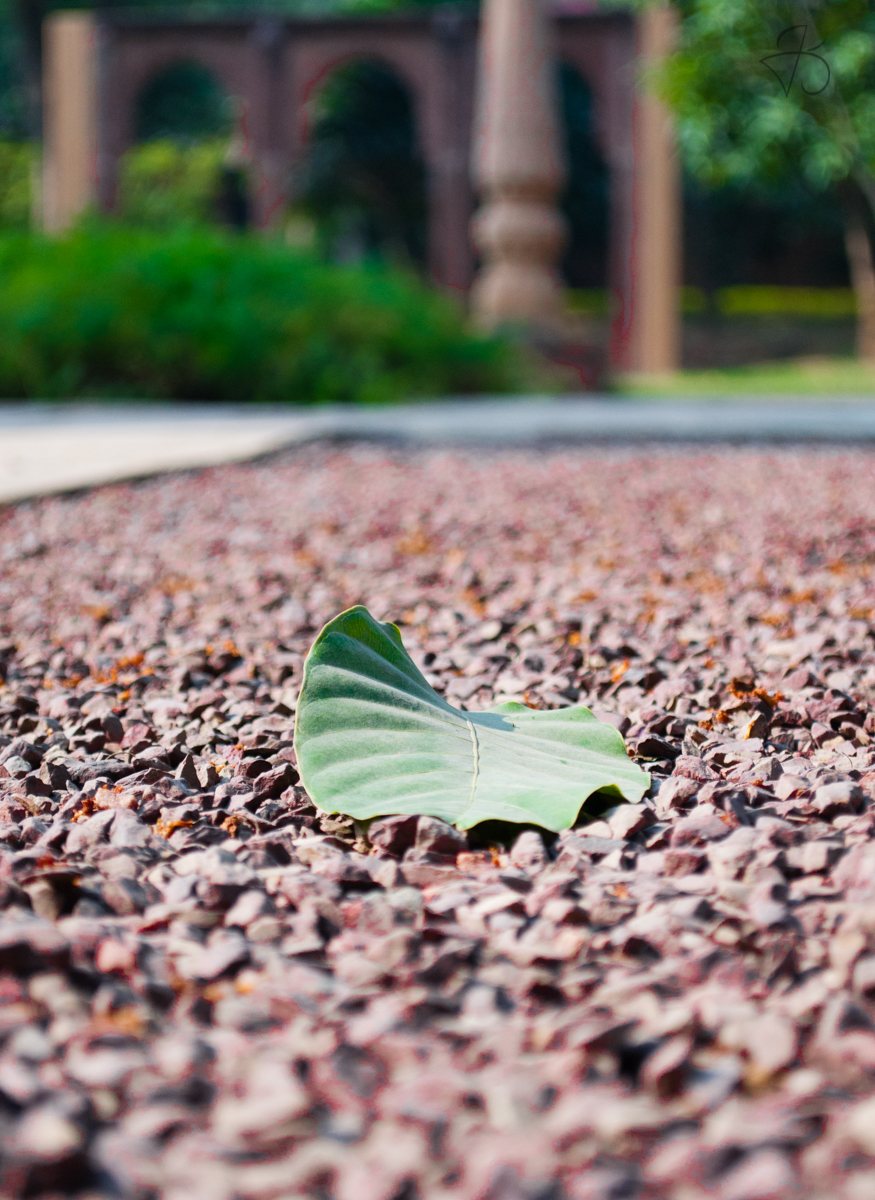
This week’s weighty photo challenge had me jumping with delight. A perfect excuse to share this picture I took at Anandagram last month.

Anandagram offers a beautiful and serene environment to visitors. It houses 3 private museums housing traditional Indian household objects, terracotta and textiles from across the country. The buildings, styled like traditional houses, are surrounded by vast manicured lawns with discarded objects turned into art installations! Kept spotlessly clean, this leaf was about the only item which ‘littered’ the place – and it too was pretty 🙂

leaf_on_the_ground

Categories
Stories

Patterns On The Floor


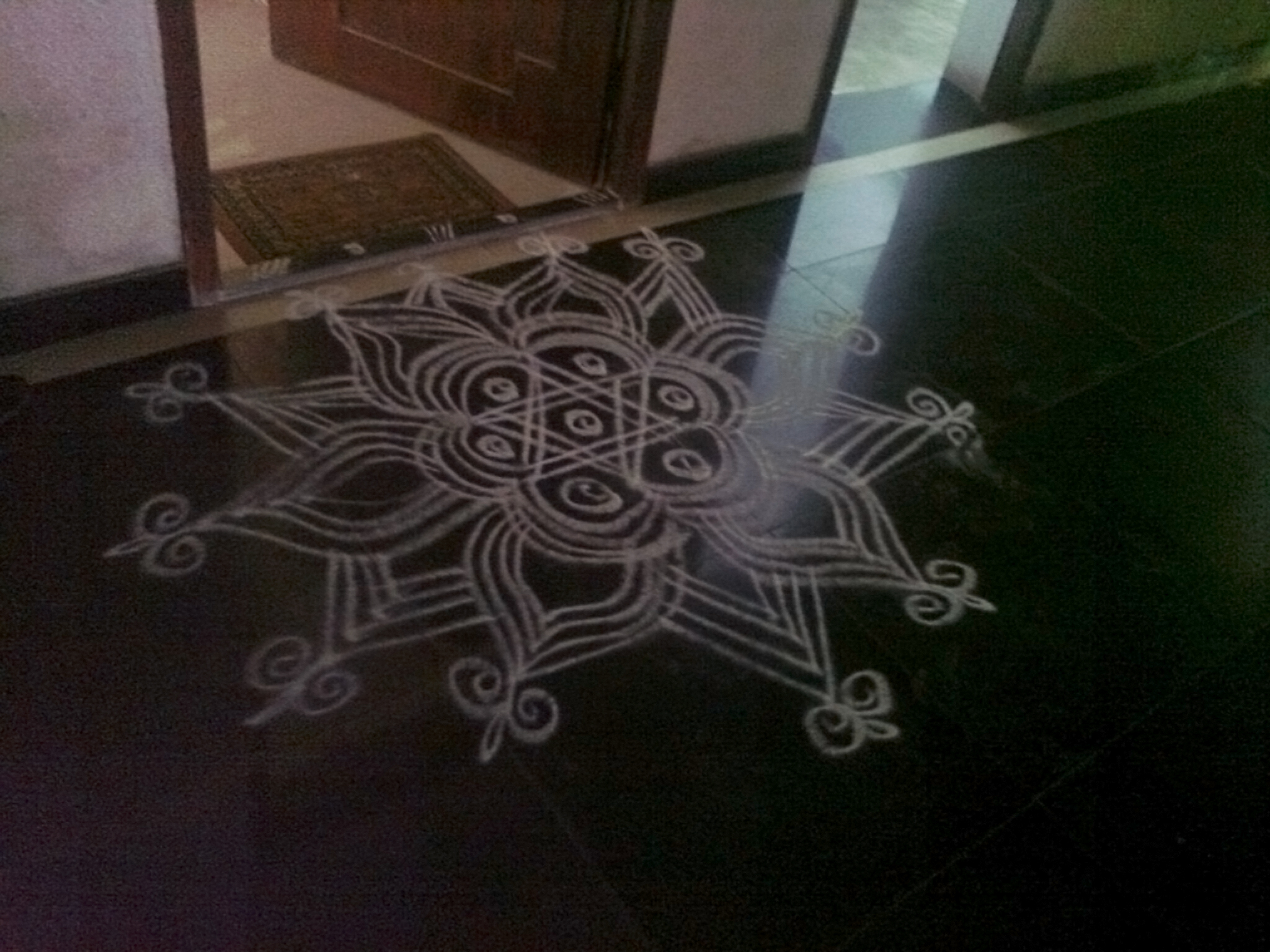
As the sun prepares to visit this part of the world, a few of its rays have jumped ahead, trying to take a peak at our front entrance. While most of the city is either asleep, or busy getting ready to take on the day’s work, my mother opens the door and thoroughly cleans the floor with water. She then opens a small box and picks up a pinch of the white powder that it contains.

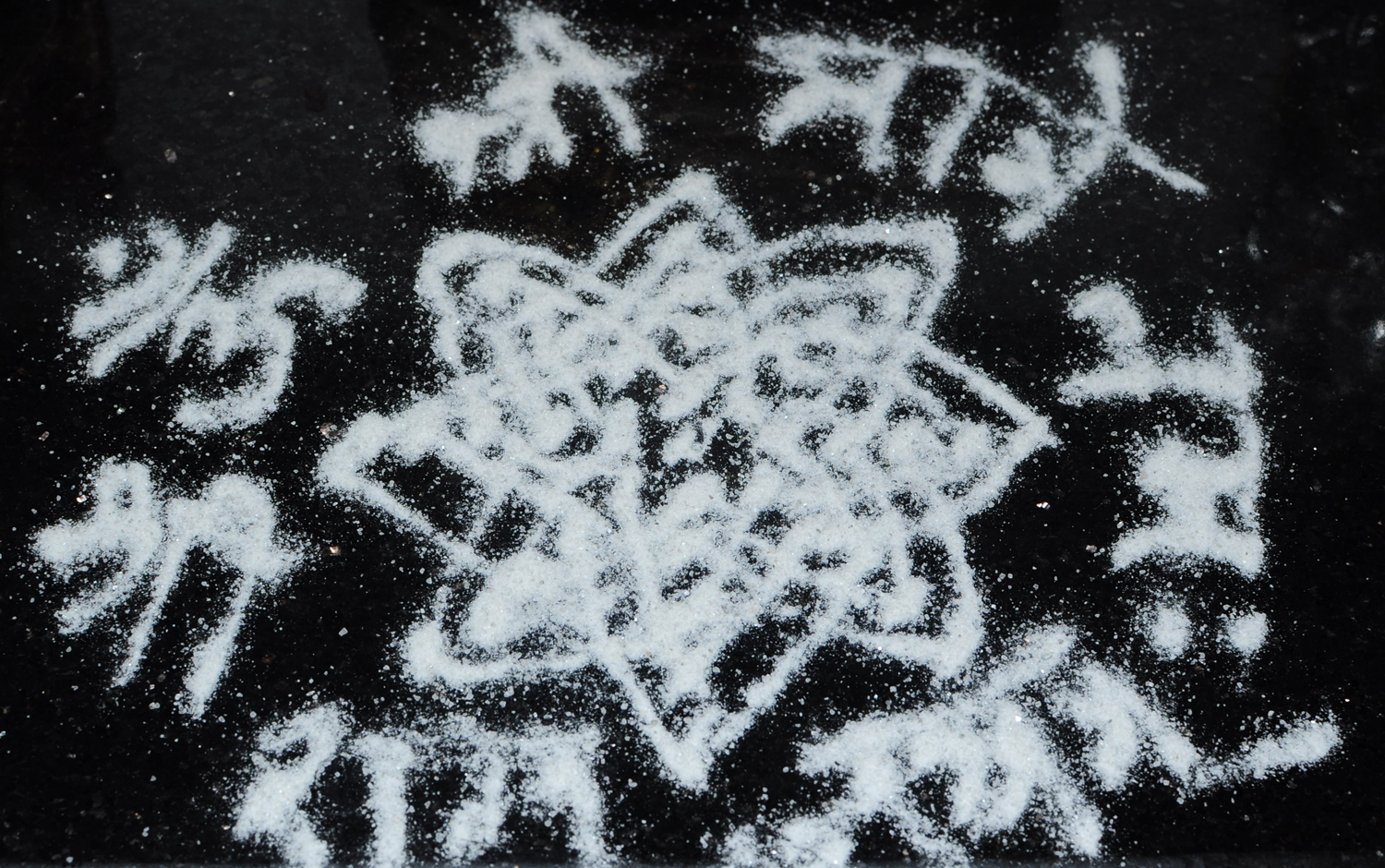
The Hrydayakamalam
The Hrydayakamalam

She rolls the powder between her thumb and index finger and makes a series of dots. They are perfectly arranged in a symmetrical pattern – drawn with pin-point accuracy. She picks up more powder and with a steady hand, draws several even lines – some connecting the dots, others, encircling them.

Ever since I can remember, my mother has performed this fascinating ritual, every single day, without fail.

Traditional dots at the Surajkund crafts fair

Earlier, the only source of obtaining the kolam podi*, was relatives who visited us. Our trips to Chennai would be incomplete without buying the white stone powder, which she used for making the designs. Now the powder is available more readily. Kolams are not common in Delhi. Here, elaborate ‘rangolis‘** are made with colourful powders and flowers, that too only on Diwali, or special occasions. Some other migrants like us make the kolams with a more long lasting wet ‘paint’ made using rice flour. Others use ready-made stickers.

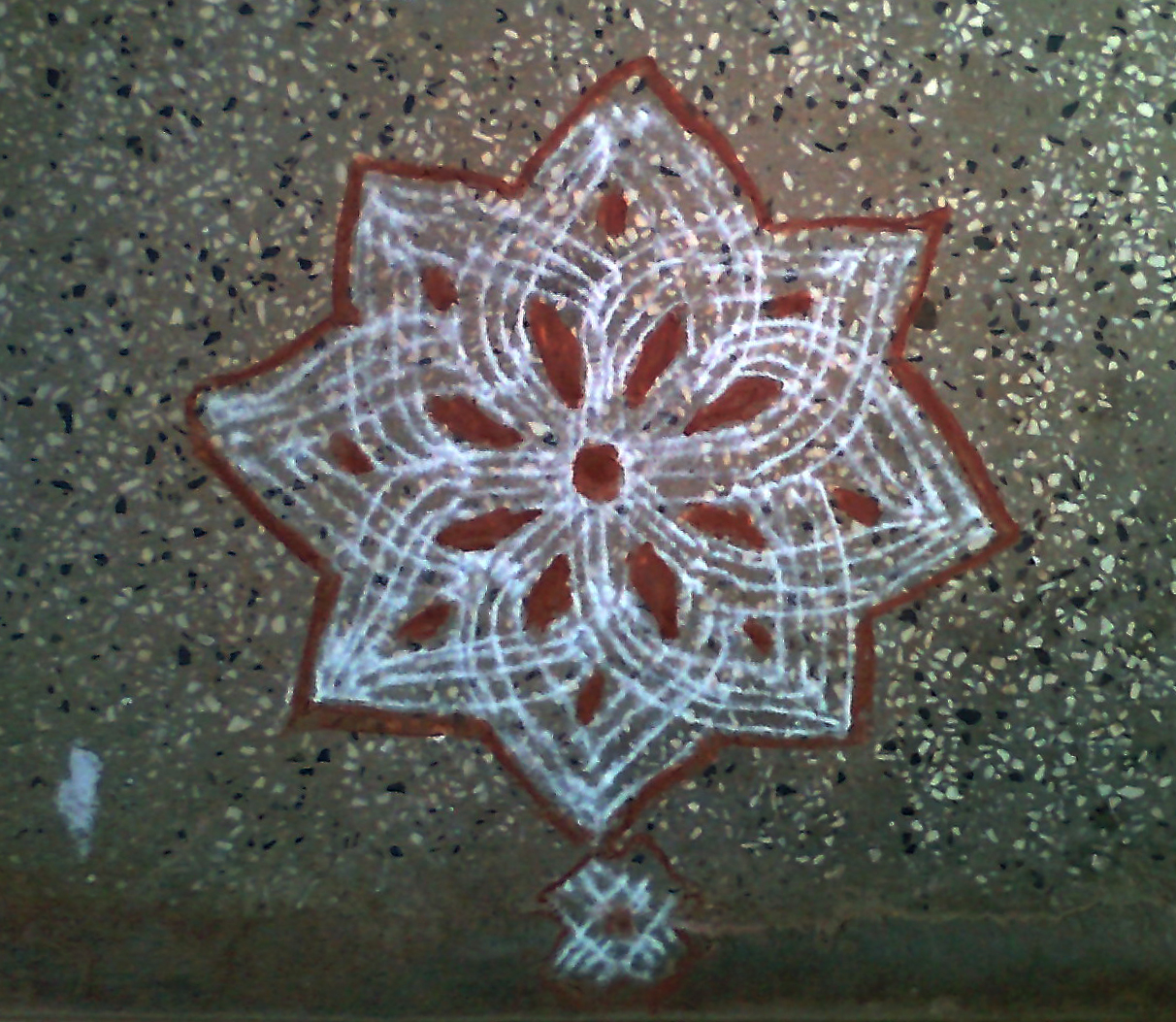
Traditional Kolam made with lines and filled with red stone color
Traditional Kolam made with lines and filled with red stone colour

Visitors often ignore the kolam at the entrance and sometimes step over them. Some mischief makers deliberately destroy them. And on several occasions, the sweeper sweeps them away. It infuriates my mother… “Kolams are swept away only when the family is in mourning… Wiping it away is a sin”, she would shout. But nothing has ever deterred my mother from starting afresh the next morning.

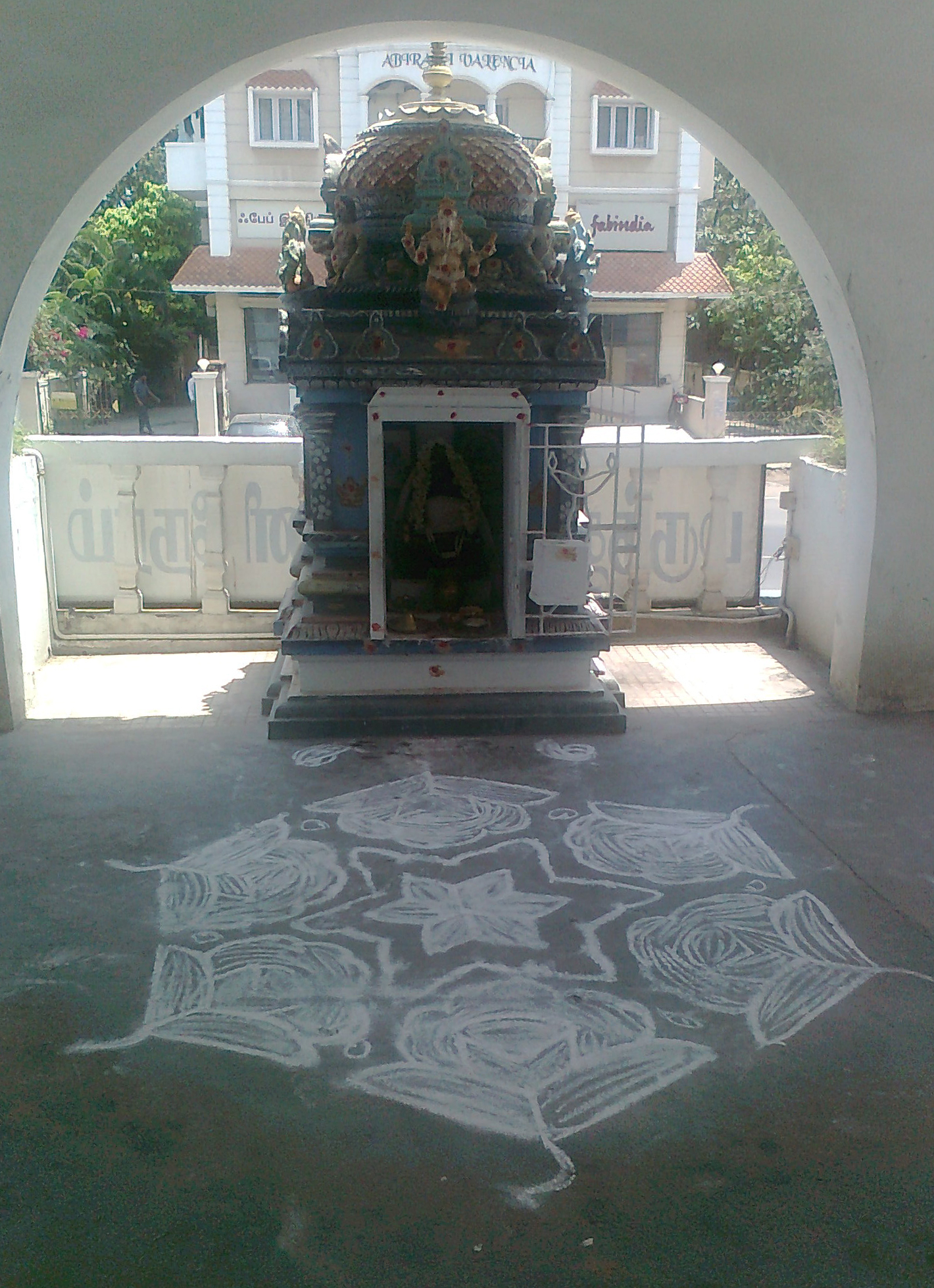
In Chennai, though, kolams are found everywhere – at the entrance of every house, temples, and even public buildings. Friday belongs to Devi, and so, the kolams are extra special on these days. On festive occasions, the red stone comes out of the shelf. The stone is dipped in a little water and the kolam is painted with a deep red colour.

A small temple in a hospital (Chennai)
Kolam in a hospital (Chennai)

Celebrations like marriages present a much larger canvas for the ladies. Rice flour kolams are prepared the night before the auspicious event, and, covering large areas, they are grander than what one can imagine. That they will be hidden beneath the holy flame, does not matter to the artists.

As the years have rolled by, my mother’s kolams have evolved. They are no longer limited to the strict geometrical patterns. Nor are the materials restricted to the traditional ones. The kolams are now more abstract, and created spontaneously. On special occasions, she adds more colour – something that she has adopted from the North Indian rangolis. There are times when she is unable to make it early in the morning, but even today, she does not allow anyone to step out of the house before the kolam is drawn. And we don’t mind – the entire process takes just a few minutes – the years of practice have made it second nature to her.

The neighbour's kolam (Chennai)
The neighbour’s kolam (Chennai)

It is this art form, and my mother’s interpretations and designs, that inspired me to create something of my own. Based on the traditional paisley motif – the  ‘aam‘, or the ‘mangai‘***, it is a tribute to the millions of women who practice traditional art forms as part of their daily lives. It is a tribute to the art form that encourages everybody to become an artist.

But above all, it is a tribute to my mother – who expresses her creativity and skill through patterns on the floor every single day, only to sweep it away the next morning.

This slideshow requires JavaScript.

* * *

* Podi – powder
** Rangoli – Hindi term designs made on the floor.
*** aam – Hindi for mango
mangai – Tamil for unripe mango

Categories
Stories

The Journey


Last weekend, I had been invited to attend a cultural programme. It was the Annual Day Celebrations of a social organisation, which provided foster care for street children.

The course of the programme seemed to follow the pattern of the lives of the children taking part in it.

The show began with a group of children singing the anthem of the organisation, an old Hindi classic film song – ‘Aa chal ke tujhe…‘* They seemed nervous as they missed a few beats and struggled with the correct notes. As another group sang, their voices revealed their state of mind – hesitant and unsure.

Young children then came out in their colourful attire, and enlightened the audience about real life examples of women’s entrepreneurship, and staged a play about rural life.

As the evening grew, the atmosphere became more lively. The children in the audience cheered loudly during the award ceremony, as their caretakers, and some older children, were being felicitated.

The convocation ceremony showed how contrasting our lives were. For us, attending school was as integral a part of our lives, as eating and sleeping. But for the children of the home, simply clearing the examinations was a huge milestone. They weren’t as lucky as we were – abandoned by their own parents, left to fend for themselves at a tender age, victims of various types of abuse.

As the older children began their dance performances, their eyes glowing with pride, their movements synchronised, and expressions filled with confidence, it was clear, that they had put their past behind them and were now ready to embrace their new lives.

The event was nothing short of being grand – and I’m glad I was there to witness it.

* * *

*Aa chal ke tujhe, mai leke chalun, ik aise gagan ke tale, jahaan gum bhi na ho, aansu bhi na ho, bas pyaar hi pyaar pale…

Come, I’ll take you to a place so beautiful, where there is no sorrow, no tears, only love…

Categories
Stories

The Taste Of Life


The summer has already set in and the heat is becoming unbearable. If its this hot in April, I fear to even think about May and June.

The past couple of days, have been a little different though.

Today, the wind is blowing hard. The sky is overcast, but there are some rays of light, which have managed to sneak past the clouds to get a glimpse of the world.

In the balcony, the plants are having a ball. For the past few weeks, they’ve gone crazy. Everyday they’ve been dressing up in their best outfits. The Nandiyavattai*, the common purple Flowers*, Hibiscuses, Loudspeaker* Lilies, and even Jasmine flowers, have come out in large numbers after a long, long time.

Today, also happens to be the Tamil New Year. Although there isn’t much we do to celebrate the new year, our mother draws a special kolam** at the entrance of the house, and prepares a special dish.

This dish has all flavours – sweet, salty, sour, bitter, spice, and pungent. The dish represents life, and its ingredients, its different flavours. In life, some moments are sweet, others, bitter. We experience a wide variety of emotions. On the first day of the year, this dish is prepared to remind us, that the future will be filled with varying emotions. We must, not only prepare ourselves to face life, but also learn to enjoy its different flavours.

Puthandu vazthukal (happy new year), and a happy Baisakhi to all.

* * *

Nandiyavattai – The Tamil name of a plant, whose name I did not know – till now. Called ‘Moonbeam’ or ‘Wax Flower’ in English, ‘Chandni’ in Hindi and ‘Tabernaemontana coronaria’ in Science.

The Common purple Flowers – Another plant whose name I found out today. Called ‘Madagascar Periwinkle’ in English,  ‘Sadabahar’ in Hindi and ‘Cantharanthus roseus’ in Science.

Loudspeaker Lilies – They look like a pair of loudspeakers, hence we call them that. The internet world does not seem to recognise that name. So its just plain old lilies.

**Kolam – Patterns drawn with stone powder at the entrance of the house.

Categories
Hobbies

The Scrapbook


This post belongs to the original post titled ‘Letting Go

I pulled out the scrapbook from the bottom of the cupboard with the intention of scanning a few pages. The paper has yellowed, the edges of the paper are torn, and damp hands have removed some of the colour. But as I flipped through it with my mother, we fell in love with it all over again! So I decided to scan the whole book!

A part of me wanted to retouch it, but the better part of me (read lazy) thought it best to upload it untouched – yellow and torn. The scans don’t reveal how beautifully well preserved the actual photographs are, though the newspaper clippings reveal their age. Hope you enjoy!

This slideshow requires JavaScript.

The images are the property of their respective owners. I apologise for being unable to mention the sources (I was just a 12 year old kid who didn’t really care about intellectual property). It is very very very old! Some that do come to my mind are – The Hindu (Newspaper supplements), Brochures from The Sanskriti Museum and India Habitat centre.