
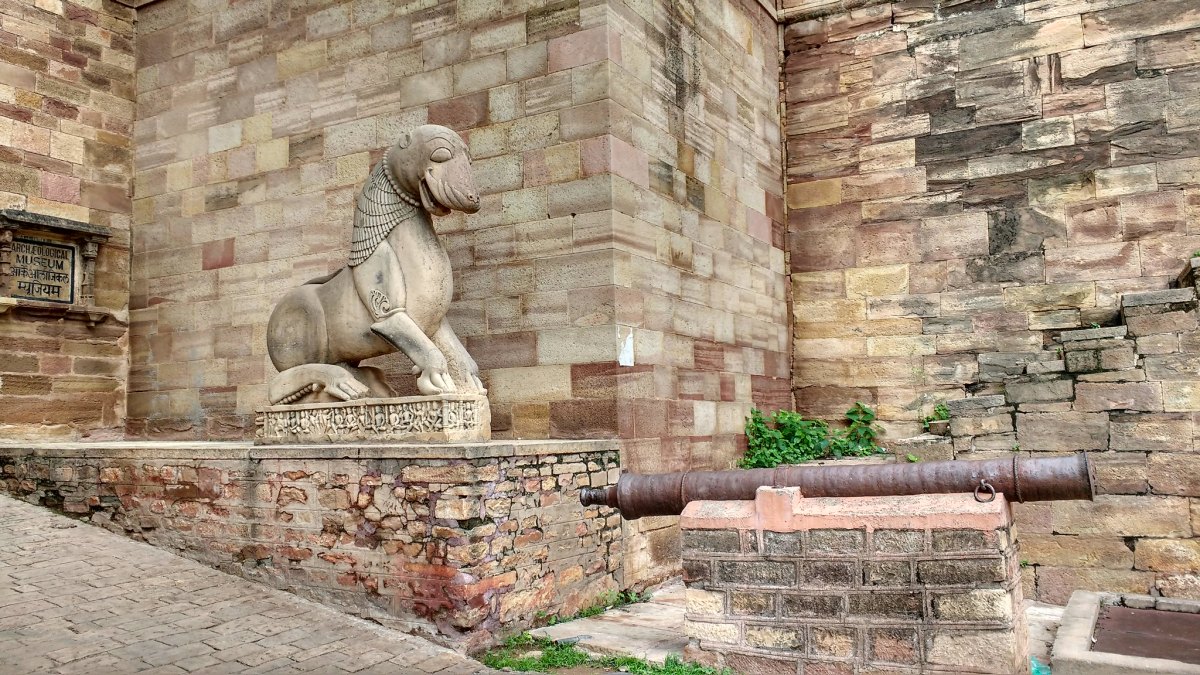
We walked past the stony gaze of the lions guarding the giant entrance. Fresh monsoon grass peered from beneath the sandstone tiles. The wings of the Fort kept a keen watch from above. The ninth Queen of Raja Maan Singh surely must have been special to get this much attention.
We walked on what was the front porch of the Gurjari Mahal and trekked up a steep path leading to the Palace. To our right was a well-manicured lawn. And to the left, a steep rocky path that seemed to lead nowhere.
The Palace had a short and narrow flight of stairs that led to a beautiful courtyard. Intricately carved stone statues of God and Goddesses here, pieces of floral patterned pillars and walls there.
The word museum was, perhaps, not very appealing to most tourists. Even those who strolled in didn’t stay long. The cool breeze only enhanced the peaceful ambiance of the courtyard.
“Do you have a ticket for your camera?” A portly man asked as we began freezing moments for our album.
We showed our ticket.
“Well, then please use only one—either your phone or the camera. Please!” Beneath his small smile, the request was firm.
I put away my phone and smiled sheepishly. Half expecting the man to run back into his administrative chamber after we had complied with his request, we turned to continue our exploration.
“Oh but first you must come and see the Salabhanjika!”
The Salabhanjika is the museum’s prized possession—a miniature statue that epitomizes femininity. We had read about the sculpture being guarded closely and were under the impression that we’d need special permissions to see her. So when the gentleman invited us to take a look, we happily accepted.
We followed him to his office. A small dark room furnished with a simple desk and a few plastic chairs. The medieval walls were covered with yellowing photographs and newspaper clippings about the sculpture. Behind the desk was a cell. Deep inside behind steel bars, stood the small, smiling Salabhanjika.
“She’s called the Indian Monalisa!” His voice was filled with pride at being the guardian of a rare sculpture. Like many of the exquisite sculptures that we’ve now become accustomed to seeing, Salabhanjika was breathtaking.
“When she was first found, she looked like this,” he said, pointing towards a grainy print stuck on the wall. “Her head was found later and was fully intact, so we could piece her together. We were lucky.”
“Look at her carefully. The more you look at her, the more she’ll smile back at you! Look at her from any direction and she’ll look towards you.”
We looked again. And she did, indeed, appear to be smiling more than before.
“Please take a picture. Go on, go closer. Make sure you switch off the flash!”
We leaned in, the lens of our camera wedged between the steel bars. Click!
“She’s been insured for five crores!” our host could hardly contain his excitement.
Five crore rupees. The Monalisa is insured for a hundred million dollars.
Salabhanjika’s smile grew wider.
I wondered, if she had been discovered before the Monalisa, would Leonardo Da Vinci’s painting be called the Italian Salabhanjika?
She stood there silently. Still smiling, and letting the question remain unanswered.
Salabhanjika is a Sanskrit word meaning ‘breaking a branch of a sala tree’. There are many intricate sculptures of Salabhanjika in Hoysala and Bednur. But the one in Gwalior is reportedly the only one that smiles.
This story is part of my digital book, The Speaking Rock.
Originally written in 2017, the ebook was published on the Juggernaut platform.
For those who aren’t aware, Juggernaut was a publishing platform that claimed to democratise publishing. It’s slogan, “You don’t need to know anyone to get published.” It provided writers access to publishing tools and a marketplace where readers could connect with writers directly. The Speaking Rock was one of three ebooks I had published with them. My story Free Bird also won a short story contest and was featured in their anthology collection.
I loved that platform, even from a design perspective. I even wrote a glowing review on Design Tuesdays.
Unfortunately, the platform soon introduced a paywall and put my stories behind a paywall (without offering any royalties). And thereafter, the platform disappeared altogether, taking my work with it, leaving me hanging high and dry. I felt betrayed. I felt bitter. I kicked myself for being naive. Of course, their business model wouldn’t pay their bills.
For a good three years, the site just showed an ugly “under construction” message. No way to get in touch with them. No way to retrieve my work. I had made peace with the fact that I’d lost my stories—until a few days ago, when I found a draft on Google Docs that had one of the stories. And when I saw the draft of the Eternal Smile sitting right under my nose on WordPress, I almost cried.
Funnily, when I opened Juggernaut’s website today, I found that it was no longer under construction. (The internet archive’s Wayback Machine reveals that the site was still down as recently as 5 days ago!)
There is no mention of a writer’s platform, and no way for any one to log in and retrieve their work. Today, the website is just like another publishing site that displays influencers and popular media icons who’ve published with them. So much for democratising publishing!
As for me, I’m happy that I can finally share Salabhanjika’s smile with you. I’m still looking for that photograph we took. I’m sure it’s there somewhere in our virtual closet.
 Musings of an eccentric mind