

An astrophysicist, a Vedic scholar and an earthworm walk into a room.
Before I complete the story, here’s a question for you:
Do you believe in a higher power? A celestial being that’s constantly keeping a watch over us?
I used to, but now, I believe that we delude ourselves into thinking the universe cares about us. Stars don’t align for us. They just go about their lives, and we simply get caught in their world. We are, but mere cogs in their grand scheme.
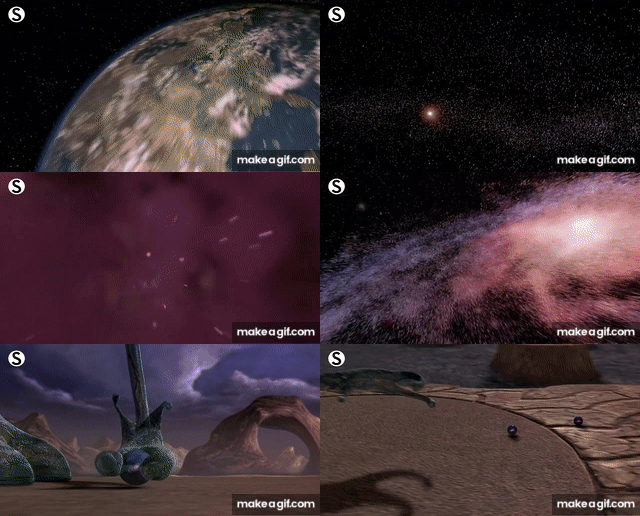
The moon revolves around the earth, and it sways our mighty oceans with its movement. We, too, are just bags of warm water. Surely, the moon must have some impact on us. We get life-sustaining energy from the sun. And it’s such a long way from home. Surely, other stars must have their secret powers.
Ancient Indian astrologers had probably cracked some of the codes of the universe. But like much of our wisdom in other disciplines, it has been tossed out in our English-medium world that’s out to make some money off our ignorance.
What I lost in ancient wisdom, an American TV personality packaged into a shareable quote:
The four most common chemically active elements in the universe—hydrogen, oxygen, carbon, and nitrogen—are the four most common elements of life on Earth. We are not simply in the universe. The universe is in us.
Neil deGrasse Tyson, Space Chronicles: Facing the Ultimate Frontier
This quote reminded of two types of universes: the more observable physical one, and the abstract, spiritual one that’s hidden within.
The Observable Universe: My Compost Pile
I started composting some seven years ago, and it has been the most rewarding, meditative experience. Composting gave me a glimpse into an entire self-sustaining ecosystem. At times, I felt like God, overseeing a world, controlling what goes in, and when it’s ready to harvest. But most of the time, it made me realise that we too are tiny insects in the compost pile of a higher force. We’re all transient creatures taking part in a grand spectacle called nature.
My compost pile is made up of organic material. The brown stuff has a lot of Carbon, the green stuff is rich in Nitrogen, and since kitchen waste tends to have a lot of water content, the other two components of Hydrogen and Oxygen complete the quartet. With each harvest, I see the universe in action.
I took whatever I learned and turned it into a small online workshop. Here’s a recording of a session done during the initial pandemic lockdown. I hope you enjoy.
The Hidden Universe Within: Aham Brahmasmi
The Brihadaranyaka Upanishad, one of the first Upanishads dated to 7th century BC, has a popular phrase, Aham Brahmasmi. It translates to “I am the Brahman.” The Brahman here is an abstract concept that may be interpreted as being the universal truth, cosmic energy, perhaps even God.
Side Note: This Brahman is not to be confused with the caste, which is pronounced differently. One’s caste is defined by one’s profession—and is neither discriminatory not hereditary. But that’s a different misconception to be dealt with by more learned scholars.
Aham Brahmasmi is a phrase that’s close to my heart because it instills a feeling of being complete, without relying on any external validation for our existence. We hold immense potential within us. If we channel it well enough, we can accomplish anything.
I love this Mahavakya (phrase) so much, that I even have a ring with the phrase written in Devanagari calligraphy.
So what happened to our astrophysicist, Vedic scholar and the earthworm? The two humans spent the whole time arguing over who was right, while the earthworm just chewed its way around the room till there was nothing left except life-sustaining matter.
The featured image at the top is of Netaji Subhash Chandra Bose Island, where nature has reclaimed man-made buildings, creating the most stunning root displays. Location: Andaman and Nicobar Islands, India.
 Musings of an eccentric mind