Categories
Musings

One More Thing…


How do you do it?

How do you manage to read all those tweets, post comments on YouTube, react to Instagram stories, finish the long reads on Medium and WordPress and catch up with emails? All while having a day job, socialising with friends, managing a decent workout and being up to date with current affairs and pop-culture.

I know I can’t.

I was a very, very late adopter of social media, primarily because I felt it was meant for lesser mortals, those who indulged in gossip. The narcissist that I am, I didn’t quite care about what other people did around me. I only wanted to write and share my thoughts to as wide an audience as I could.

I sceptically joined Facebook in mid 2013. And it wasn’t till 2017 that I joined Instagram. These occasions were so significant, that I wrote blog posts to confess about these mis-adventures. The only reason I have a Twitter account (I don’t care what they call it now, but I refuse to call it by any other name) is because my employer demanded I create one. Without that coercion, I would probably not have created it in 2014.

Then there’s LinkedIn, Flickr, Pinterest, YouTube, Behance… the list is far, far too long.

Over the years, I have tried to keep up with these services in patches and failed. I wonder how other people do it. And it bothers me that I am so digitally incompetent. I am everywhere, and yet, nowhere. At any given point of time, I can keep up with only one service. Everyone else is active everywhere.

When I think about all the different services that aim to ‘connect’ us in the world, all I see is this relentless barrage of information, and how miserable it makes me feel.

One More Thing

In 2019, I tried an experiment. I called it, the “Reverse Social Media.” I wanted to stop using social media, and instead focus on creating a community. I’d send out emails to people so that we could start one-on-one conversations. Needless to say, that experiment failed. I had ended up creating yet another digital footprint that I couldn’t manage. If you’re interested, you can find the archives of this experiment on Design Tuesdays.

In these first two decades of the twenty-first century, a certain Mr. Jobs made a catchphrase his own. “One more thing…” he’d say, at the end of his keynote, and announce something new. Steve Jobs’ characteristic style of delivering keynotes even has a name: Stevenote!

A side note: To me, those words will always belong to Uncle from Jackie Chan Adventures. The series aired during a time when information wasn’t as free-flowing as it is today, and when tech was only for geeks. What use was a business presentation to a teenager? So please allow me to indulge myself with TV memories from the early 2000s.

Source: Imgur

With the newsletters, I had created Uncle’s one more thing. More recently, that one more thing is Threads, from Meta. Sure, I’ve ‘created’ the ghost account, but it holds no meaning for me. To me, it’s just another username that’s gathering virtual dust.

The Digital Cobwebs

Remember the old days when we had hard disks and had backups of folders and backups of backups? Ah, those were simpler times. Those hard disks are gathering dust in a shelf somewhere.

Our digital clutter, on the other hand, is invisible, but several times worse. This digital clutter that we’ve chosen to create haunts me. Over the past few years, I’ve lost very close loved ones. But their profiles show up in recommendation feeds on social media. I don’t want to tell these behemoth companies that those are my dead relatives. The large tech companies have no business knowing this private information. But, at the same time, I don’t want their click-hungry algorithms to be so insensitive.

In my curiosity to explore the internet, I wonder how far my own footprint has landed. Who has my email address? Which database has a username attached to me?
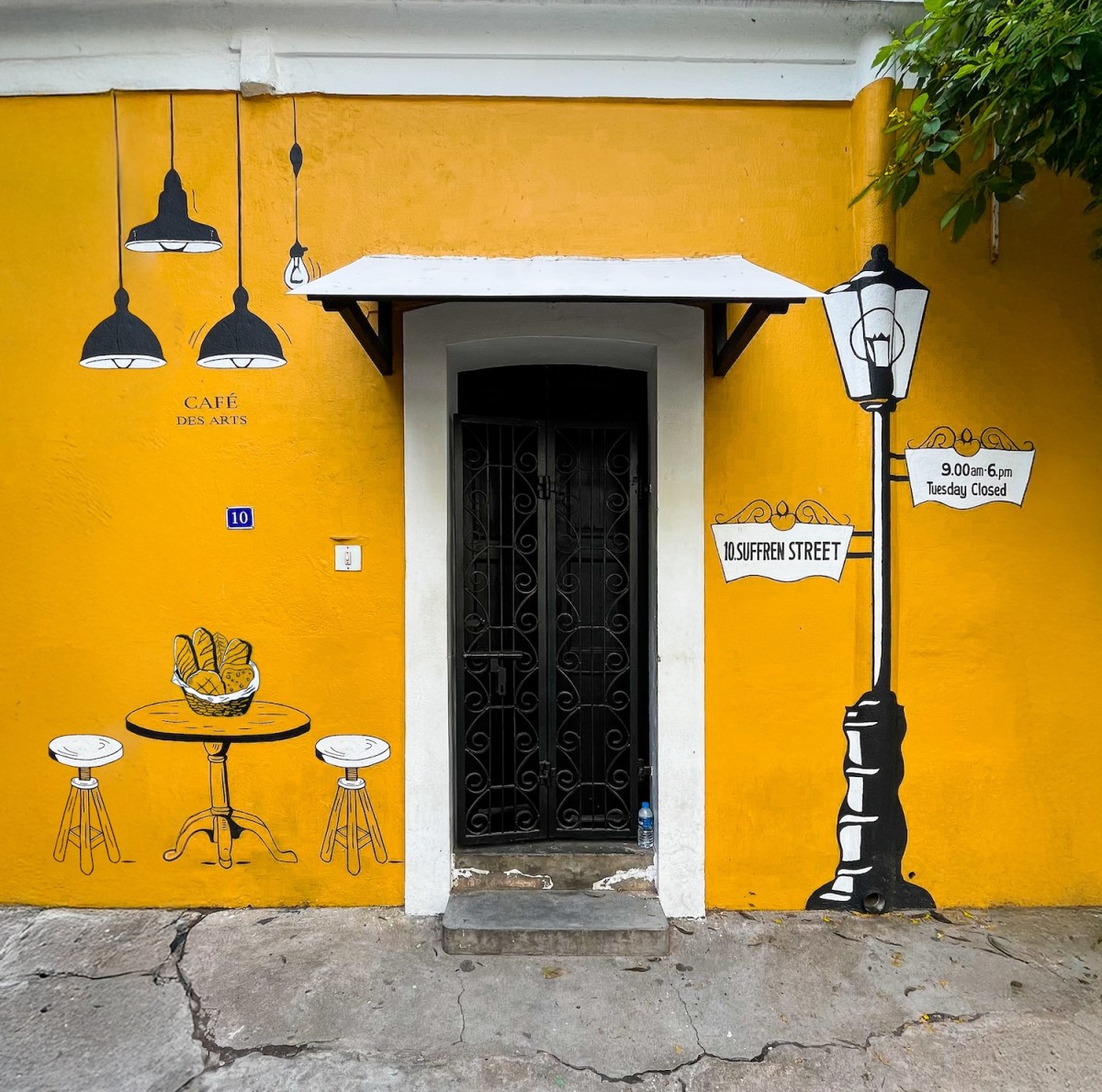
Entrance to a cafe with yellow-coloured walls and black and white murals showing a coffee table and bar stools.
In our quest to share virtual memories, we’ve built physical spaces to be Instagrammable. How many people would have half-squatted to “sit” on the painted chairs on this pretty yellow wall? Guilty as charged. Location: Puducherry, India

Worse still are the chains I’ve tied around myself. Those accounts that I do know about, I find it hard to let go. It was easy to delete my Facebook (now Meta) account over three years ago. But Twitter is giving me a hard time. Not because I use it. I don’t. But because once I delete the account, my username will be available for use by someone else. And I shudder to think someone else will take on my identity. So much for me championing reuse and recycle.

There’s so much digital waste we’ve generated. All that waste is sitting on some server. Consuming electricity. Generating heat. And consuming more electricity to cool down. Every little piece of digital information I leave unattended reeks of a hypocritical sustainability advocate.

The Way Forward

I don’t have an easy answer to this mess. In this virtual chaos we’ve created, it’s a daily struggle to decide what to keep and what to discard. Which memories to hold on to, and which to let go.

A couple of months ago, out of sheer frustration, I embarked on a virtual housekeeping project. The task looked insurmountable, but I had to begin somewhere.

So, I looked for low-hanging fruits. I located those physical hard disks. I thought to myself, if I haven’t needed it in the last ten years, I won’t need it again. First, I transferred them to my Dropbox folder, so that everything was in one place, and then I began reviewing them.

So many duplicate photographs. Old portfolio files that I was once proud of, but now find ghastly. And those legacy file formats that I can neither open, nor have had the need to edit. I began hitting the delete key.

As Dropbox later informed me, I had deleted about 15000 files in the span of a week. It was a statistic I didn’t know I needed to hear. And it was so cathartic.

This was just the tip of the iceberg. There are several more files and photographs to go through. I’ve hit pause on that activity because, as I’ve now learned, I can’t focus on one thing constantly. Plus, frustration and adrenaline can fuel such binge-deleting sprees for only so long. But I hope to pick it up in patches.

My current project is to clear up the cobwebs of my blog drafts. Several of my last few posts have indeed been 3 – 4 year old drafts (this one included!) I’m still only 10% in, but seeing some virtual dust being cleaned up is helping me mentally.

I don’t know how far I’ll get. But I’m going to try. It’s a marathon, not a sprint. And the only way to tackle it is to take it one thing at a time.


On an unrelated note, how would you like me to narrate these stories via a podcast?

Categories
Musings

The Reckoning


In mid-2020, while the world was going through an upheaval, I got the opportunity of a lifetime: to turn my passion for writing into a profession. It was a dream come true: combining my love for writing and teaching with my experience in UX design. At the Interaction Design Foundation, I met and worked with some of the most brilliant minds from across the globe. I had opportunities to travel and grow professionally, eventually leading the editorial team.

In three and a half years I grew and changed as an individual. It was the most fulfilling role I’ve had in my life and for that, I will forever be grateful. But it came with a cost.

Some people say that we must not mix passion with profession. We might lose both! Others say that we must be in love with our work so that we don’t actually “work”. I realized that there was another angle to this debate. In my case, I was so much in love with my job, that I lost myself in it. I spent such a long time doing what I love for someone else, that I was too exhausted to work on the stories I wanted to write for myself. I adopted the brand’s voice and lost my own.

Before I knew it, my body started to hurt.

Fortunately, or rather, unfortunately, I could see where I was heading. It had been close to eight years, but memories started haunting me. It was a different time, a different company, but the pain was eerily similar.

I used to struggle with lower back pain. Most days it would be okay. And then every now and then it would flare up. And when it did, it made my life a living nightmare. I couldn’t sit, stand, walk, or even lie down without jolting.

I went to several doctors and popped all kinds of pills. Everything seemed to work for a while. And then, everything stopped working. I continued soldiering through the pain.

I was practically second in command in the company. I couldn’t take too many days off.

My family pleaded with me to leave my job. Angry and in tears, I fought with them. I stood my ground. To them, I was stubborn. In reality, I was scared.

Our society places a premium on being employed. Our worth and the respect we command are based on what we do in life. The last thing I wanted to be was a housewife. Housewife: that word is so demeaning that we now use different synonyms to make it sound like we appreciate that role: a homemaker, family manager, home engineer. But call it what you will, it is subtly associated with someone who doesn’t earn money or have status in public life. Since my childhood, I was conditioned to believe that choosing not to work was synonymous with being useless. The ultimate humiliation.

I needed to work, not for the money, but for my self-esteem.

Meanwhile, my attacks were getting more frequent. There were days when I couldn’t get out of bed. I began missing important meetings. It got to a point where I felt I might be fired. So, I finally took the most difficult decision of my life. I told myself to quit.

Quitting a job without another in hand and with no financial safety net isn’t easy. I had no choice. I needed to fix myself.

Understanding my predicament, my employer suggested that I take a break, and use this opportunity to start a freelance career. “Take a month off. We can work out a part-time contract. We’ll be your first clients.”

Perhaps it was that reassurance that I’d still have something to come back to, that helped me relax a little. I tied as many loose ends as I could, handed over my work and signed the offboarding documents. I still remember that metro ride home. My body writhed in agony every time the train stopped. My colleagues pitied my plight.

The first few days of my unemployment, however, had a profound impact. To my surprise, I felt like a big weight was off my shoulders. More importantly, I realized that being employed wasn’t the sole purpose of life. Contrary to what I expected, I even enjoyed being at home. “You look happy,” my uncle remarked when he saw me shortly after my newfound freedom.

I also learned that patriarchy—that thing that I always complained about—was helping me. When I met an ex-colleague a month later, he remarked, “You can afford to quit because you’re a woman. No one would say anything to you. I wish I could also quit my job.”

I am not going to defend patriarchy. But I can better explain feminism. It is not about men being subservient to women as revenge for centuries of oppression. It’s about men and women both being allowed to live their lives the way they’d like to, without having to live up to certain expectations from society or being judged for their life choices and circumstances.

Workplace dynamics aren’t built for everyone. And I realized that the work environment I was in, wasn’t built for me. I didn’t form any meaningful friendships at work. The office was in a basement, devoid of sunlight. While I learned a lot and did meaningful work, at the end of the day, it didn’t pay as well as a corporate job would’ve paid me. I wished I had quit sooner.

If I hadn’t quit, I wouldn’t have become a freelancer. I began working remotely much before the world discovered it. Money wasn’t regular, but that didn’t matter. I was a master of my time and priorities. I regained my health and felt physically and mentally fit.

I had the capacity to work on side projects that mattered to me—like online workshops in storytelling and composting! I vowed to not work full-time again.

That vow, however, didn’t last long. Three years later, I randomly applied for the role of writer at the Interaction Design Foundation and turned out to be a perfect fit.

Fast forward three more years. My backaches were coming back, and this time, they were bringing more mysterious friends with them. My body was showing signs of unrest. I had to act fast before it turned out to be an all-out revolution like my last full-time gig.

I’d quit once before. It should’ve been easy to take that plunge again. But like the last time, I fought with my family and lingered on. This time, for very different reasons. I loved my job, the people, and well, the paycheck. This was the organization that made me realize my worth. Money sometimes acts like a golden noose. The string is always in our hand, and money makes us pull it tighter around our neck.

I debated hard with myself for several months. Eventually, I decided to pull the plug again. And like last time, it was only after I left that I realised why it was important for me to have done that. I had sacrificed my voice for someone else, and it would take several months for me to regain the courage to write again.

Related Posts

When life kicks you in the back