
Categories
Musings

The Universe in My Palm


An astrophysicist, a Vedic scholar and an earthworm walk into a room.

Before I complete the story, here’s a question for you:

Do you believe in a higher power? A celestial being that’s constantly keeping a watch over us?

I used to, but now, I believe that we delude ourselves into thinking the universe cares about us. Stars don’t align for us. They just go about their lives, and we simply get caught in their world. We are, but mere cogs in their grand scheme.
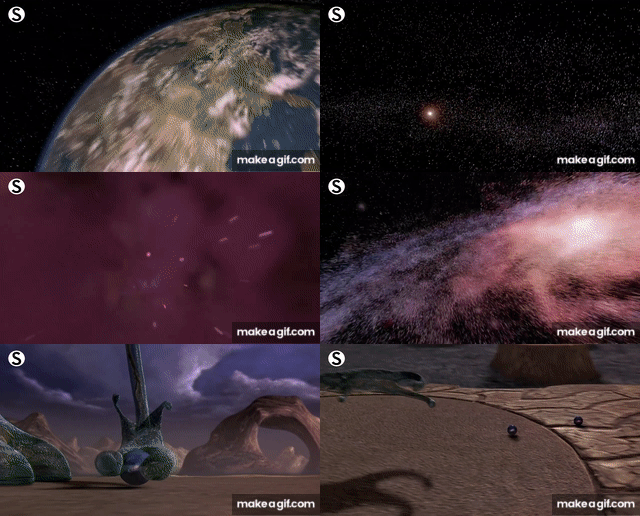
Men In Black Movie ending sequence where the universe is revealed to be a marble in the hands of an alien.

The moon revolves around the earth, and it sways our mighty oceans with its movement. We, too, are just bags of warm water. Surely, the moon must have some impact on us. We get life-sustaining energy from the sun. And it’s such a long way from home. Surely, other stars must have their secret powers.

Ancient Indian astrologers had probably cracked some of the codes of the universe. But like much of our wisdom in other disciplines, it has been tossed out in our English-medium world that’s out to make some money off our ignorance.

What I lost in ancient wisdom, an American TV personality packaged into a shareable quote:

The four most common chemically active elements in the universe—hydrogen, oxygen, carbon, and nitrogen—are the four most common elements of life on Earth. We are not simply in the universe. The universe is in us.

Neil deGrasse Tyson, Space Chronicles: Facing the Ultimate Frontier

This quote reminded of two types of universes: the more observable physical one, and the abstract, spiritual one that’s hidden within.

The Observable Universe: My Compost Pile

I started composting some seven years ago, and it has been the most rewarding, meditative experience. Composting gave me a glimpse into an entire self-sustaining ecosystem. At times, I felt like God, overseeing a world, controlling what goes in, and when it’s ready to harvest. But most of the time, it made me realise that we too are tiny insects in the compost pile of a higher force. We’re all transient creatures taking part in a grand spectacle called nature.

My compost pile is made up of organic material. The brown stuff has a lot of Carbon, the green stuff is rich in Nitrogen, and since kitchen waste tends to have a lot of water content, the other two components of Hydrogen and Oxygen complete the quartet. With each harvest, I see the universe in action.

I took whatever I learned and turned it into a small online workshop. Here’s a recording of a session done during the initial pandemic lockdown. I hope you enjoy.

The Hidden Universe Within: Aham Brahmasmi

The Brihadaranyaka Upanishad, one of the first Upanishads dated to 7th century BC, has a popular phrase, Aham Brahmasmi. It translates to “I am the Brahman.” The Brahman here is an abstract concept that may be interpreted as being the universal truth, cosmic energy, perhaps even God.

Side Note: This Brahman is not to be confused with the caste, which is pronounced differently. One’s caste is defined by one’s profession—and is neither discriminatory not hereditary. But that’s a different misconception to be dealt with by more learned scholars.

Aham Brahmasmi is a phrase that’s close to my heart because it instills a feeling of being complete, without relying on any external validation for our existence. We hold immense potential within us. If we channel it well enough, we can accomplish anything.

I love this Mahavakya (phrase) so much, that I even have a ring with the phrase written in Devanagari calligraphy.

So what happened to our astrophysicist, Vedic scholar and the earthworm? The two humans spent the whole time arguing over who was right, while the earthworm just chewed its way around the room till there was nothing left except life-sustaining matter.


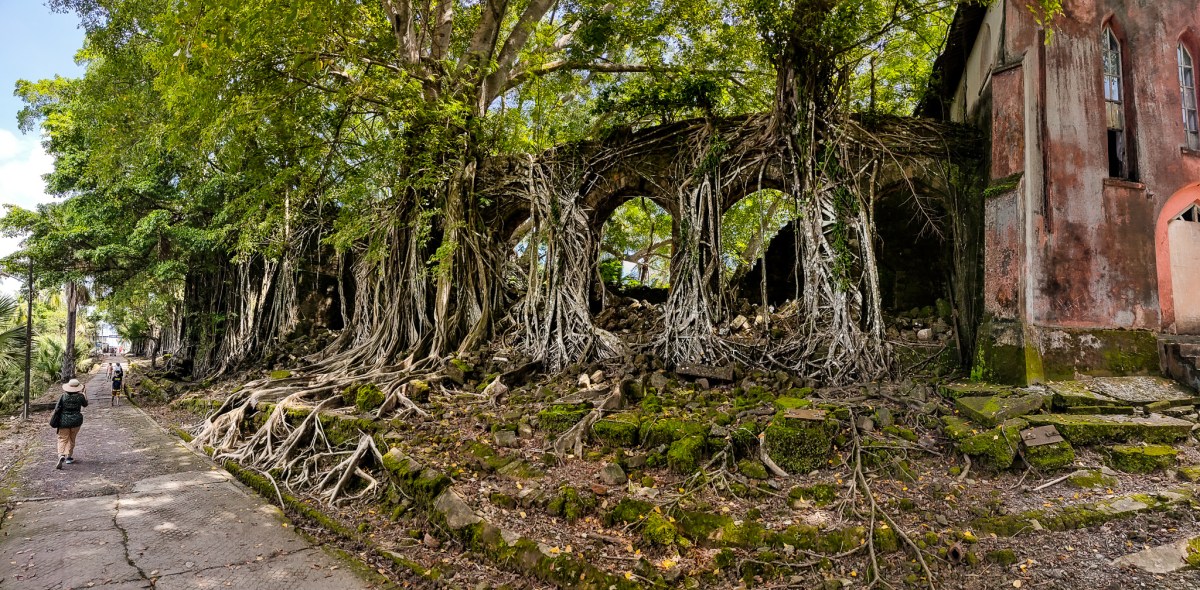
The featured image at the top is of Netaji Subhash Chandra Bose Island, where nature has reclaimed man-made buildings, creating the most stunning root displays. Location: Andaman and Nicobar Islands, India.
Categories
Hobbies Musings Stories

A whole new world


(Continued from “We’ll draw a green thumb”)

I watched my father-in-law poke a few holes into the bag with the screwdriver. He left it in the corner, and turned around to find me in a happy daze.

Here I was fretting about the lack of an actual ground. ‘One can’t possibly compost without a hole in the ground,’ I thought to myself. And there he was, coolly collecting all the kitchen waste into a plastic bag to make a compost bag in our tiny apartment balcony.

After my in-laws returned to their home, we continued to add kitchen waste to this make-shift compost bag, excited about harvesting compost.

But something wasn’t quite right.

For starters, it smelt bad. Very, very bad.

And it was super soggy – dripping brown smelly liquid wherever we kept it.

And then there were the maggots. Lots of them.

I was sure that I wanted to compost waste, and was determined to do so. But was it to be as yucky as this? Neither of us had any idea. And so we shot the question out into the electrical void – the internet.

The internet informed us what was going wrong. The short answer: our compost was out of ‘balance’ and had too much moisture*.

To solve our immediate composting crisis, we added shredded newspaper, and left the bag slightly open, in the furthest corner of our balcony. Next step: we decided to get a proper composter.

Fast-forward a couple of months, and we welcomed our Kambha.

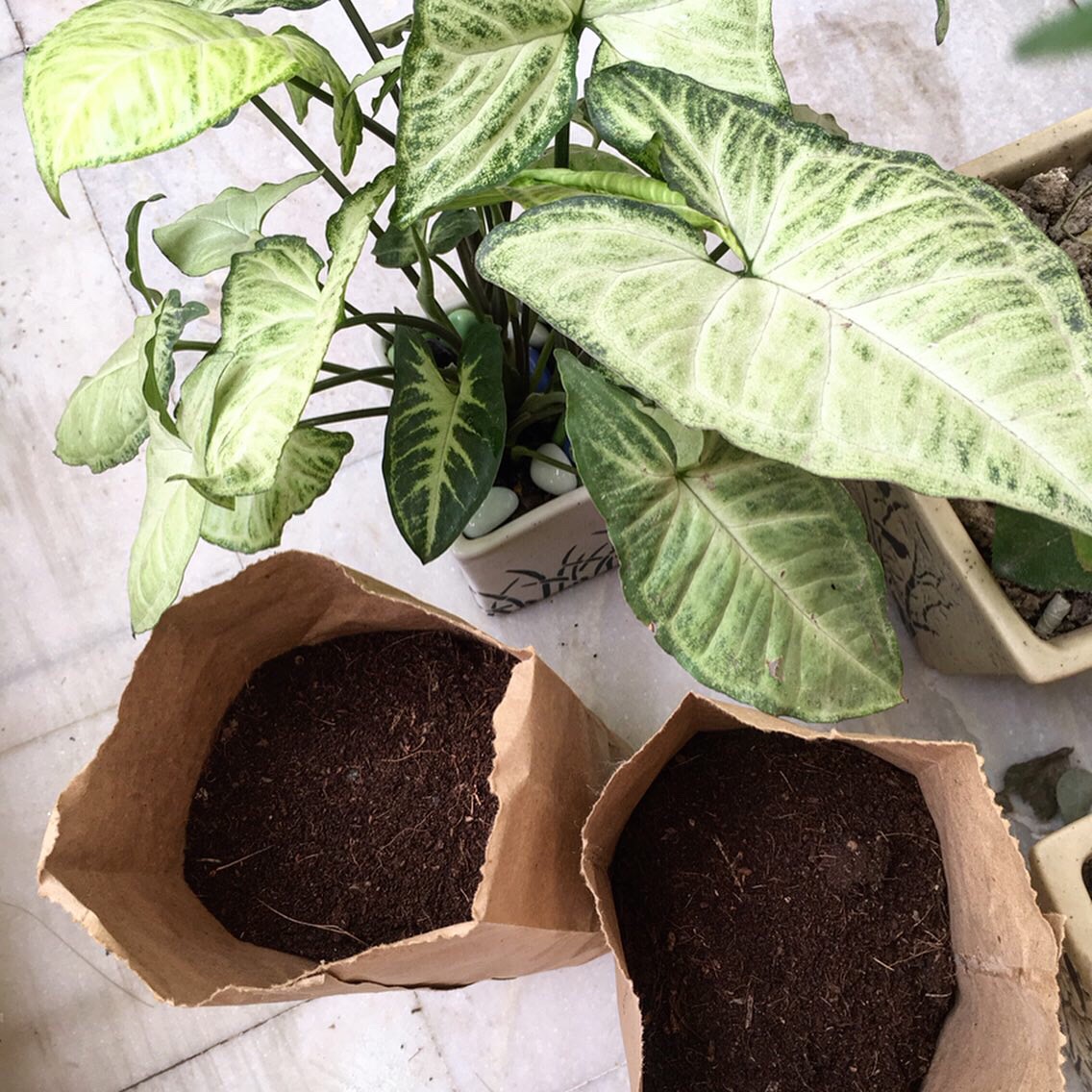
The Kambha is a terracotta composter made by a Bengaluru based NGO, Daily Dump. There really isn’t much to it: three earthen pots with holes on the sides. While the top two had a rope mesh at the bottom, the third one was closed at the bottom. They stacked up neatly. I marvelled at the simplicity of its design.

We watched the instructional video and transferred our (now utterly disgusting) waste and added some of the ‘remix’ material supplied by the organisation. The ‘remix’ material and the terracotta absorbed the excess moisture, and within a couple of days the compost stopped smelling.

As I learnt soon enough, the compost pile is as much a living organism as you and me. Needing a well balanced diet, breathing in oxygen, and exhaling carbon dioxide. And if it is malnourished or there is something wrong with its digestion, it emits a foul smell.

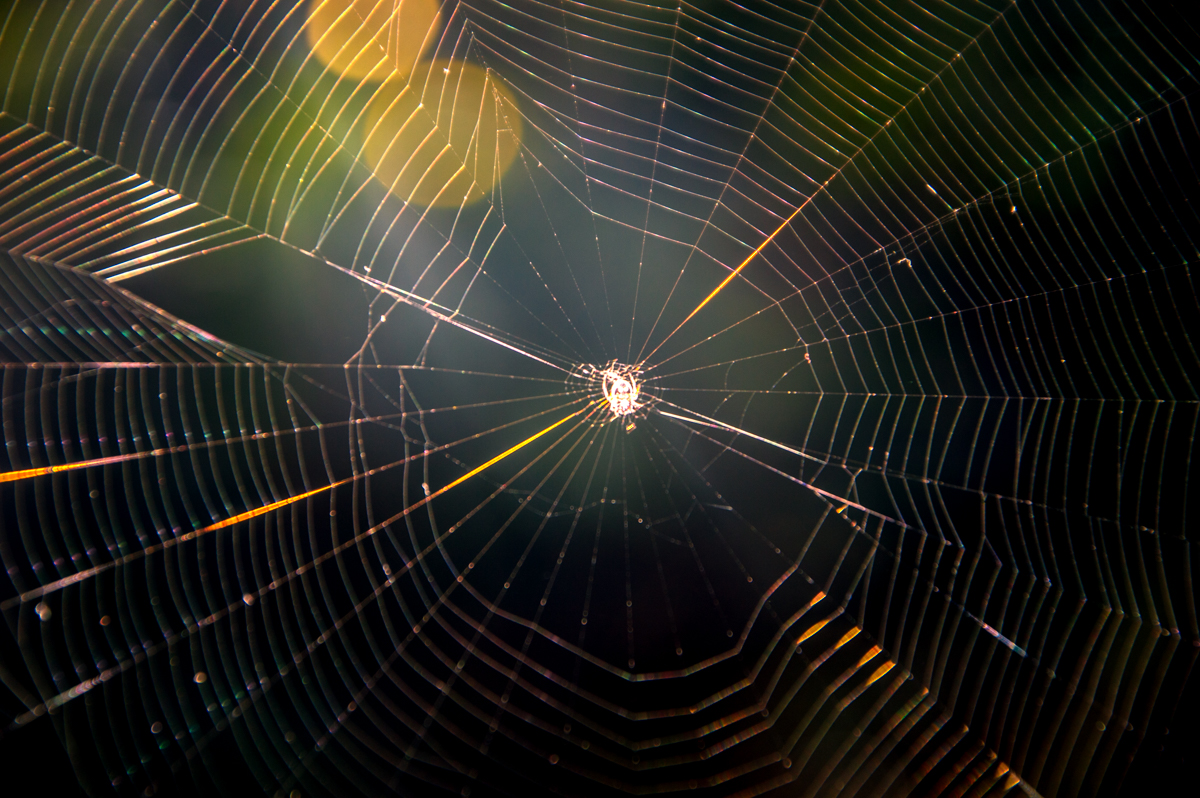
As for the maggots, they stopped bothering me. The composter was now a self enclosed eco-system. The compost pile was its earth. And a host of creatures grazed on its lands. With the plastic bag out of the way, the air around the compost became more breathable, and the fruit flies joined the maggots. Soon the land sprung shoots of large fungi, and even a sapling here and there. And the fungus gnats appeared. The maggots slowly reduced in number, as the competition for food grew. And then came the spiders – the top of the food chain, preying upon the insects.

All the while the kitchen waste continued to reduce. What was first green, yellow and purple slowly turned a rich, dark brown colour, and it smelt sweet – like Mother Nature.


* For the long answer, here’s me explaining the science in an Instagram live:

Categories
Stories

The Silk Trap


“Mommy, mommy!” The little bug ran towards her mother.

“I’m not going foraging!” she cried.

“Budku! What have you told Chitkoo now?”

Budku chuckled to himself and flew swiftly away from his mother.

“Mommy! Budku says there are spiders out there! And they chase gnats into their silk traps! Is it true?”

Mommy bug let out a deep sigh. Budku had always been mischievous. But this time, he had been partially right.

“Come here, sweetie… don’t think too much about it… It’s too early to be thinking about foraging.”

Chitkoo hugged her mother and calmed down.

Mommy bug glared at Budku as he peeped from behind the fungus, even as she kept Chitkoo close to her. There were spiders, yes. But Chitkoo was in deeper danger at home than out there. Just yesterday she had spotted a web close to their home. It was Budku’s first day learning to fly, and he’d had quite the adventure.

“Out there, is a wonderland, my dear.” Mommy bug said softly.

“In a few days you’ll be ready to start flying on your own. And it will be fun. There are peels of fruits and vegetables all over the ground. And there are fungi. So many different types than the ones near our home. And there are seeds too. They are much harder to forage, but they are the ones that have the most goodness – the reward is worth the effort.”

“Yeah, and there are fruit flies,” added Budku. Mommy bug’s glare had had its effect. Budku changed his tone.

“They’re just the cutest – brown and round, floating slowly. You’ll really get along very well with them.”

“What about spiders?” Chitkoo asked, without looking around.

Mommy bug sighed. “Yes, dear. There are spiders,” she replied.

“But they are fewer than us gnats and flies. And they can’t fly. No! They crawl and spin webs, but we have wings and we can fly. Budku was chased by one today. And he was so scared. But he flew away. And you will learn to navigate the alleys.”

Mommy bug didn’t dare tell Chitkoo about how close Budku was to being spider-meal. But Chitkoo would have to fend for herself. Spiders weren’t the only threat.

Chitkoo looked up and caught her mother’s glare. She turned around to see her brother sitting next to the fungus. He loved fungus, and was always nibbling at it. But today he just sat there, too scared of his mother to even look at the white goodie.

Above the ground, the other gnats and flies were busy going about their foraging, when the heavens above opened up. “Giant alert! Giant alert!”

Bright light filled the the sky, and it began raining. The gnats and flies flew, as far apart as they could. The spiders ran for their lives. The giants were notorious for squishing the spiders, purely for game, it seemed. They sure didn’t eat the spiders.

It was all over in a few minutes. As it always did. The rains were always heavy, and buried the slower flies and gnats. But once the sky closed back, it was a feast. A fresh pile of food, and the spiders away for some time.

To be continued.

Cover image by Atul. (@chitraakriti)